
News
Insecurity: Army Bans ‘Okada’ In Seven Northern States …Situation May Get Out Of Control -Britain …As Buhari Comes Under Fire Over Zamfara Killings

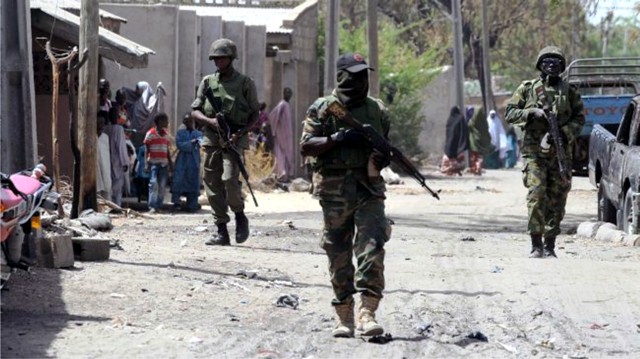
In furtherance of its efforts at curtailing the murderous activities of armed bandits and kidnappers in Northern states, the Nigerian Army under its Exercise Harbin Kunama 111 has banned the use of motorcycles in seven states of the North, noting that perpetrators of these criminal acts made use of the Okada.
A statement titled ‘Enforcement of Ban on the use of Motorcycles in Ex-Harbin Kunama Area of Responsibility’, signed by Col Sagir Musa, Acting Director, Army Public Relations, made the disclosure in Abuja, yesterday. It said.
“The Nigerian Army (NA) over time has observed the use of motorcycles by armed bandits, kidnappers, criminal elements and their collaborators as enablers to perpetrate their heinous crimes especially in the states within the north west geopolitical zone of the country.
“This informed the decision and directive to ban the use of motorcycles within the hinterland particularly around the Forests where the armed bandits, criminals and kidnappers hibernate and all around where troops are conducting operations alongside other security agencies.
“While this may cause some inconveniences to some law abiding citizens in the area, the need to use all means possible to stop the dastardly activities of these bandits across the North West part of Nigeria needs no emphasis.
“The general public, particularly in the North West and some parts of North Central in Nigeria where Ex Harbin Kunama is ongoing are enjoined to bear with the NA as concerted efforts are being made to combat the insecurity menace ongoing within the area.
“In this wise, it is hereby reiterated that the use of motorcycles remain banned within the forest areas in Kano, Katsina, Zamfara, Sokoto, Kaduna, Kebbi and Niger States..
“ Anyone caught using motorcycles within the named areas will be taken for an armed bandit, criminal and kidnapper with dire consequences. “The respective State Governments are enjoined to please disseminate the ban on the use of motorcycles in the named areas and enforce the ban in conjunction with the Security Agencies”.
Meanwhile, the British government has warned that the security condition of Nigeria has the potential of spiralling out of control if necessary measures are not taken immediately.
It therefore, said it is considering stepping up its military efforts to help the Nigerian government defeat Boko Haram, following a rise in terrorist activity in the country’s north-east in the past year, Jeremy Hunt has said after a visit to the region.
The UK foreign secretary Jeremy Hunt said that he would be discussing what more the British government can do in terms of aid and military support to combat the terrorist group, warning the crisis had the potential to trigger a humanitarian catastrophe on the scale of that in Yemen.
Britain provides £240m in aid to Nigeria, of which £100m goes to the north-east, making it the second-largest donor after the US, and giving the UK a sizeable stake in what happens in the region.
Boko Haram and Islamic State in west Africa have terrorised the region for several years, but their activities came to the world’s attention when hundreds of Nigerian schoolgirls were kidnapped in 2014.
British military personnel in Abuja and the wider region are giving strategic advice to Nigerian forces on how to run counterinsurgency operations, with their advice focused on combining humanitarian and military activities.
The Nigerian military has been repeatedly criticised by humanitarian groups for running brutal campaigns that make little effort to win over hearts and minds.
The 120,000-strong army is structured on very traditional lines but sends troops to highly hostile areas for as long as four years. Operating on a small budget, soldiers are often underpaid and morale is low.
Speaking on a visit to Maiduguri as part of a week-long trip to Africa, Hunt said: “It has got all the hallmarks of something that if you do not nip in the bud, it will get a lot worse. Conversely, it feels like a situation that it is something that could be dealt with if there was appropriate action by the government of Nigeria with international support.”
He said the crisis had spread to Niger, Chad and Cameroon. “There is a potential solution here … Nigeria is huge country and it is very stretched,” Hunt added.
Asked if he supported an increase in military action in the region, the UK foreign secretary said: “I think the crucial deciding factor is the willingness and enthusiasm of the Nigerian government and the Nigerian army to work closely with us – we would like to support and help them, but they are a sovereign nation and they have got to want our help.”
He said Britain wanted to bring holistic solutions, suggesting by implication that the Nigerian army has focused too heavily on militaristic solutions. “I think our approach is potentially a very significant one, because we could bring not just the British army but also DfID [the Department for International Development] and our experience in holistic solutions to these kind of situations,” Hunt added.
“This is a region of Africa that is being massively destabilised by conflict. These things can escalate quite quickly and get out of control. We know from Sri Lanka that Daesh [Isis] are looking to make their presence felt now they have lost their territory. We have to be vigilant.”
He said Sri Lanka was not on anyone’s radar, and showed how threats can escalate. Nigeria was “an area where all the warning signs are there”, he said, adding that not all the conflict was driven by religion.
“The feedback I got from NGOs on the ground is that lack of trust between the authorities and local people is one of the things that is fuelling the problem at the moment. The Nigerian army strategy is largely about herding people into towns and saying if you are not in a secure area, we are going to assume you are Boko Haram and/or Islamic State west Africa,” he said.
“Such an approach was understandable in the short term, but the long-term risk is that you are depriving people of their livelihoods and their farms. There are 2 million people displaced living there at the moment in pretty horrific circumstances.
“Both NGOs and military analysts fear the recent increase in violence reflects changes in the terrorist leadership, and a failure by the Nigerian military to establish humanitarian plans to follow the military clearances of areas. The brutal methods only lead to a loss of support for the military.”
In another development, Human Rights Writers Association of Nigeria, HURIWA, has described as a constitutional crime and an unmitigated evil tantamount to an impeachable offence the decision of President Muhammadu Buhari administration to go into dialogue in Zamfara State with armed fulani militia and bandits.
HURIWA frowned at an alleged planned to appease “these mass murderers” with the whooping sum of N100 billion from the tax payers under the guise of setting up cattle ranches for their totally privately owned businesses of herders.
Besides, the group also carpeted the Acting Inspector General of Police, AlhajiAdamu Mohammed, for gleefully announcing the ‘truce’ reached in Zamfara between the Federal Government’s delegation made up largely of Hausa/Fulani Muslem dominated internal security team of the current administration and the Miyetti Allah cattle owners Association- a group that supports the activities of armed fulani Herdsmen over the past few years.
HURIWA expressed disappointment that a supposed chief law enforcement officer of the Country can descend so low as to beg persons suspected to have been carrying out persistent armed banditry and attacks across Zamfara, Kaduna, Niger, Katsina, to stop attacking Nigerians when it is the constitutional obligation of the Nigeria police force to enforce law and order and bring all criminal suspects to face the legal consequences of their crimes against humanity and against the Nigerian State.
In a statement issued to newsmen over the weekend against the backdrop of the purported meeting between the Federal Government and the leadership of Miyetti Allah cattle owners association, the group said the only possible reason the current administration could enter into dialogue with armed bandits is because the offenders share the same Ethno-religious affiliations with the holders of the top security portfolios who make up the exclusive Hausa/Fulani dominated Internal Security architecture.
The statement added, “The members of the current national security team made up of mostly one Ethnicity and persons of one Religious affiliations same with the armed fulani herdsmen and bandits have always made decisions that reflects their biasness and inclination to pamper and protect these armed bandits who ought to be dealt a heavy blow in line with the constitutional provisions.
“The other time the minister of Defence who is from Zamfara state was the person who rather than condemn and order the arrest and prosecution of armed fulani herdsmen unleashing mayhem and violence in Benue state was the one who tried to provide some kind of justification for these dare devil blood cuddling attacks on Benue communities by blaming the properly passed state legislation banning open grazing of cattle which has been at the core of much of the bloodshed.
“The minister of interior who is Fulani Moslem has on many occasions belittled the gravity of the armed fulani violent attacks and dismissed it not as a terror campaign but as a mere law and order issue which the police can handle.
“These members of the internal security team including Mr President have openly made statements that are obviously ambiguous and have failed to decisively treat these attacks by armed bandits and armed fulani attacks as a major national security challenge.
“This is why there is the urgency of the now for President Buhari to obey the constitution and appoint persons of diverse Ethno religious affiliations to make up the national security team and professionally and clinically tackle the rising waves of insecurity and national paralysis.
“As a group of committed patriots, we are shocked to read that this government has entered into a communion of the devil with the armed bandits and armed fulani herdsmen who have wreaked havoc and unleashed devastation across many communities in Nigeria.
“Why do we have laws and why do we have institutions of law enforcement? This shameful piece of bad news of seeking to bribe outlaws and terrorists by this government must be seen for what it is. It is treason that must be seen as an immediate impeachable offence.
“All those who communicated with bandits and outlaws must be arrested and prosecuted for high treason because the laws must not be a respecter of any person.”
HURIWA recalled that in a bizarre twist, the Federal Government practically offered monumental bribe against pur laws to the Miyetti Allah Cattle Breeders Association of Nigeria, MACBAN, by offering it N100 billion over two years to stop kidnapping in the country.
The Federal Government delegation was led by the Minister of Interior, Abdul-Rahman Dambazau, and met with MACBAN leaders on Friday.
HURIWA quoted the media as reporting that this satanic meeting was a closed door event which lasted for over five hours as monetary negotiations according to a source dragged on until N100 billion was accepted.
MACBAN had said it would take nothing less than N160 billion.
But briefing news men after the meeting the exhausted Minister said, the “gathering is part of steps we have taken to tackle insecurity and clashes between herdsmen and farmers.”
“You should not forget the fact that we have extended the meeting as a regional one when the Economic Community of West African Countries hosted a conference on this,” it added.
HURIWA quoted the media as saying that General Danbazau affirmed as follows: “These issues were discussed, and part of the dialogue was to provide a national action plan on security challenges and solutions by all members of the ECOWAS commission, and to present it to the commission for consideration.
“That is the main reason we have come to Kebbi State, to dialogue with leaders of herdsmen as part of the process.”



The Rivers State House of Assembly has approved the 2026–2028 Medium Term Expenditure Framework (MTEF) submitted by Governor Siminalayi Fubara.
This reaffirms the lawmakers’ commitment to enacting laws and taking legislative actions geared towards the overall development of the State.
The Assembly gave the approval during its Second Legislative Sitting of the Fourth Session held last Friday.
Speaking on the MTEF document during plenary, the House Speaker, Rt. Hon. Martin Amaewhule, noted that by the provision of Section 10(1)(b) of the Rivers State Fiscal Responsibility Law No. 8 of 2010, the MTEF ought to have been laid before the House in September 2025.
Amaewhule explained that traditionally, the document is expected to be presented four months before the commencement of the next financial year and immediately after the expiration of every three-year fiscal cycle.
He, however, stated that in the interest of the State and its people, the House considered it necessary to deliberate on the document, describing it as a precursor to the 2026 Budget Estimates.
The Speaker expressed concern that the year had already progressed significantly before the presentation of the framework.
During deliberations on the document, members examined the assumptions and projections contained in the MTEF and observed that strict adherence to the outlined fiscal parameters would ultimately serve the interest of Rivers people.
The lawmakers maintained that effective implementation of the framework would promote prudent financial management and enhance developmental planning across the State.
Following the debate and positive consideration by members, the Speaker put the question to the House and members voted overwhelmingly in support of the approval of the MTEF.
Meanwhile, during the same sitting last Friday, the House also received a petition from the Chairman of Obio/Akpor Local Government Council, Dr. Gift Worlu.
The petition was presented by the member representing Obio/Akpor Constituency II, Hon. Emilia Amadi.
According to the petition, concerns were raised over an imminent security breach, threats to lives, destruction of property and alleged forceful takeover of property by some lawless persons within parts of the Local Government Area.
Presenting the petition before the House, Hon. Amadi appealed to the lawmakers to revisit the matter and take necessary steps aimed at safeguarding lives and property in the affected communities.
The House is expected to further deliberate on the petition and consider measures to address the concerns raised in order to sustain peace and security in the area.
King Onunwor
News
Fubara Reaffirms Commitment To Blue Economy, Private Sector Growth …Calls For Protection Of Marine Resources


The Rivers State Government has reaffirmed its commitment towards fostering private sector-driven economic growth and harnessing the vast opportunities within the blue economy to drive national development.
Rivers State Governor, Sir Siminalayi Fubara, made this known during the opening ceremony of the 2026 Annual General Meeting and Conference of the Nigerian Association of Chambers of Commerce, Industry, Mines and Agriculture (NACCIMA), held in Port Harcourt, last Thursday.
Represented by his deputy, Prof. Ngozi Odu, Governor Fubara described the conference theme, “The Gulf of Guinea and Blue Economy: Pathways to Trade, Investment and Security Towards a $1 Trillion Economy,” as both timely and strategic.
?
?The governor welcomed the leadership of NACCIMA, delegates from the 115 Chambers of Commerce across Nigeria, members of the diplomatic corps, captains of industry, investors, and other distinguished guests to Rivers State.
?
?He commended the National President of NACCIMA, Engr. Jani Ibrahim, for choosing Rivers State as the host of the 2026 conference, noting that the decision had drawn national attention to the immense economic opportunities embedded in the blue economy.
?
?Fubara stated that the blue economy possesses the capacity to generate revenue that could surpass earnings from the oil and gas sector if properly developed and managed.
?
?He stressed the need for Nigeria and other countries along the Gulf of Guinea to take deliberate steps toward maximizing the benefits of their maritime resources while guarding against the continued exploitation of coastal assets by foreign operators.
?
?Expressing concern over the activities of foreign fishing trawlers operating in Nigerian waters, the governor noted that many harvest seafood resources without making meaningful economic contributions to the country.
?
?He emphasized the need for stronger monitoring mechanisms and enhanced protection of Nigeria’s marine resources.
?
?”We must wake up and hit the ground running. If we do not capitalize on and utilize our blue economy, other nations will utilize it for us,” he stated.
?
?The governor thanked NACCIMA for what he described as a timely wake-up call on the importance of the blue economy and maritime security, adding that the successful hosting of the conference in Rivers State demonstrates the state’s safety, hospitality, and readiness for business and investment.
?
?Earlier in his remarks, the President of NACCIMA, Engr. Jani Ibrahim, expressed appreciation to the Rivers State Government for hosting the 66th Annual General Conference of the Association and for the warm reception accorded delegates.
?
?He noted that the state’s commitment to hosting the conference reflects its readiness for business and has helped restore investors’ confidence in its economic potential.
?
?According to him, NACCIMA highly values the cordial relationship between the Rivers State Government and the organized private sector, emphasizing that the association remains the foremost voice of the Nigerian business community.
?
?In her welcome address, the President of the Port Harcourt Chamber of Commerce, Industry, Mines and Agriculture (PHCCIMA), Dr. Chinyere Nwoga, described the conference as a historic milestone, noting that it was the first time in the Chamber’s 66-year history that it was hosting the national body of NACCIMA.
Nwoga commended the national leadership for entrusting PHCCIMA with the hosting rights and pledged the Chamber’s continued commitment to advancing the objectives of the association and promoting sustainable economic growth through private sector engagement.

Rivers State Governor, Sir Siminalayi Fubara, has ordered a complete seal-off of the site of a five-storey building which collapsed last Wednesday, killing one person and injuring several others in Port Harcourt.
Fubara gave the order during his visit to the site of the collapsed building last Thursday to assess the situation.
He said the site will remain “completely sealed off” until the government gets to the “root cause” of the incident.
He described the incident as unfortunate but observed that preliminary investigation had shown that the developer had earlier refused to subject his site to inspection by the state authorities and comply with the necessary building regulations.
The governor, who inspected the site alongside the Commissioner for Physical Planning and Urban Development, Sir Amairigha Edward Hart, and the Permanent Secretary of the Ministry of Special Duties, Dabite Sokari George, explained that he couldn’t visit the site the previous day because he was awaiting formal briefing from the relevant agency of government on the situation.
“We’re here to see for ourselves the very unfortunate incident that took place here. I didn’t come yesterday because I wanted to get the report first, and the Commissioner did brief me that the incident site, first, is not as claimed by the developer, that it’s not under the jurisdiction of the state; that it’s under the jurisdiction of the Federal Housing Authority.
“He also informed me that when the project was ongoing, they came here severally to inspect what was happening and also to see the level of compliance. But unfortunately, that the developer kept claiming that we don’t have any right to interfere,” he said.
Fubara said that the issue was no longer about interference but about the life lost to the building collapse and the collateral damage brought upon the family of the deceased.
He extended condolences to the families of the victims, insisting that the incident could have been avoided if the developer had complied with the rules guiding the engineering design and construction of such a structure in the 21st century.
“We feel very sorry and very regretful that such an incident should be happening in this 21st century because technology has advanced, engineering has developed. I wonder what kind of engineer would even allow this kind of project to go on when everything about it from inception has been faulty.
“I think that at this point, nothing is going to happen on this site any more. We are going to make sure that this place is completely sealed off until we get to the root cause of this incident,” the governor said.
-
Rivers3 days ago
Rivers Police Uncovers Firearm Concealed In Loaf Of Bread
-

 Niger Delta2 days ago
Pro-Chancellor Hands Over Okey Onuchuku Peace, Conflict Institute Building
-
Sports3 days ago
Six Nigerians To Play For NBA Teams
-

 News2 days ago
Fubara Reaffirms Commitment To Blue Economy, Private Sector Growth …Calls For Protection Of Marine Resources
-
Business3 days ago
Gas Economy: Decade of Gas, Pi-CNG/ EV Deepen Media Engagement
-
Sports3 days ago
NPFL Warns Newly Promoted Clubs
-
 Business2 days ago
IPMAN Raises Concern Over Delay In Chinese Refinery Deal …Predicts Lower Fuel Prices Through Competition
-

 Politics3 days ago
Senate Defends Passage Of State Police Bill