
Featured
Rivers Governorship Poll: Assert Your Independence, PDP Tell INEC …Laments APC’s Justification Of Killings …Uncovers APC’s Fresh Plot To Concoct Results …Declare Unit, Ward Results, Rivers Monarchs Tell INEC

The Rivers State PDP Campaign Council has called on the Independent National Electoral Commission (INEC) to use the case of Rivers State elections to assert her independence and not allow the military and FSARS to usurp her functions.
The State PDP Campaign Council made this call yesterday in a press statement issued by the Director of Information and Communications, Barr Emma Okah.
According to Okah, the INEC needs to be bold and independent and call the bluff of the defaulting security agencies and their collaborators in the APC who are bent on dragging the name of the commission in the mud.
“The integrity of the electoral process is the hallmark of democracy and development and if people can no longer trust the umpire, all the talks about civil rule is like blowing hot air,” Okah said, pointing out that time has come for Nigerians to review the role of the military in our elections.
Okah said a situation where security agencies determine the measure of INEC’s succeess in elections which are purely civil exercises spells doom for the nation and called for a rethink.
Meanwhile, the Rivers State Chapter of the Peoples Democratic Party, PDP, says it is shocked at the reasons given by the opposition All Progressives Congress, APC, justifying the killing of scores of Rivers people by the APC hired military and FSARS during the Presidential, National Assembly and Governorship and State Assembly elections respectively.
A statement by the State Chairman of the PDP, Bro Felix Obuah through his Special Adviser on Media and Publicity, Jerry Needam said when PDP first raised alarm over the sinister plot by the APC to visit mayhem on the State if they were omitted on the ballot as witnessed during the Presidential and National Assembly elections, many did not believe it.
We’ve however been vindicated, the statement further noted, given the admission of one Chris Fynebone who still claims to be the spokesman of APC despite the supreme court judgement stripping him of all paraphernalia of office of the APC in the State that the onslaught unleashed on the hapless innocent Rivers people was a revenge of alleged killings in 2015 that saw the APC at the receiving end.
The State PDP boss said any other foolishness could be forgiven but for one to rejoice and celebrate the massive killing of his kith and kin to say the least, is the height of stupidity, describing Mr. Fynebone’s perception and justification of the killing of over fifty Rivers sons and daughters in Abonnema, over 10 in Ogoniland, about five in Andoni and scores of others elsewhere in the State as a useless life which in itself is early death.
“We are even shocked the more that Mr Fynebone in his passion to access power to legitimately showcase the animal in him but God forbid, boasted that he and his paymasters in the APC are satisfied with the 2019 general election killings in Rivers State” Bro Obuah regretted.
The State PDP Chairman was however quick to remind Mr Fynebone that passions whether for power or any other thing else are like fire, useful in a thousand ways and dangerous only in one through their excesses.
Bro. Obuah appealed to Rivers people to continue to trust in God who sees beyond the superficial and remains the final arbiter, and discountenance the misleading and many lies of the APC in an attempt to justify the massacre of ‘Our People’ as though they were mere animals.
The PDP he said, is rooted in God and service to the people and God willing, ‘though they gather and conspire’ but in vain they do so, reassuring that in the end the PDP will have the last laugh to God’s glory.
However, the Rivers State chapter of the Peoples Democratic Party (PDP) has just uncovered a grave plot by the chieftains of the All Progressives Congress (APC) and two other political parties to deceive and tele-guide the Independent National Electoral Commission (INEC) fact-finding committee in the state with concocted and false election results supposedly obtained in the 23 local government areas of the state.
The PDP, in a statement, said the APC leaders in the state have also planned to coerce INEC officials that supervised the Governorship and State Assembly elections on Saturday, March 9, to admit the concocted results as authentic.
The fake results, the statement added, are to be presented to the fact-finding committee through FSARS Commander in the state, ACP Akin Fakorede, who right from the outset spearheaded the onslaught in Rivers State for the APC chieftains in the state.
The statement warned of the impending danger, if the perpetrators of the nefarious acts, do not refrain from their evil plot which was capable of causing crisis in the state as the PDP, and indeed, the masses of Rivers people will not accept any results other than the undistorted one that emanated from the March 9 Governorship and State Assembly elections.
The statement, however, thanked Governor Nyesom Wike for the peaceful disposition displayed to ensure that the state remains calm and peaceful.
“We urge and believe the INEC and the fact-finding committee will remain firm on what is right and save Rivers State from the turmoil being orchestrated by one man’s inordinate ambition to continue to rule the State through proxy.
“The Federal Government, all well-meaning Nigerians, the media, civil society organizations and the international community should please take note, and warn those unrepentant anti-democratic elements fomenting trouble in the state, and hold them responsible for any breach of the law and order their plot to concoct the governorship election results in the state may cause,” the statement stressed.
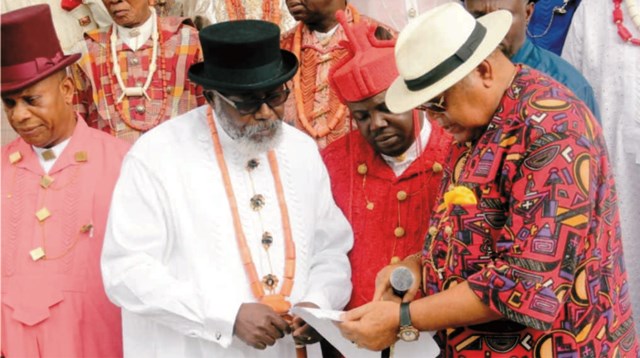
In a further development, the Rivers State Council of Traditional Rulers has urged the Independent National Electoral Commission (INEC) to declare all verifiable results of the Rivers State Governorship Election of March 9, 2019, on units and ward basis.
The Rivers traditional rulers stated that only compromised results should be discountenanced.
The traditional rulers made their position known in a press conference addressed by their Chairman, the Amayanabo of Opobo, King Dandeson Douglas-Jaja.
“We urge INEC to declare all verifiable results and immediately look into only compromised results on units and wards basis, where boxes were snatched by thugs or military personnel.
“We cannot go through round of elections at a later date. INEC must ensure that collated results are declared and not tampered with by third parties”.
They expressed disappointment with the alleged involvement of the military and SARS personnel in the direct process of the 2019 elections in Rivers State.
They said: “What we have today is a few government appointees using federal apparatus, including men in uniform to cause chaos and breakdown of law and order.
“Our people who have attempted to resist such illegality have either been arrested or dealt with extra judicially”.
They regretted that Rivers communities have been militarised, with innocent people harassed, arrested and detained.
“We are sad to note that in many kingdoms and communities, the uniformed or military men were actively involved in giving cover to politicians and their thugs who are carting ballot boxes and result sheets.
“There are also allegations that some of these uniformed personnel are ‘fake soldiers’ but the real soldiers have not arrested any of the so-called fake soldiers involved in these dastardly acts.
“The Army has also come out on AIT today, 11th March, 2019, to state that the people in Army uniforms are fake. So, why are they not being arrested, if they are thugs in military uniforms”, they queried.
They described as deafening the silence of the National Peace Committee headed by General Abdulsalami Abubakar, and wondered why the committee has failed to call all parties and the military to order for breaching the peace.
They said that parties cannot be asked to accept results of elections that are brazenly rigged, manipulated and falsified in an atmosphere of Intimidation and violence.
“Last time we checked, the President and Commander-in-Chief has not given any such order, neither has the Chief of Army Staff or Chief of Air Staff ordered the full participation of the military in the electoral process in our various kingdoms.
“So, who has deployed the military, Army and Air Force in this number, even assaulting officials of INEC and taking over of premises when they were not invited by INEC”, the Rivers State Council of Traditional Rulers noted.
They wondered how come the military took over the Rivers State INEC Headquarters and even fought the police and attempted hijacking results from local government areas.
“We need peace in Rivers State. The people’s will must prevail. The military must remove itself from directly participating in our elections.
“The Nigerian Army must immediately identify and arrest the so-called political thugs in military uniforms”, they said.
The traditional rulers said that politicians who collaborated with the military or thugs in military uniforms would be cursed traditionally.
They called on the Federal Government and the international community to come to the aid of Rivers people.



Fubara gave the assurance last Friday at the NYSC permanent orientation camp, Nonwa-Gbam, Tai Local Government Area in the State, during the swearing-in ceremony of 2026 Batch B Stream II orientation course.
Represented by the Permanent Secretary, Cabinet Bureau, Office of the Secretary to the State Government, Dr. Promise Oguzie, the governor said the State Government would remain intentional in providing the necessary support to improve the NYSC scheme and enhance the experiences of corps members deployed to the state.
He charged the corps members to be role models and quality nation-builders in their service to the good people of Rivers State in particular, and Nigeria at large.
“I charge you to be exemplary, dedicated and committed in all you do. Take full advantage of all the camp programmes and activities to enrich yourselves”, he said.
In his welcome address, the State Coordinator of NYSC in Rivers State, Mr. Moses Oleghe, urged corps members to see their deployment to Rivers State as a “veritable opportunity to make meaningful contribution to the growth of the State in particular and Nigeria at large.”
He further charged them to serve with all sense of “integrity, discipline, and the fear of God, especially when they will be engaged as INEC ad-hoc staff that will conduct the 2027 general elections.”
A total of 3,584 corps members composed of 1,421 males and 2,163 females were sworn in by the Chief Judge of Rivers State, who was represented by Justice Godspower Aguma.

The Governor stated this yesterday when he received in audience, the World President of the Seventh Day Adventist Church, Pastor Erton Kohler; his wife, Andriene Marques Kohler; daughter Mariana Marques Kohler and a retinue of ministers of the church at Government House, Port Harcourt.
Fubara who hailed the Seventh Day Adventist Church for its contributions to education and the grooming of future leaders in Nigeria, expressed delight that the Church had over the years, been investing in education at various levels and currently runs two universities in the country.
He commended the church for not only using its institutions to spread the gospel of Christianity but to groom future leaders for the country.
According to him, religion should not be just about defending one’s faith, but also making meaningful impact on the lives of the people.
He said that by floating these educational institutions, the church has demonstrated capacity to support Nigeria in the task of producing not only educated people but a breed of God-fearing leaders.
“Our country is where it is today because we lack the fear of God. If you have the fear of God, there should be a limit to what you can do because you understand the supremacy of God. But when God is not in your equation, you’ll go beyond the line and that is what has brought us to where we are today.
“So, I feel very happy that you are contributing to the development of our future leaders in this country. We need the right people being in the right place; prepared properly with good minds; that is what we need, not just in Nigeria but round the whole world.,” he said.
Governor Fubara further observed that the absence of God-fearing people in high places to take the right decisions that could impact positively on the society, has also given rise to other problems such as social inequality, poverty, corruption and criminality. According to him, Nigeria needs a system where the average parent could afford quality education for their children and a guarantee that upon graduation, the average child will have the capacity to compete favourably with anybody, anywhere in the world.
“If we have a situation where the little money that you’re being paid as wage can also afford you quality healthcare and after working at least for 15-20 years, you have a roof over your head, tell me why you should be involved in any kind of crime? At that point, you’ll feel secured and this attitude of insecurity about the future that leads to all the social vices we have today won’t be there,” he said.
Governor Fubara expressed appreciation to the delegation for the visit and for their prayers for Rivers State, assuring them of his continued support for their programmes in the state.
Leader of the delegation and World President of the Seventh Day Adventist Church, Pastor Erton Kohler said he was in Nigeria for a special conference of the church during which thousands of the church’s ministers will be undergoing an empowerment programme to further equip them for the task of herding their flocks and serving the society.
He expressed gratitude to the Governor for the warm reception accorded his entourage, saying the memory of the visit will linger in his mind for a lifetime.
Kohler disclosed that the Church has over twenty -four million (24,000,000) members and more than 182,000 places of worship, spread across 212 countries of the world.

This reaffirms the lawmakers’ commitment to enacting laws and taking legislative actions geared towards the overall development of the State.
The Assembly gave the approval during its Second Legislative Sitting of the Fourth Session held last Friday.
Speaking on the MTEF document during plenary, the House Speaker, Rt. Hon. Martin Amaewhule, noted that by the provision of Section 10(1)(b) of the Rivers State Fiscal Responsibility Law No. 8 of 2010, the MTEF ought to have been laid before the House in September 2025.
Amaewhule explained that traditionally, the document is expected to be presented four months before the commencement of the next financial year and immediately after the expiration of every three-year fiscal cycle.
He, however, stated that in the interest of the State and its people, the House considered it necessary to deliberate on the document, describing it as a precursor to the 2026 Budget Estimates.
The Speaker expressed concern that the year had already progressed significantly before the presentation of the framework.
During deliberations on the document, members examined the assumptions and projections contained in the MTEF and observed that strict adherence to the outlined fiscal parameters would ultimately serve the interest of Rivers people.
The lawmakers maintained that effective implementation of the framework would promote prudent financial management and enhance developmental planning across the State.
Following the debate and positive consideration by members, the Speaker put the question to the House and members voted overwhelmingly in support of the approval of the MTEF.
Meanwhile, during the same sitting last Friday, the House also received a petition from the Chairman of Obio/Akpor Local Government Council, Dr. Gift Worlu.
The petition was presented by the member representing Obio/Akpor Constituency II, Hon. Emilia Amadi.
According to the petition, concerns were raised over an imminent security breach, threats to lives, destruction of property and alleged forceful takeover of property by some lawless persons within parts of the Local Government Area.
Presenting the petition before the House, Hon. Amadi appealed to the lawmakers to revisit the matter and take necessary steps aimed at safeguarding lives and property in the affected communities.
The House is expected to further deliberate on the petition and consider measures to address the concerns raised in order to sustain peace and security in the area.
King Onunwor
-

 News3 days ago
RSG Targets Nine Million Residents in Mosquito Net Distribution Campaign
-

 Oil & Energy3 days ago
Aiyedatiwa Signs New Electricity Bill
-

 Maritime3 days ago
Marine Minister Commends President Tinubu On NPERA Bill Assent
-

 Oil & Energy3 days ago
NLNG Commissions Research And Innovation Centre In RSU
-

 News3 days ago
KenPoly Holds Eight Convocations, August 29
-

 News3 days ago
RSG Begins Another Phase of Projects Commissioning Today
-

 News3 days ago
RMAFC Completes Revenue Sharing Review, Proposes New Pay
-

 Maritime3 days ago
NAGAFF Petitions IGP Over Alleged Maritime Police Harassment