
News
PDP Petitions Germany, UK Over Buhari’s Dictatorship …Rule Of Law Must Be Respected -CJN

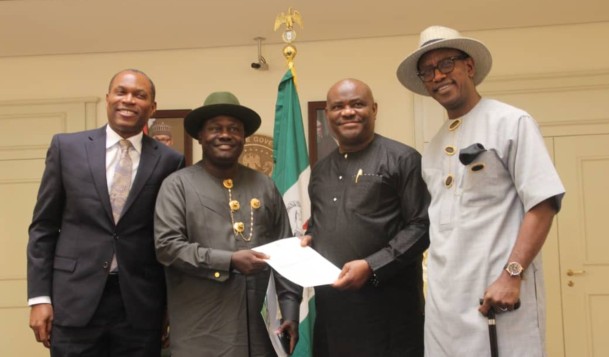
The Peoples Democratic Party (PDP) has formally petitioned German Chancellor, Angela Merkel and British Prime Minister, Theresa May, over what it termed “growing” impunity and acts of oppression by the President Muhammadu Buhari-led Federal Government.
The party, in a letter signed by its National Chairman, Uche Secondus and made available to journalists yesterday also accused the All Progressives Congress (APC)-led government of using anti-corruption agencies to harass and intimidate opposition figures, ahead of the 2019 general elections.
The letter read: “The Economic and Financial Crimes Commission (EFCC), under this administration, has metamorphosed into a draconian agency, showing scant regard for the rule of law and respect for human rights. The commission has turned the process of investigation into a media event to embarrass and tarnish the image of key opposition figures and sub-national governments of the federation perceived to be averse to the whims and electoral interest of the ruling party.
“For instance, in flagrant disregard of the law, the EFCC suspended the operation of statutory bank accounts belonging to PDP-controlled state governments of Akwa lbom, Benue and Rivers states.
“It might interest you to know that a clear reading of today’s political reality in our country shows a resolute desire by majority of Nigerians to vote out the Buhari administration in 2019, leading to the mass rallying on the platform of our party as the major opposition party; hence the desperate resort by government to muzzle and emasculate opposition in Nigeria ahead of the election.
“This includes the use of the EFCC to harass and attempt to force aspirants, particularly Presidential aspirants out of the race and reduce their capacity to raise funds through unending investigations and harassment of (potential) donors.
“Contrary to the anti-corruption promises made to the Nigerian people, associates of the President and his party, the APC, who have been accused and even indicted of corruption, are walking the streets free while opposition members are hounded.
“The EFCC has lost so much focus that when they are not chasing the President’s opponents; they are shaking down legitimate businessmen like a mafia group. The acting chairman of the EFCC, who has not been confirmed by the National Assembly (a requirement of the law), goes about wearing a pinup of the President’s re-election campaign, as if he is a volunteer in the President’s campaign. While the PDP is not against any genuine effort against corruption, we totally reject government underhand method of hiding under a phony anti-corruption fight to unleash or attempt to decapitate the opposition ahead of the elections.”
The party also reminded the leaders of some of the strides recorded during its 16 years in power, saying, “As you may have learnt, between 1999 and 2015, our party was in government, and tasked with the historic burden of restoring democracy and its tenets of good governance and rule of law; strengthened national cohesion and unity among our citizens, while reversing over a decade-long economic decline and stagnation.
“Above all, the PDP integrated Nigeria’s ethnic groups and created a free atmosphere for the opposition and media to operate unhindered. The Freedom of Information Act remains a testimony to PDP’s undying belief in a free and democratic Nigeria.
“On all counts, the PDP discharged its historic duty to global approbation. We released Nigeria from London and Paris Club debt, conducted four elections and grew our democratic practice leading to the first victory of an opposition party in Nigeria’s history.
“We liberalized the economy, enhanced best practices in all sectors of government businesses and set up the infrastructure for fighting corruption through the establishment of the EFCC and the Independent Corrupt Practices Commission and Other Related Offenses Commission (ICPC). “Sadly, the unfettered freedom and respect for human dignity entrenched by our party has been eroded in the last three years of the current administration.
“The recent outburst by President Buhari that he will jail more looters, created national outrage and concern about the role of the judiciary and respect Of our institutions. Also, his recent declaration, at an event of the Nigerian Bar Association (NBA), that rule of law will take second stage on issues involving alleged threat to national security, raises fresh concern about this administration’s attitude and respect for constitutional rule,” it added.
The two leaders were in the country recently for bilateral talks with President Buhari on multiple levels of cooperation.
Meanwhile, the Chief Justice of Nigeria (CJN), Justice Walter Onnoghen, yesterday, described the rule of law as an essential element in any democratic society, maintaining that justice could not be effectively delivered when the supremacy of law was not respected.
Onnoghen spoke at a national workshop for Chief Registrars, Deputy Chief Registrars, Directors and Secretaries of Judicial Service Commissions/Committee, held at National Judicial Institute (NJI), in Abuja.
While fielding questions from some of the participants, the CJN said he had on various occasions in the past, harped on the necessity of allowing the rule of law to prevail in the country.
He said: “I have said it repeatedly that we should let the law prevail in every aspect of our lives. It is only then that justice will flow down.
“When I was sworn in as the acting CJN then, I was asked to make a speech even though I did not prepare for it. On that occasion, I told them, members of the executives were there, including Mr. President. I told them that rule of law must be respected.”
Buhari maintained that individual rights of alleged offenders would not be spared when national security and public interest were threatened.
Meanwhile, the CJN said the workshop was part of measures to reinvigorate the judiciary to be able to administer justice without fear or favour.
He said: “The theme of this workshop, ‘Applying Best Practices in Court Administration’, is deliberate. It captures our efforts in ensuring better justice delivery in Nigeria, which has become imperative especially if justice is viewed within the context of service delivery. It also brings to focus the present challenges in court administration.



The Chief of Army Staff (COAS), Lt.-Gen. Waidi Shaibu, has tasked troops of Operation SAVANNAH SHIELD to dominate the battlespace and intensify offensive operations against kidnappers, bandits and other criminal elements in the North Central region.
Shaibu gave the directive yesterday during his maiden operational visit to the Headquarters, Joint Task Force North Central (JTF-NC), at Sobi Barracks, Ilorin.
This is contained in a statement by the Acting Director, Army Public Relations, Col. Appolonia Anele, in Abuja, yesterday.
Shaibu said the Nigerian Army would remain resolute in its constitutional responsibility of safeguarding lives and property, stressing that troops must sustain pressure to decisively deny criminal elements freedom of action.
He assured personnel of continued deployment of combat enablers and operational resources to enhance clearance operations and dismantle criminal hideouts across Kwara and Niger states.
The COAS reaffirmed his commitment to troop welfare, noting that improved welfare remained critical to sustaining morale, operational effectiveness and combat readiness.
He urged the troops to remain disciplined, professional and loyal to the Constitution and the democratically elected government.
Earlier, the Theatre Commander, JTF-NC Operation SAVANNAH SHIELD, Maj.-Gen. Yakubu Yahaya, commended the COAS for his strategic leadership and support.
Yahaya assured that troops would remain committed and steadfast in restoring peace and stability in the region.

The Nigerian Navy says it is expanding training and infrastructure to address emerging security threats and strengthen operational efficiency across formations and units nationwide.
The Chief of Naval Staff, Vice Adm. Idi Abbas, spoke during the inauguration of projects at the Nigerian Navy Basic Training School (NNBTS) in Onne, Rivers as part of activities marking the Nigerian Navy’s 70th anniversary.
Abbas, represented by the Flag Officer Commanding, Naval Training Command (NAVTRAC), Rear Adm. Ebiobowei Zipele, said the projects reflected significant progress made by the navy since its establishment in 1956 from the British Royal Navy.
“Training and infrastructure have improved significantly to meet contemporary security challenges and fulfil the navy’s constitutional responsibilities.”
According to him, the anniversary provides the navy an opportunity to reflect on its achievements and contributions over the past seven decades.
Projects inaugurated included a remodelled female trainees’ hostel accommodating more than 500 occupants and an expanded golf course upgraded from one to nine holes.
Others were the NNBTS fuel dump, Chief Boatswain’s Mate House, renovated pharmacy department and a new theatre block at the Naval Medical Centre, Onne.
Abbas described the new theatre as a major milestone for the navy’s medical services.
“Previously, injured personnel requiring surgeries were referred outside the facility.
“With this theatre, surgeries can now be conducted within the base.’’
He added that a 30KVA inverter had also been installed to guarantee uninterrupted electricity supply at the training school.
The naval chief assured officers, ratings and trainees that the navy leadership remained committed to their welfare and wellbeing.
“These infrastructure upgrades show the commitment of the Chief of Naval Staff to addressing operational and welfare challenges promptly,” he said.
In addition, NAVTRAC distributed educational materials to pupils of Community Primary Schools One and Two, Ogale, in Ebubu-Eleme area of Rivers.
Items distributed included exercise books, school bags and other writing materials as part of the navy’s civil-military engagement initiative.
Zipele said the outreach was designed to strengthen relations between the navy and host communities while supporting children’s education.
“Education remains critical to national growth and youth empowerment. Some of these pupils may eventually serve in the Nigerian Navy,” he said.
He noted that the initiative demonstrated the navy’s commitment to educational development, peace, security and sustainable community relations.
Zipele urged the pupils to remain disciplined, focused and committed to their studies while embracing patriotism, integrity and hard work.
He thanked the Ebubu community for its continued support for the naval training command headquarters and the navy.
-
News1 day ago
Obuah’s Victory Excites Former Lawmaker as APC Primaries Conclude in Rivers West
-

 Politics3 days ago
APC PRIMARIES: FUBARA’S WITHDRAWAL, HISTORIC SACRIFICE FOR NATIONAL STABILITY ……. GROUP
-

 News4 days ago
Court Sentences Seven To Death Over Murder Of Cleric In Rivers
-
News1 day ago
105 Nigerians Killed In S/Africa In Seven Years
-

 Sports3 days ago
PH Arsenal Community Set For Streets Procession, Saturday
-

 Politics3 days ago
IPAC Flays INEC Over Election Guidelines Judgement
-

 Politics3 days ago
NDC To Adopt Electronic Voting For Future Primaries
-

 Niger Delta1 day ago
Royal Father Endorses PH Arsenal Community, Pledges To Support