
News
RSG Begins Reconstruction Of School In Amaechi’s Village …Seizes Private Property In School Premises

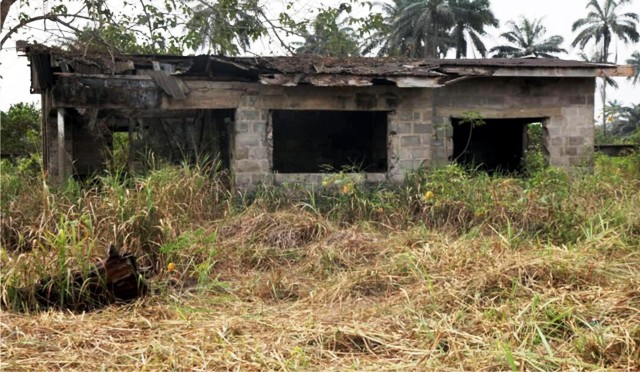
In a move to take education to rural communities of Rivers State, Governor Nyesom Wike last Saturday flagged off the reconstruction of Community Secondary School, Ubima in Ikwerre Local Government Area.
The school sited in the village of former Rivers State Governor, Chibuike Amaechi had been abandoned for several years without any form of upgrade.
Performing the flag-off, Wike recalled how the former Rivers State Governor stopped the rehabilitation of the school in 2014.
He said: “As the Minister of State for Education, I tried to intervene and rehabilitate this school. But the former Rivers State Governor drove away the contractors on the ground that the Federal Government cannot intervene in a school in the state.
“But God’s time has come. As governor, I now have the opportunity to turn around the fortunes of this school. I also call on the Federal Government to intervene in projects in this state, even though, I know they will never do so”, the governor said.
Wike said that the reconstruction of the Community Secondary School, Ubima will be completed in five months, as the funds have been deposited in the account of the state Ministry of Education.
The governor charged the people of Ubima to work with the contractors for the scheduled delivery of the project.
He explained that the state government was tackling the security challenge in Ubima by checking the excesses of kidnappers and cultists in the community.
Wike announced the process for the revival of electricity in Ubima, with the donation of a transformer.
He directed the Commissioner for Health, Prof Princewill Chike to commence the process for the rehabilitation of General Hospital, Ubima, while he stated that the road leading to the Community Secondary School, Ubima will be constructed.
Also speaking, the former Rivers State governor, Sir Celestine Omehia thanked Wike for remembering Ubima, which was forgotten by Amaechi, an indigene of the community.
Omehia said that Wike has made history by his decision to reconstruct the Community Secondary School, which was built through communal effort in 1980.
Former Chairman of the Governing Council of Kaduna Polytechnic, Chief Sergeant Awuse regretted that the ex-governor of Rivers State would exhibit so much hatred for his people.
Awuse wondered why President Muhammadu Buhari was harbouring Amaechi, who has no political relevance, aside the sponsorship of violence in the area.
Senator George Thompson Sekibo praised Wike for taking development to Ubima, even when their own son neglected them.
Rivers State Education Commissioner, Dr Taminosisi Gogo-Jaja said that new facilities such as administrative block, modern classrooms, laboratories, hostels and staff quarters would be built as part of the reconstruction efforts of the government.
Meanwhile, government’s hammer has finally hit some persons encroaching on public school land as the Rivers State Governor, Chief Nyesom Wike, last Friday, declared all buildings in the premises of Western Ahoada County High School, as government property.
The governor announced this during the flag-off of upgrading/remodelling/reconstruction of Western Ahoada County High School in Ahoada-East Local Government Area of the state.
The governor directed the state Commissioner for Education, Dr Tamunosisi Gogo-Jaja to immediately commence the fencing of the entire school premises, and challenged those who developed properties in the school to go to court.
He equally appealed to parents in Ekpeye land to warn their children to stop forthwith from harassing or disturbing the contractors doing work in the school compound as the state government would deal decisively with anyone caught in the act.
Wike, who expressed disappointment that in spite of efforts by the government to turn around the fortunes of the school, said some direct beneficiaries of government’s gesture from the area were rather frustrating the plan, and stressed the determination of his administration to reconstruct the school.
The governor said the flag-off ceremony was in fulfilment of his promise to the people, and disclosed that the fund for the project has been set aside.
“I’m committed to keeping our promises to the Ekpeye kingdom. The fund for the rehabilitation of this school has been set aside”, the governor said.
Wike explained that the remodelling of the school was part of his administration’s effort of bringing back boarding system, and urged the people of the area to support the contractors handling the job to complete the project within scheduled time.
Also speaking, Commissioner for Education, Dr Tamunosisi Gogo-Jaja, while giving description of the project, said it has four hostels, new well-equipped classroom blocks, administration block, various laboratories, sick bay and council lounge, among other modern facilities.
The Eze Igbu-Upata 111, Dr Felix Otuwarikpo lauded the governor for keeping to his promise to the people of Ahoada-East Local Government Area.


The Rivers State chapter of the All Progressives Congress Christian Leaders Forum has expressed strong confidence in the capacity of All Progressives Congress (All Progressives Congress) candidates in the state to deliver effective governance if elected into office in the coming elections.
The State Coordinator of the forum, Archbishop Lucky Aroh, made this known during a breakfast and thanksgiving meeting held in Port Harcourt, where leaders gathered to pray for the stability of the party and the safety of its candidates ahead of the 2027 general elections.According to him, the meeting was convened to seek divine intervention for peace, unity, and security among APC candidates across Rivers State.
“Today we are praying for APC stability in Rivers State and the security of our candidates that have been elected to contest the 2027 elections. It is a breakfast meeting,” Aroh said.
He further expressed optimism that the party’s candidates would not disappoint the people if entrusted with leadership responsibilities.
“They will not fail when elected into office. We are here as fathers of the land to let them know, and I must tell you the truth that these are the authentic people that will do well in Rivers State,” he added.
Speaking earlier, the National Chairman of the forum, Professor Olanrewaju Abraham, commended the Rivers State chapter for organizing the programme, noting that the national body of the forum believes strongly in the power of prayer.
He stated that political leadership provides an opportunity to influence society positively, including advancing moral and spiritual values, while expressing confidence that APC candidates at all levels would emerge victorious in the upcoming elections.
Also speaking, the Rivers State Women Leader of the APC, Hon. Darling Amadi, praised the forum for its commitment to prayers for peace, stability, and the protection of party candidates.
Represented by the Deputy Women Leader of the party in the state, she described the initiative as commendable and urged other political and support groups within the party to emulate the gesture in promoting unity and stability.
By: John Bibor, Menebe Emmanuel & Fortune Paibi
Prominent businessman and philanthropist, Elder Anthony Osagwe-Ogo, was celebrated in grand style as he marked his 70th birthday anniversary, with distinguished Nigerians, business leaders, and golf enthusiasts gathering to honour his remarkable contributions to society.
The colourful celebration took place at the Port Harcourt Golf Club, where friends, associates, and well-wishers converged to pay tribute to the revered elder statesman.
Chairman of the occasion, High Chief (Dr.) Ikenna Okafor, described the celebrant as a detribalised Nigerian whose generosity, humility, and commitment to humanity have earned him admiration across different communities and backgrounds.
According to Dr. Okafor, Pa Osagwe-Ogo’s impact on society and the development of his community remains unparalleled. He noted that members of the golfing community are proud to be associated with a father figure who consistently promotes the welfare and well-being of those around him.
He further stated that the history and growth of the Port Harcourt Golf Club cannot be told without acknowledging the significant role played by the celebrant, whose wisdom, encouragement, and leadership have helped sustain the club over the years.
“We are here to celebrate a man who has impacted humanity positively, a peace-loving individual and an epitome of hope for the younger generation. We pray to emulate his virtues. Today, we celebrate a bridge-builder, a trailblazer, and an iconic leader whose life continues to inspire many,” Dr. Okafor said.
He expressed delight at the large turnout of guests from various walks of life, describing it as a testament to the respect and affection Pa Osagwe-Ogo commands within and beyond Rivers State.
In his response, the celebrant, Pa Anthony Osagwe-Ogo, expressed profound gratitude to God for preserving his life and granting him the privilege of attaining the milestone age of 70.
He also thanked members of the Port Harcourt Golf Club, family members, friends, and associates for identifying with him during the celebration and for their unwavering support over the years.
The event featured the cutting of the birthday cake, presentation of awards to deserving members of the club, goodwill messages, and moments of celebration among guests.
The ceremony was attended by notable personalities from the business community, the golfing fraternity, and other sectors, all of whom joined in celebrating the life and legacy of the respected elder statesman.
Rivers State Governor, Sir Siminalayi Fubara, and the Permanent Secretary of the Rivers State Ministry of Information and Communications, Dr. Honour Kuru Sirawoo, have been honoured with awards of recognition in connection with the 2026 Democracy Day celebrations held in Port Harcourt.
The awards, which formed part of activities marking Nigeria’s Democracy Day on June 12, were formally presented on Tuesday at the Ministry of Information and Communications in Port Harcourt.
Presenting the awards was Hon. Abdul Hameed Oladipupo Alli, popularly known as “Mr. Nigeria,” Publisher of Asiwaju Trumpet Magazine and Achievers World International Magazine.
Governor Fubara was recognised for his efforts in sustaining peace, stability, and a conducive political atmospherJohn Bibor / Menebe Emmanuel / Fortune Paibie in Rivers State. The organisers noted that his administration has fostered harmony and strengthened civic participation across the state.
Dr. Sirawoo, on the other hand, was honoured for his exemplary administrative leadership and significant contributions to effective information management within the Ministry of Information and Communications.
Representing Dr. Sirawoo at the presentation ceremony, Dr. Christian Davies received the award on his behalf and expressed gratitude for the recognition. He described the honour as a reflection of Dr. Sirawoo’s unwavering commitment to professionalism, excellence, and dedicated public service.
Dr. Davies assured the organisers that the award would be formally conveyed to the Permanent Secretary.
The event also featured the presentation of commemorative publications highlighting major governance and civic milestones in Rivers State, including Easter celebrations, Workers’ Day activities, the Governor’s third anniversary in office, and Democracy Day programmes.
Organisers of the awards commended the Rivers State administration for what they described as sustained peace, political stability, and improved civic engagement, noting that these achievements have contributed significantly to the state’s continued development.
By: Jessica Sambol
-

 Niger Delta2 days ago
Warri Airport Manager Disputes Air Peace Bird Strike Claim
-

 News2 days ago
Nigeria Won’t Surrender Any Territory To Criminals -Tinubu
-

 News2 days ago
FG Begins Trial Of Over 600 Terrorism Suspects
-

 Rivers2 days ago
79th IAUE Inaugural Lecture: Prof Anero Advoctes Tuition-Free Education For Children
-

 Politics2 days ago
Parties’ Deregistration: How Justice Lifu Overruled Appeal Court Justices
-

 Politics2 days ago
ADC: Okonkwo Rejects Amaechi As Presidential Running Mate, Withdraws Support
-

 News2 days ago
Rivers Judges Commence Annual Vacation, July 20
-

 Politics2 days ago
2027: Tinubu’s Projects Give APC Edge In South East – Yilwatda