
News
Ortom Indicts Buhari Over Benue Killings …Condemns Sanusi’s Claim About Herdsmen …As Lalong Apologises To Benue Gov

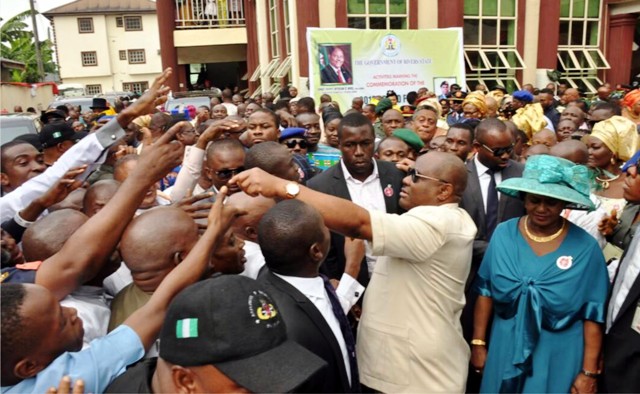
Benue State Governor, Samuel Ortom says the Presidency and the security agencies ignored security alerts provided by his government ahead of the many killings, particularly of the recent 72 Benue indigenes by Fulani herdsmen.
The governor, who made the claim while meeting with members of Senate Ethics Committee on Security and Infrastructure, which visited the state, said that President Muhammadu Buhari, Vice-President Yemi Osinbajo, the National Security Adviser, Babagana Monguno, and Inspector General of Police, Ibrahim Idris, all ignored several warnings sent by the state government alerting them to the planned attack on Logo and Guma communities in Benue.
The governor told the Senate Committee led by the Senate Majority Leader, Senator Ahmed Lawan, that security agencies were also guilty of the continued killing of inhabitants of the state by Fulani herdsmen since 2008.
According to him, once the state government got the information of planned attack by Fulani herdsmen, he wrote a letter to the Vice-President Osinbajo, who was by then the Acting President, while President Buhari was away for medical treatment in London.
He stated that attempts to get the then Acting President’s attention through the letter were fruitless, as he stated that he got no reply whatsoever.
He also stated that when Buhari returned, he also wrote severally, but received no reply as well.
The governor said when driven by desperation, he made additional efforts to draw the attention of the National Security Adviser, Babagana Monguno to the threat.
He said the message was contained in separate letters addressed to the NSA, which he said were not replied.
He said: “We wrote to the Vice-President on the planned attack on parts of Benue by Fulani herdsmen, because the word was everywhere on the street, but he refused to reply.
“And when there was no response, and when Mr President came back, I personally went and intimated him, and I also wrote. The documents are here. I will hand them over to you. I wrote to him on the planned attack by Fulani herdsmen because these threats were [real] on the streets.
“I intimated Mr President and it was put to writing. On the same October 7, 2017, I wrote to the Inspector General of Police. I told him of a planned attack on our people.When there was no response, on October 27, 2017, I reminded him that these people are planning to attack us. We are law-abiding; we have disarmed our youths, and we are looking unto security agencies. And the way to do it is to arrest those people who were inciting the herdsmen to combat us, and we knew they were going to come.
“These people were all over the place: on television, in papers, doing various press conferences, and they eventually took us to court. But we felt that it was a crime for anyone to incite people against us with the purpose of killing or causing harm, destruction. So, we expected them (security agencies) to act, but there was no action.”
“Of course, I wrote to the Senate President for information, and the Speaker. I also wrote on 7th of October. When I was writing to the Acting President and Inspector General of Police, I also wrote to the National Security Adviser on this planned attack against Benue people. I also wrote to the Director-General of the Department of State Security (DSS). And when there was no action, I followed it up with a reminder on 27th of October, 2017. So, that was it, and also on the 17th of October, I wrote to the president and I copied the National Security Adviser. There was no response. Of course, the National Security Adviser invited us for a meeting two times, but it was put off.
“This is very sad. Those people who are responsible for these killings, I know. I accuse them and I have evidence against them in newspaper publications; they are in video; they are in audio, and they are known.
“If I had wanted to buy guns, I wouldn’t wait. But if I bought guns and gave to those people, would my people have been killed in the manner they were killed? I disarmed the people. I’ve not bought a single gun. I’m a Christian. If I bought, I would say yes,” Ortom said.
On the claims that the Governor of Plateau State, Solomon Lalong, warned him against introducing the anti-grazing law in Benue, Ortom replied: “So, the sponsored write ups in the papers and the sponsored speech by my colleague in Plateau State, he said he warned me. How can you warn me? Am I the governor of Plateau State, Or am I his staff? Do I work for him? I’m Governor of Benue State, and my responsibility is to do what my people want. That is what democracy is.
“So, when you castigate people about because you were induced by someone, and you come out to make those kinds of statements, then it’s unfortunate.
“Remember, this is the same man, a double standard person, who told me when I visited Jos three weeks ago, he told me that he is under pressure by his people to do the same law that I did in Benue State. He told me this. He never warned me anywhere. He’s just trying to use that to blackmail me. What crime have I committed?” he queried.
He added: “Is this how we want to continue as a country? Where some people are given privilege to be lawless?”
Meanwhile, Governor Ortom and a first class traditional ruler in the state, Abu Shuluwa, have condemned the statement credited to Emir of Kano, Muhammadu Sanusi II, that people in Middle Belt had all along been killing Fulani herdsmen in their domains.
Ortom, who spoke through his Chief Press Secretary, Mr. Terver Akase, said there was never a time Benue people raised their hands against Fulani herdsmen.
According to him, ‘Tiv people have not been killing Fulani, the whole world knows who has been the aggressor and who has been the victim in these attacks and the victim is Tivland.”
Governor Ortom further reiterated his stand that anti-open grazing is the global best practice to avert constant clashes between herdsmen and farmers in the country.
Also reacting, the first class chief in the state, Tor Zankera, Chief Abu Shuluwa, described the statement as ‘unfortunate.’
“I mean unfortunate for a traditional ruler who is expected to maintain peace, especially in crisis situation, traditional rulers are not expected to fuel crisis.”
Shuluwa noted that the emir must have been misrepresented considering his roles as a father in the country whose wise counsel was needed during crisis time.
“I doubt an emir of that status could make such sweeping statement; possibly, he was misquoted, but if truly he said so, then it is unfortunate.”
In another development, Governor Simon Lalong of Plateau State has apologized to his Benue State counterpart, Samuel Ortom, over his comment condemning the implementation of anti-open grazing law in the state.
The Plateau state governor had attributed recent killing of over 70 persons in Benue State to the implementation of anti-grazing law by Gov. Ortom.
He also said he had warned Ortom against implementing the law.
His comment sparked outrage and condemnation from diverse segments of Nigerians.
Addressing newsmen in Abuja Lalong said “Concerning the lingering issue after my presidential visit in respect to the crisis in Benue State I apologies to the Governor and people of Benue sate”.
He continued “first of all, let me use this opportunity to once again extend my felicitation and also to extend our condolences to the people of Benue state over this great loss. My prayer is that God would continue to give them and every Nigerian the fortitude to bear this irreparable loss . I must say that I humbly apologize for my comment because I have seen that it was really misconceived and misinterpreted.
“The comment generated a lot of social media attention . So I apologize for that because either argument for or against does not help the matter because it involves loss of lives. I have great respect the people and feel pained by the loss of lives. I am also concerned about the unity of the middle belt.
“I would not want any impression created that Plateau is fighting Benue state at all, we are all brothers and sisters. Benue was created out of Plateau and Nassarawa was created out of Plateau, we still remain brothers and sisters .”
The Governor continued “I once again extend my apologies to the Governor. I pray to all the families of the deceased that God almighty will give them the fortitude to bear the loss.and also grant souls of the departed eternal rest.”



The Chief of Army Staff (COAS), Lt.-Gen. Waidi Shaibu, has tasked troops of Operation SAVANNAH SHIELD to dominate the battlespace and intensify offensive operations against kidnappers, bandits and other criminal elements in the North Central region.
Shaibu gave the directive yesterday during his maiden operational visit to the Headquarters, Joint Task Force North Central (JTF-NC), at Sobi Barracks, Ilorin.
This is contained in a statement by the Acting Director, Army Public Relations, Col. Appolonia Anele, in Abuja, yesterday.
Shaibu said the Nigerian Army would remain resolute in its constitutional responsibility of safeguarding lives and property, stressing that troops must sustain pressure to decisively deny criminal elements freedom of action.
He assured personnel of continued deployment of combat enablers and operational resources to enhance clearance operations and dismantle criminal hideouts across Kwara and Niger states.
The COAS reaffirmed his commitment to troop welfare, noting that improved welfare remained critical to sustaining morale, operational effectiveness and combat readiness.
He urged the troops to remain disciplined, professional and loyal to the Constitution and the democratically elected government.
Earlier, the Theatre Commander, JTF-NC Operation SAVANNAH SHIELD, Maj.-Gen. Yakubu Yahaya, commended the COAS for his strategic leadership and support.
Yahaya assured that troops would remain committed and steadfast in restoring peace and stability in the region.

The Nigerian Navy says it is expanding training and infrastructure to address emerging security threats and strengthen operational efficiency across formations and units nationwide.
The Chief of Naval Staff, Vice Adm. Idi Abbas, spoke during the inauguration of projects at the Nigerian Navy Basic Training School (NNBTS) in Onne, Rivers as part of activities marking the Nigerian Navy’s 70th anniversary.
Abbas, represented by the Flag Officer Commanding, Naval Training Command (NAVTRAC), Rear Adm. Ebiobowei Zipele, said the projects reflected significant progress made by the navy since its establishment in 1956 from the British Royal Navy.
“Training and infrastructure have improved significantly to meet contemporary security challenges and fulfil the navy’s constitutional responsibilities.”
According to him, the anniversary provides the navy an opportunity to reflect on its achievements and contributions over the past seven decades.
Projects inaugurated included a remodelled female trainees’ hostel accommodating more than 500 occupants and an expanded golf course upgraded from one to nine holes.
Others were the NNBTS fuel dump, Chief Boatswain’s Mate House, renovated pharmacy department and a new theatre block at the Naval Medical Centre, Onne.
Abbas described the new theatre as a major milestone for the navy’s medical services.
“Previously, injured personnel requiring surgeries were referred outside the facility.
“With this theatre, surgeries can now be conducted within the base.’’
He added that a 30KVA inverter had also been installed to guarantee uninterrupted electricity supply at the training school.
The naval chief assured officers, ratings and trainees that the navy leadership remained committed to their welfare and wellbeing.
“These infrastructure upgrades show the commitment of the Chief of Naval Staff to addressing operational and welfare challenges promptly,” he said.
In addition, NAVTRAC distributed educational materials to pupils of Community Primary Schools One and Two, Ogale, in Ebubu-Eleme area of Rivers.
Items distributed included exercise books, school bags and other writing materials as part of the navy’s civil-military engagement initiative.
Zipele said the outreach was designed to strengthen relations between the navy and host communities while supporting children’s education.
“Education remains critical to national growth and youth empowerment. Some of these pupils may eventually serve in the Nigerian Navy,” he said.
He noted that the initiative demonstrated the navy’s commitment to educational development, peace, security and sustainable community relations.
Zipele urged the pupils to remain disciplined, focused and committed to their studies while embracing patriotism, integrity and hard work.
He thanked the Ebubu community for its continued support for the naval training command headquarters and the navy.
-
News2 days ago
Obuah’s Victory Excites Former Lawmaker as APC Primaries Conclude in Rivers West
-

 Politics4 days ago
APC PRIMARIES: FUBARA’S WITHDRAWAL, HISTORIC SACRIFICE FOR NATIONAL STABILITY ……. GROUP
-

 News4 days ago
Court Sentences Seven To Death Over Murder Of Cleric In Rivers
-
News2 days ago
105 Nigerians Killed In S/Africa In Seven Years
-

 Sports4 days ago
PH Arsenal Community Set For Streets Procession, Saturday
-

 Niger Delta2 days ago
Royal Father Endorses PH Arsenal Community, Pledges To Support
-

 Politics4 days ago
IPAC Flays INEC Over Election Guidelines Judgement
-

 Politics4 days ago
NDC To Adopt Electronic Voting For Future Primaries