
Business
NAICOM Inaugurates C’ittee On Public Building Insurance Enforcement

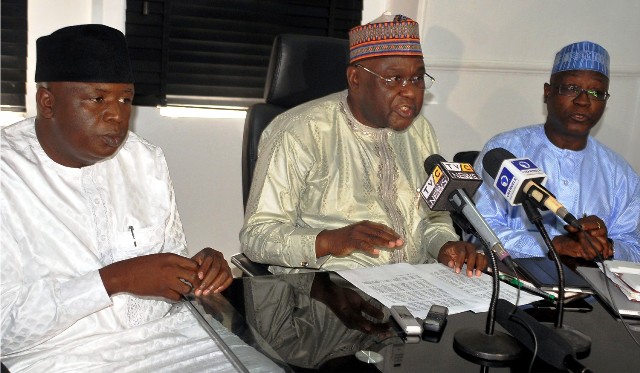
The National Insurance Com
mission (NAICOM) has recently inaugurated a Technical Committee that would drive the enforcement of public building insurance in the country.
The committee was inaugurated by the NAICOM’s Commissioner for Insurance, Mr Mohammed Kari, in Abuja.
The Tide source reports that the technical committee is made up of representatives of NAICOM, the Federal Fire Service (FFS) from all the zones and the Nigeria Insurance Association (NIA).
The steering committee on the other hand is made up of the Commissioner for Insurance, the Controller-General of the Federal Fire Service and the Director-General of the NIA.
While the consumers are represented by the FFS, the NIA will supply the funds and NAICOM will be responsible for the disbursement of the funds.
Kari said that it was the responsibility of the committee to advise the steering committee on how public building funds would be effectively and efficiently be disbursed in the country.
Kari was represented by the Deputy Commissioner for Insurance, Technical, Mr Thomas Sunday.
He said that NAICOM, under the National Insurance Act 2003 had the responsibility of ensuring that public buildings and buildings under construction were insured.
“We have the responsibility for collecting of funds, monitoring and also disbursing the funds for the purpose of improving fire activities in Nigeria.
“0.25 per cent of premium collected with respect to public buildings are supposed to be accumulated in the fire funds.
“But over time, these funds have not been forthcoming because the process for collection are not put in place.
“Therefore, the NAICOM in the spirit of transparency and all inclusive administration has decided to bring in those who know more about fire service into this activity,’’ he said.
The commissioner said that fire service activities were abysmal in many states of the federation, which was not supposed to be so.
On disbursement, Kari explained that the steering committee planned on disbursing the funds for the purpose of training of staff of the fire service both at the federal and state levels.
He said that a portion of the funds would be used to upgrade the activities of the academy of the federal fire service and refurbish/repair fire fighting trucks and equipment.
He said that some of the funds would be used for the purchase of vehicles for inspection, investigation and also for the purpose of publicity.
The commissioner said that about N78 million had already been accumulated in the funds, adding that a template had been given to the market that would ensure proper enforcement for collection of more funds.
“The amount has a potential of multiplying itself and unlike what we had, we have set a template by which this collection will be appropriately and adequately remitted into the commission.


Business
IPMAN Raises Concern Over Delay In Chinese Refinery Deal …Predicts Lower Fuel Prices Through Competition

-
Rivers2 days ago
Rivers Police Uncovers Firearm Concealed In Loaf Of Bread
-

 Niger Delta2 days ago
Pro-Chancellor Hands Over Okey Onuchuku Peace, Conflict Institute Building
-
Sports2 days ago
Six Nigerians To Play For NBA Teams
-

 News2 days ago
Fubara Reaffirms Commitment To Blue Economy, Private Sector Growth …Calls For Protection Of Marine Resources
-

 Business2 days ago
IPMAN Raises Concern Over Delay In Chinese Refinery Deal …Predicts Lower Fuel Prices Through Competition
-
Business2 days ago
Gas Economy: Decade of Gas, Pi-CNG/ EV Deepen Media Engagement
-
Business2 days ago
Navy Nabs 13 Black Sand Miners In Bayelsa –Impound Two Boats
-
Sports2 days ago
NPFL Warns Newly Promoted Clubs