
News
Rivers APC Crisis Deepens …As Amaechi, Abe’s Clash Claims Four Caucus Leaders

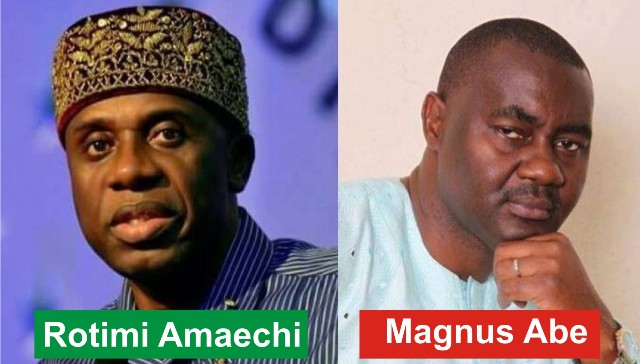
The festering feud between former governor, and Transportation Minister, Chibuike Rotimi Amaechi and Senator Magnus Abe, over who controls the mainstream machinery of Rivers State chapter of the All Progressives Congress (APC), deepened, last Friday, as the former announced removal of his former Chief of Staff, Chief Tony Okocha, and three others as leaders of the party’s caucus in their various local government areas.
Others affected by the leadership crisis in the state are Amaechi’s former Attorney General and Commissioner for Justice, Mr Worgu Boms, who lost his seat as leader of the party’s caucus in Port Harcourt City Local Government Area, and member representing Ikwerre/Emohua Federal Constituency in the House of Representatives, Hon Chidi Wihioka, who was replaced as leader of the party’s caucus in Ikwerre Local Government Area.
Also removed by Amaechi as leader of the party’s caucus in Etche Local Government Area is Hon Allwell Onyesoh.
Speaking at the various stakeholders’ meetings, the Minister of Transportation and the Leader of the All Progressives Congress in Rivers State, Chibuike Rotimi Amaechi, vowed that nobody, not even President Muhammadu Buhari, could make him shift his ground on Senator Magnus Abe and endorse his gubernatorial ambition in the state.
At a stakeholders meeting at the residence of former chairman, Local Government Service Commission, Chief Nnamdi Wokekoro, at the Rumukalagbo axis of Port Harcourt, Amaechi said that the gubernatorial ticket of the APC in the state was his prerogative.
During the meeting, which began around 11.35.am, Amaechi suspended Worgu Boms, as the leader of the APC caucus in Port Harcourt Local Government Area (PHALGA), and replaced him with Wokekoro.
The minister later met with stakeholders of the party from Obio/Akpor Local Government Area, at 2.pm, during which he suspended Okocha as the leader of the APC caucus.
The minister also held another meeting at the residence of the APC Chairman of Etche Local Government Area, Barr. Reginald Ukwuoma, during which he met with top brass of the party from Etche Local Government Area.
At the meeting, Amaechi ratified the suspension of Chief Allwell Onyesoh, as the leader of the APC caucus in Etche.
Onyesoh’s suspension, early last week, by a former member of the House of Representatives, Ogbonna Nwuke, had sparked a whirlpool of discontent among top players of the party in Etche.
Amaechi allegedly said at the meeting, “I have foreclosed Abe’s governorship ambition as far as the Rivers APC is concerned. If he likes, let him run to President Buhari; that will not change anything. If he likes, let him go to the First Lady, Aisha Buhari, nothing will change.”
He stressed: “In my capacity as the leader of the APC in Rivers State, Abe cannot be the governorship candidate of the party in Rivers State in 2019. Abe has no character. I hear the executives of about 15 local government areas are already working for him. I will see how far they can go.
“I am the only one that can determine who gets the party’s ticket in 2019. Suddenly, Abe has become something else in the party because he won his senatorial election. Was I not governor for eight years? Was I not speaker for eight years?” he asked.
Amaechi warned that he would suspend any party leader that was supporting Abe’s candidature for 2019.
“I remain the leader of the APC in Rivers State. Even if the 23 LGA chairmen of the party support him, that will not change anything,” he boasted.
He recalled: “As the speaker of the House of Assembly, I submitted his name to former Governor Peter Odili for appointment as Secretary to the State Government (SSG). But Odili turned down my request. Odili rather made him commissioner for information.
“I appointed him as SSG in my first term as governor because I wanted to fulfill my promise to him. I recommended that he should move to the Senate in my second tenure. Because I now operate from Abuja, Abe has expanded his tentacles all over the place. Just imagine people who are not even politicians are now telling me that it is only Abe that can win the governorship seat for the APC in 2019.
“I am waiting to see how they will make him the governorship candidate of Rivers APC in 2019. We have the National Working Committee (NWC). We also have the National Executive Committee (NEC), of the party. But no one will deny that I have made enormous sacrifices for the party to get to where it is today,” he said.
He branded Abe as a “treacherous politician who is now fraternising fulltime with my political enemies in Rivers and Lagos States, including Abuja politicians who are always willing to flaunt their new found political titles and connections.”
The minister of transportation fumed: “I know Abe is a senator. But I also know that he is fraternising with my political enemies like the Senate President, Dr Bukola Saraki. If Abe likes, let him come to Rivers State with the leadership of the National Assembly or that of the APC. I, Amaechi, will not support him for governor in 2019.”
Some leaders of the APC in the state opine that the Minister has resorted to the suspension of party leaders in their respective local governments as a last ditch move to wrestle the APC from the clutches of Senator Abe, solely, to forestall him from earning the APC governorship ticket in 2019.
Reacting, one of those removed as leader of the party’s caucus in Obio/Akpor Local Government Area, Chief Tony Okocha, rebuffed Amaechi’s ranting, and affirmed his commitment to the gubernatorial bid of Abe for 2019, insisting that he was convinced in the qualities of Abe to provide good governance in the state, if he wins,
He said it was unfortunate that he was removed as leader of his party’s caucus at a meeting he was not in attendance, stressing that the action showed the alleged desperation of one man to muscle up the party.
According to him, “They just removed me now for supporting Senator Magnus Abe, the removal is to confirm that APC belongs to one man. I have nothing to worry about because he also appointed me. The one who appoints has powers to remove. Later in the day, he would remove Senator Wilson Ake.
“He has removed his former attorney general and commissioner of justice, Worgu Boms. I support Abe because I believe he has the qualities, the following. He has what it takes to win elections. I was not given opportunity to defend myself. I was in Abuja when they removed me”, he claimed.
The minister had earlier removed Hon. Chidi Wihioka, a member of the House of Representatives, representing Ikwerre/Emohua Federal Constituency, as the leader of the APC caucus in Emohua, and replaced him with Chibike Ikenga, who is regarded as the minister’s satellite.



The Chief of Army Staff (COAS), Lt.-Gen. Waidi Shaibu, has tasked troops of Operation SAVANNAH SHIELD to dominate the battlespace and intensify offensive operations against kidnappers, bandits and other criminal elements in the North Central region.
Shaibu gave the directive yesterday during his maiden operational visit to the Headquarters, Joint Task Force North Central (JTF-NC), at Sobi Barracks, Ilorin.
This is contained in a statement by the Acting Director, Army Public Relations, Col. Appolonia Anele, in Abuja, yesterday.
Shaibu said the Nigerian Army would remain resolute in its constitutional responsibility of safeguarding lives and property, stressing that troops must sustain pressure to decisively deny criminal elements freedom of action.
He assured personnel of continued deployment of combat enablers and operational resources to enhance clearance operations and dismantle criminal hideouts across Kwara and Niger states.
The COAS reaffirmed his commitment to troop welfare, noting that improved welfare remained critical to sustaining morale, operational effectiveness and combat readiness.
He urged the troops to remain disciplined, professional and loyal to the Constitution and the democratically elected government.
Earlier, the Theatre Commander, JTF-NC Operation SAVANNAH SHIELD, Maj.-Gen. Yakubu Yahaya, commended the COAS for his strategic leadership and support.
Yahaya assured that troops would remain committed and steadfast in restoring peace and stability in the region.

The Nigerian Navy says it is expanding training and infrastructure to address emerging security threats and strengthen operational efficiency across formations and units nationwide.
The Chief of Naval Staff, Vice Adm. Idi Abbas, spoke during the inauguration of projects at the Nigerian Navy Basic Training School (NNBTS) in Onne, Rivers as part of activities marking the Nigerian Navy’s 70th anniversary.
Abbas, represented by the Flag Officer Commanding, Naval Training Command (NAVTRAC), Rear Adm. Ebiobowei Zipele, said the projects reflected significant progress made by the navy since its establishment in 1956 from the British Royal Navy.
“Training and infrastructure have improved significantly to meet contemporary security challenges and fulfil the navy’s constitutional responsibilities.”
According to him, the anniversary provides the navy an opportunity to reflect on its achievements and contributions over the past seven decades.
Projects inaugurated included a remodelled female trainees’ hostel accommodating more than 500 occupants and an expanded golf course upgraded from one to nine holes.
Others were the NNBTS fuel dump, Chief Boatswain’s Mate House, renovated pharmacy department and a new theatre block at the Naval Medical Centre, Onne.
Abbas described the new theatre as a major milestone for the navy’s medical services.
“Previously, injured personnel requiring surgeries were referred outside the facility.
“With this theatre, surgeries can now be conducted within the base.’’
He added that a 30KVA inverter had also been installed to guarantee uninterrupted electricity supply at the training school.
The naval chief assured officers, ratings and trainees that the navy leadership remained committed to their welfare and wellbeing.
“These infrastructure upgrades show the commitment of the Chief of Naval Staff to addressing operational and welfare challenges promptly,” he said.
In addition, NAVTRAC distributed educational materials to pupils of Community Primary Schools One and Two, Ogale, in Ebubu-Eleme area of Rivers.
Items distributed included exercise books, school bags and other writing materials as part of the navy’s civil-military engagement initiative.
Zipele said the outreach was designed to strengthen relations between the navy and host communities while supporting children’s education.
“Education remains critical to national growth and youth empowerment. Some of these pupils may eventually serve in the Nigerian Navy,” he said.
He noted that the initiative demonstrated the navy’s commitment to educational development, peace, security and sustainable community relations.
Zipele urged the pupils to remain disciplined, focused and committed to their studies while embracing patriotism, integrity and hard work.
He thanked the Ebubu community for its continued support for the naval training command headquarters and the navy.
-
News1 day ago
Obuah’s Victory Excites Former Lawmaker as APC Primaries Conclude in Rivers West
-

 Politics3 days ago
APC PRIMARIES: FUBARA’S WITHDRAWAL, HISTORIC SACRIFICE FOR NATIONAL STABILITY ……. GROUP
-

 News3 days ago
Court Sentences Seven To Death Over Murder Of Cleric In Rivers
-
News1 day ago
105 Nigerians Killed In S/Africa In Seven Years
-

 Sports3 days ago
PH Arsenal Community Set For Streets Procession, Saturday
-

 Politics3 days ago
IPAC Flays INEC Over Election Guidelines Judgement
-

 Politics3 days ago
NDC To Adopt Electronic Voting For Future Primaries
-

 Niger Delta1 day ago
Royal Father Endorses PH Arsenal Community, Pledges To Support