
News
Boko Haram Kills 11 In Yobe, 17 In Chad …Takes Over Highways In Damaturu

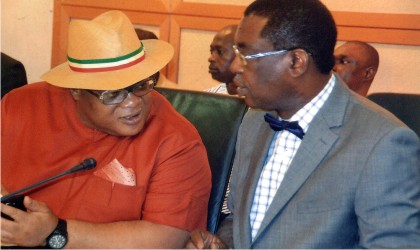
Secretary to the Rivers State Government, Barr Kenneth Kobani (left) conferring with Attorney General and Commissioner for Justice, Barr Emma Aguma (SAN),during inauguration of CTC Chairmen ceremony at Government House Port Harcourt ast Friday
Suspected members of the Boko Haram terrorist group have attacked Gamdu town in Yobe State, killing 11 residents and taking over Damaturu-Maiduguri highway.
Gamdu is a commercial and agricultural settlement along Damaturu-Maiduguri highway and is located 35 kilometres east of Damaturu, the capital of Yobe State.
A resident of Gamdu town, Mallam Bukar Gamdu, told newsmen yesterday that the militants came to town in the midnight of Friday and carried out some killings.
“The attackers came in the night and killed people of our community and as the day breaks, we counted eleven inhabitants killed in the dastard act,” Gamdu said.
Apart from the killings that were carried out on Friday night, Gamdu said the insurgents had formed the habit of mounting temporary road blocks on the busy Damaturu-Maiduguri highway to terrorise people travelling on the road.
Another traveller on the security-threaten road, who asked not to be mentioned, said “travellers often wait for each other to move in long convoy for fear of attack”, and called for more security patrol along the road.
He also confirmed that the insurgents had by noon on Saturday blocked the Damaturu-Maiduguri highway which lasted for several minutes, as several vehicles had to stop at nearby villages to avoid the attackers who were later chased away by security forces.
“We were travelling from Damaturu to Maiduguri in a long convoy and luckily security operatives on patrol were leading the convoy and suddenly we had a loud sound and the security men immediately had a stopover and run into the bush.
“We later heard that they sighted the insurgents who were strategising to mount a road block. We stayed there for over an hour and the security operatives later returned and we continue the journey but no one knows what really transpired between them and the insurgents deep in the bush,” he explained.
The traveller called on President Muhammadu Buhari and the relevant authorities to step up efforts towards ending the insurgency which had held back development in the two states and the north-east in general.
Some travellers from Maiduguri to Damaturu told newsmen in Damaturu on Saturday afternoon that several cars along the Damaturu-Maiduguri highway around Benesheiehk, the headquarters of Kaga Local Government Area, were set ablaze by the insurgents, as at the time they were plying the route.
Boko Haram attacks on innocent people in Borno and Yobe States are gradually on the rise, with wide spread cases of suicide bombings, attacks on communities, places of worship and areas believed to have crowds.
President Buhari had, during his inaugural address on the May 29, assured Nigerians that his “administration will fight and subdue the militants,” the Boko Haram.
Despite the assurance by the President, the terrorist group, which had lost some of the territories it had captured to heightened counter-terrorism operations by Nigerian Armed Forces, have intensified attacks, killing over 300 persons since May 29.
Meanwhile, a Boko Haram suicide bombing in a crowded market in Chad’s capital has killed 17 people on Saturday, just days after the militant group claimed a previous bombing in the city that left 38 people dead.
The attack in N’Djamena, by a man disguised as a woman in a full-face veil, came after a botched bombing in Maiduguri, Borno State, which killed two pedestrians.
The attacks underlined the threat still posed by the militants in the region, despite the authorities’ claims of recent military successes and with a new regional force set to deploy at the end of the month.
Police Director-General, Taher Erda said the N’Djamena bomber detonated his explosives belt when he was stopped for security checks at the entrance to the market.
Chad banned the full-face veil, ramped up security measures and bombed militant positions in Nigeria last month after the first ever Boko Haram attack in its capital.
The provisional toll on Saturday was 15 dead and 80 injured, four of them seriously, said police spokesman, Paul Manga.
Nine of the victims were female traders and one was a police officer, he added. An AFP correspondent there described a gruesome scene of carnage and pools of blood.
The area, in the heart of the capital, was cordoned off by security forces after the attack at about 8:45am (0745 GMT), and a police source said there was “no doubt it was Boko Haram”.
Prime Minister Kalzeube Pahimi Deubet called a crisis meeting to discuss the attack.
Foreign Minister of Chad’s former colonial masters France, Laurent Fabius, called the bombing “despicable”.
Experts said the latest bombing in Chad, following previous strikes in Niger and repeated targeting of northern Cameroon, showed the need for a joined-up solution involving Nigeria and its neighbours.



The Rivers State chapter of the All Progressives Congress Christian Leaders Forum has expressed strong confidence in the capacity of All Progressives Congress (All Progressives Congress) candidates in the state to deliver effective governance if elected into office in the coming elections.
The State Coordinator of the forum, Archbishop Lucky Aroh, made this known during a breakfast and thanksgiving meeting held in Port Harcourt, where leaders gathered to pray for the stability of the party and the safety of its candidates ahead of the 2027 general elections.According to him, the meeting was convened to seek divine intervention for peace, unity, and security among APC candidates across Rivers State.
“Today we are praying for APC stability in Rivers State and the security of our candidates that have been elected to contest the 2027 elections. It is a breakfast meeting,” Aroh said.
He further expressed optimism that the party’s candidates would not disappoint the people if entrusted with leadership responsibilities.
“They will not fail when elected into office. We are here as fathers of the land to let them know, and I must tell you the truth that these are the authentic people that will do well in Rivers State,” he added.
Speaking earlier, the National Chairman of the forum, Professor Olanrewaju Abraham, commended the Rivers State chapter for organizing the programme, noting that the national body of the forum believes strongly in the power of prayer.
He stated that political leadership provides an opportunity to influence society positively, including advancing moral and spiritual values, while expressing confidence that APC candidates at all levels would emerge victorious in the upcoming elections.
Also speaking, the Rivers State Women Leader of the APC, Hon. Darling Amadi, praised the forum for its commitment to prayers for peace, stability, and the protection of party candidates.
Represented by the Deputy Women Leader of the party in the state, she described the initiative as commendable and urged other political and support groups within the party to emulate the gesture in promoting unity and stability.
By: John Bibor, Menebe Emmanuel & Fortune Paibi
Prominent businessman and philanthropist, Elder Anthony Osagwe-Ogo, was celebrated in grand style as he marked his 70th birthday anniversary, with distinguished Nigerians, business leaders, and golf enthusiasts gathering to honour his remarkable contributions to society.
The colourful celebration took place at the Port Harcourt Golf Club, where friends, associates, and well-wishers converged to pay tribute to the revered elder statesman.
Chairman of the occasion, High Chief (Dr.) Ikenna Okafor, described the celebrant as a detribalised Nigerian whose generosity, humility, and commitment to humanity have earned him admiration across different communities and backgrounds.
According to Dr. Okafor, Pa Osagwe-Ogo’s impact on society and the development of his community remains unparalleled. He noted that members of the golfing community are proud to be associated with a father figure who consistently promotes the welfare and well-being of those around him.
He further stated that the history and growth of the Port Harcourt Golf Club cannot be told without acknowledging the significant role played by the celebrant, whose wisdom, encouragement, and leadership have helped sustain the club over the years.
“We are here to celebrate a man who has impacted humanity positively, a peace-loving individual and an epitome of hope for the younger generation. We pray to emulate his virtues. Today, we celebrate a bridge-builder, a trailblazer, and an iconic leader whose life continues to inspire many,” Dr. Okafor said.
He expressed delight at the large turnout of guests from various walks of life, describing it as a testament to the respect and affection Pa Osagwe-Ogo commands within and beyond Rivers State.
In his response, the celebrant, Pa Anthony Osagwe-Ogo, expressed profound gratitude to God for preserving his life and granting him the privilege of attaining the milestone age of 70.
He also thanked members of the Port Harcourt Golf Club, family members, friends, and associates for identifying with him during the celebration and for their unwavering support over the years.
The event featured the cutting of the birthday cake, presentation of awards to deserving members of the club, goodwill messages, and moments of celebration among guests.
The ceremony was attended by notable personalities from the business community, the golfing fraternity, and other sectors, all of whom joined in celebrating the life and legacy of the respected elder statesman.
Rivers State Governor, Sir Siminalayi Fubara, and the Permanent Secretary of the Rivers State Ministry of Information and Communications, Dr. Honour Kuru Sirawoo, have been honoured with awards of recognition in connection with the 2026 Democracy Day celebrations held in Port Harcourt.
The awards, which formed part of activities marking Nigeria’s Democracy Day on June 12, were formally presented on Tuesday at the Ministry of Information and Communications in Port Harcourt.
Presenting the awards was Hon. Abdul Hameed Oladipupo Alli, popularly known as “Mr. Nigeria,” Publisher of Asiwaju Trumpet Magazine and Achievers World International Magazine.
Governor Fubara was recognised for his efforts in sustaining peace, stability, and a conducive political atmospherJohn Bibor / Menebe Emmanuel / Fortune Paibie in Rivers State. The organisers noted that his administration has fostered harmony and strengthened civic participation across the state.
Dr. Sirawoo, on the other hand, was honoured for his exemplary administrative leadership and significant contributions to effective information management within the Ministry of Information and Communications.
Representing Dr. Sirawoo at the presentation ceremony, Dr. Christian Davies received the award on his behalf and expressed gratitude for the recognition. He described the honour as a reflection of Dr. Sirawoo’s unwavering commitment to professionalism, excellence, and dedicated public service.
Dr. Davies assured the organisers that the award would be formally conveyed to the Permanent Secretary.
The event also featured the presentation of commemorative publications highlighting major governance and civic milestones in Rivers State, including Easter celebrations, Workers’ Day activities, the Governor’s third anniversary in office, and Democracy Day programmes.
Organisers of the awards commended the Rivers State administration for what they described as sustained peace, political stability, and improved civic engagement, noting that these achievements have contributed significantly to the state’s continued development.
By: Jessica Sambol