
News
Fuel Scarcity Persists In Rivers, FCT Groans

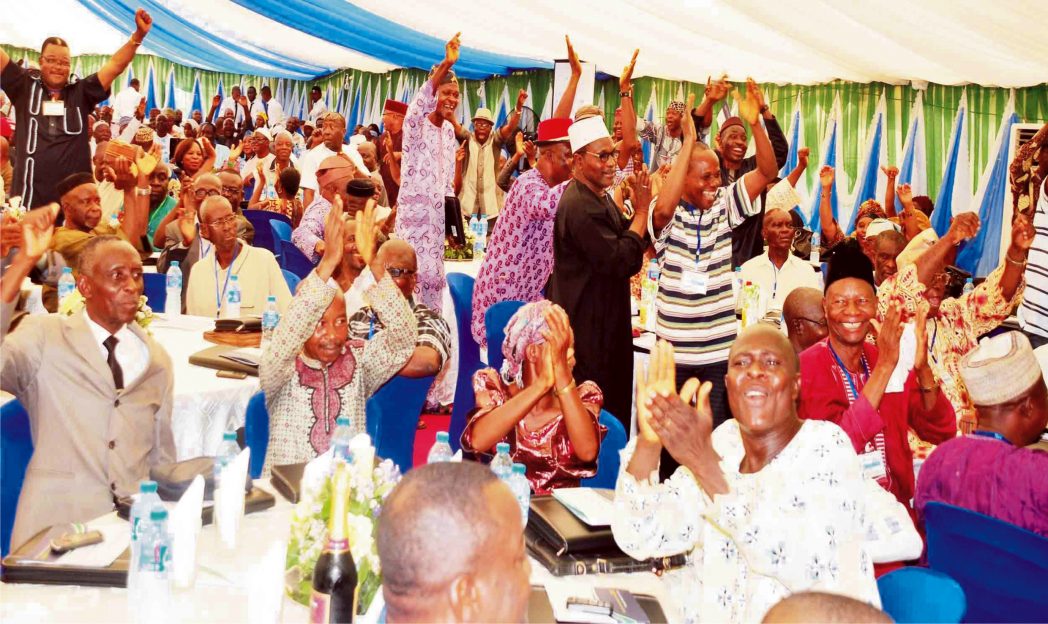
Pensioners at the Pension Transitional Arrangement Directorate Stakeholders Forum in Abuja last Thursday.
The scarcity of Petrol in Port Harcourt, the Rivers State Capital, has remained high since last week with some filling stations selling at between N110.00 and N120 per litre as against the official pump price of N87.00 while most do not have product.
The situation is even worse at the outskirts of Port Harcourt city as marketers sell at between N120.00 and N130.00 per litre.
It would be recalled that scarcity of the product resurfaced in the state since last week Saturday thereby engendering panic buying by helpless buyers who have the fear that full scale scarcity night hit the state.
A motorist, Mike Odeh said he bought petrol yesterday at Eliozu in Obio/Akpor Local Government Area at the cost of N120.00per litre.
Another commercial bus driver, Zubi Iyke, who plies Port Harcourt/Yenagoa route, said he bought a litre of Petrol at N120.00 in Ahoada.
“The problem is that there is no product in most filling stations on the way. So, you have no option than to buy it at any price”, lyke said.
Investigation by The Tide shows that marketers have started to hoard the product in anticipation of more serious scarcity and pump adjustment has become a bizarre thing.
A reliable source close to some of the marketers disclosed to our correspondents that there might be imminent shortage of product across the nation as marketers are not comfortable with the official reduction from N97.00 to N87.00 and the consistent depreciation of Naira, Nigeria’s official currency.
He blamed the Department of Petroleum Resources (DPR) for not effectively monitoring the activities of marketers in the state.
“DPR in Rivers State feels less concerned while marketers embark on all sorts of fraud as selling above official pump price and adjustment of meters”, he said.
The source, who expressed worry at the attitude of DPR, said it takes serious monitoring to check the excesses of the marketers.
The Rivers State Commissioner for Energy, Hon. Okey Amadi blamed the Federal Government over the situation, saying the circumstances surrounding the price adjustment is responsible for the situation.
Meanwhile, the NNPC, yesterday, promised that it is working to ensure that the situation is addressed quickly and assured Nigerians that the fuel supply situation will improve in the coming days. The fuel crisis in Abuja worsened weekend, as many of the petrol stations across the Federal Capital Territory, FCT, were shut down, leaving motorists stranded.
This was in spite of claims by the Nigerian National Petroleum Corporation, NNPC, on Friday, that it is injecting about 688 million of Premium Motor Spirit, PMS, into the market. Motorists had to resort to the black marketý, where roadside petrol sellers now sell the commodity for as high as N250 per litre.
Spokesperson for the NNPC, Mr. Ohi Alegbe, said, “On Friday, we had stated that in 48 hours we will wet the market with 688 million litres of petrol. Distribution of products is by trucking. You will agree that it is some distance from the depots and tank farms in the south to the depots and retail outlets in the hinterland. Expectedly, the ýqueues should disappear before long.”
Alegbe blamed the scarcity oný panic buying by motorists and sharp practices by some retail outlets who are hoarding the commodity, thereby frustrating efforts to stem the scarcity.
He said the NNPC has informed the Department of Petroleum Resources, DPR, of the ýthese sharp practices by some petrol stations’ owners for adequate sanctions against them.
He said, “Panic buying has persisted in spite of our appeal to motorists. Secondly, some retail outlets are hoarding product by dispensing from only one pump head. We have reported some of them to the DPR and we believe appropriate sanctions will be meted out to them.
A source in the Department of Petroleum Resources, DPR, disclosed that the scarcity currently being experienced in Abuja is as a result of panic buying and not because of non-availability of petrol.
According to the source who spoke on the condition of anonymity, DPR officers ýin depots across the country and even in the FCT have been sending in reports of availability of the commodity at the various depots and liftings by trucks to various petrol stations.
“The DPR had also had discussions with a number of petrol stations’ owners who told us that the long queues is as a result of panic buying. A particular owner of one of the petrol stations told us that he received a tanker load of fuel on Friday morning and is expecting to receive another consignment of the product before the end of the day. So, it is evident that the product is not scarce, just people buying the commodity out of fear of the unknown,” the source said.
In addition, the source urged motorists to avoid panic buying as there are large quantity of the products in depots across the country.
ýAlmost all the petrol stations in Wuse, Maitama, Nyanya, Abuja – Keffi expressway, Asokoro, Jabi, Gwarinpa, Kubwa Expressway, Airport Road among others were closed while the few that were selling had long queues of motorists to contend with.
Some residents said they had to abandon their vehicles at home throughout the weekend, hoping to conserve the little fuel they had for their journey to their various offices during the week.
Some of the respondents called on the Federal Government to intervene urgently and bring the situation under control, before it escalates.
ýThe crisis had started on Thursday when long queues resurfaced in petrol filling stations in Abuja, over rumour of an impending scarcity of the product earlier in the week.
The rumour of the impending scarcity was hinged on the debt owed marketers by the Federal Government, a development which was claimed has made it impossible for the marketers to import the commodity.
However, to forestall the crisis in the sector, the Federal Government quickly stepped in and promised to pay off about N264 billion between now and end of March, as subsidy reimbursement applications submitted to marketers as at end of January 2015.
The sum comprises 2014 outstanding debts of N164 billion in addition to N100 billion derived from foreign exchange and bank interest charges.
The decision to pay the debts was arrived at a crucial meeting with the Ministries of Finance, Petroleum Resources, the Central Bank of Nigeria, CBN, and oil marketers in Abuja on Monday at the instance of the Minister of Finance, Dr. Ngozi Okonjo-Iweala.



The Rivers State chapter of the All Progressives Congress Christian Leaders Forum has expressed strong confidence in the capacity of All Progressives Congress (All Progressives Congress) candidates in the state to deliver effective governance if elected into office in the coming elections.
The State Coordinator of the forum, Archbishop Lucky Aroh, made this known during a breakfast and thanksgiving meeting held in Port Harcourt, where leaders gathered to pray for the stability of the party and the safety of its candidates ahead of the 2027 general elections.According to him, the meeting was convened to seek divine intervention for peace, unity, and security among APC candidates across Rivers State.
“Today we are praying for APC stability in Rivers State and the security of our candidates that have been elected to contest the 2027 elections. It is a breakfast meeting,” Aroh said.
He further expressed optimism that the party’s candidates would not disappoint the people if entrusted with leadership responsibilities.
“They will not fail when elected into office. We are here as fathers of the land to let them know, and I must tell you the truth that these are the authentic people that will do well in Rivers State,” he added.
Speaking earlier, the National Chairman of the forum, Professor Olanrewaju Abraham, commended the Rivers State chapter for organizing the programme, noting that the national body of the forum believes strongly in the power of prayer.
He stated that political leadership provides an opportunity to influence society positively, including advancing moral and spiritual values, while expressing confidence that APC candidates at all levels would emerge victorious in the upcoming elections.
Also speaking, the Rivers State Women Leader of the APC, Hon. Darling Amadi, praised the forum for its commitment to prayers for peace, stability, and the protection of party candidates.
Represented by the Deputy Women Leader of the party in the state, she described the initiative as commendable and urged other political and support groups within the party to emulate the gesture in promoting unity and stability.
By: John Bibor, Menebe Emmanuel & Fortune Paibi
Prominent businessman and philanthropist, Elder Anthony Osagwe-Ogo, was celebrated in grand style as he marked his 70th birthday anniversary, with distinguished Nigerians, business leaders, and golf enthusiasts gathering to honour his remarkable contributions to society.
The colourful celebration took place at the Port Harcourt Golf Club, where friends, associates, and well-wishers converged to pay tribute to the revered elder statesman.
Chairman of the occasion, High Chief (Dr.) Ikenna Okafor, described the celebrant as a detribalised Nigerian whose generosity, humility, and commitment to humanity have earned him admiration across different communities and backgrounds.
According to Dr. Okafor, Pa Osagwe-Ogo’s impact on society and the development of his community remains unparalleled. He noted that members of the golfing community are proud to be associated with a father figure who consistently promotes the welfare and well-being of those around him.
He further stated that the history and growth of the Port Harcourt Golf Club cannot be told without acknowledging the significant role played by the celebrant, whose wisdom, encouragement, and leadership have helped sustain the club over the years.
“We are here to celebrate a man who has impacted humanity positively, a peace-loving individual and an epitome of hope for the younger generation. We pray to emulate his virtues. Today, we celebrate a bridge-builder, a trailblazer, and an iconic leader whose life continues to inspire many,” Dr. Okafor said.
He expressed delight at the large turnout of guests from various walks of life, describing it as a testament to the respect and affection Pa Osagwe-Ogo commands within and beyond Rivers State.
In his response, the celebrant, Pa Anthony Osagwe-Ogo, expressed profound gratitude to God for preserving his life and granting him the privilege of attaining the milestone age of 70.
He also thanked members of the Port Harcourt Golf Club, family members, friends, and associates for identifying with him during the celebration and for their unwavering support over the years.
The event featured the cutting of the birthday cake, presentation of awards to deserving members of the club, goodwill messages, and moments of celebration among guests.
The ceremony was attended by notable personalities from the business community, the golfing fraternity, and other sectors, all of whom joined in celebrating the life and legacy of the respected elder statesman.
Rivers State Governor, Sir Siminalayi Fubara, and the Permanent Secretary of the Rivers State Ministry of Information and Communications, Dr. Honour Kuru Sirawoo, have been honoured with awards of recognition in connection with the 2026 Democracy Day celebrations held in Port Harcourt.
The awards, which formed part of activities marking Nigeria’s Democracy Day on June 12, were formally presented on Tuesday at the Ministry of Information and Communications in Port Harcourt.
Presenting the awards was Hon. Abdul Hameed Oladipupo Alli, popularly known as “Mr. Nigeria,” Publisher of Asiwaju Trumpet Magazine and Achievers World International Magazine.
Governor Fubara was recognised for his efforts in sustaining peace, stability, and a conducive political atmospherJohn Bibor / Menebe Emmanuel / Fortune Paibie in Rivers State. The organisers noted that his administration has fostered harmony and strengthened civic participation across the state.
Dr. Sirawoo, on the other hand, was honoured for his exemplary administrative leadership and significant contributions to effective information management within the Ministry of Information and Communications.
Representing Dr. Sirawoo at the presentation ceremony, Dr. Christian Davies received the award on his behalf and expressed gratitude for the recognition. He described the honour as a reflection of Dr. Sirawoo’s unwavering commitment to professionalism, excellence, and dedicated public service.
Dr. Davies assured the organisers that the award would be formally conveyed to the Permanent Secretary.
The event also featured the presentation of commemorative publications highlighting major governance and civic milestones in Rivers State, including Easter celebrations, Workers’ Day activities, the Governor’s third anniversary in office, and Democracy Day programmes.
Organisers of the awards commended the Rivers State administration for what they described as sustained peace, political stability, and improved civic engagement, noting that these achievements have contributed significantly to the state’s continued development.
By: Jessica Sambol