
Business
FG Advocates Appropriate PPP Framework

The Minister of Finance, Dr Ngozi Okonjo-Iweala, has advocated appropriate legal framework for Public-Private Partnerships (PPP) that would accommodate risk sharing.
Okonjo-Iweala made the call in Abuja at the PPP Foundational Training organised for stakeholders by the African Development Bank (AfDB).
She said that some of the existing PPP framework and agreements in the country put all the risks involved in transactions on governments alone.
She said that a situation where the private sector always walked away with no risk, while the government bore all the risks involved in the projects was not the best of arrangements.
Okonjo-Iweala said that the right framework would be in terms of financial and economic analysis that allowed participating parties to make a decent rate of returns.
She said that there was the need for the consumers to get a fair deal at the end of every project to save consumers from bearing unnecessary costs.
The minister said that there were many interesting existing PPP projects in the country that were based on well-structured framework.
“We’ve got the second Niger Bridge which I think is going along very well. We’ve got the Lagos –Ibadan road, the Lekki Deep Seaport, the Onne Port and many more.
“There should be the right framework in terms of financial and economic analysis that permits participating parties to make a decent rate of returns to ensure that the consumers get a fair deal.
“I do not want a situation whereby after we finish the project we will be trying to come back and undo it because it was not properly structured,” she said.
Okonjo-Iweala said that one of the major problems confronting the success of PPP arrangement in Africa is its length of time.
She said that statistics had shown that it took an average of seven years to complete a PPP project on the continent.
The minister said that no ministry would hurry into any PPP agreement when the time horizon for delivery was longer, while the time horizon for the policy maker was short.
“If they are going to be in office for four years and the PPP is not going to be realised, it means that they are leaving office without delivering.
“We cannot afford to take that length of time because we have so many projects and this means that we need the financial capacity to understand the types of arrangements needed.
“We need the legal and the regulatory framework within which we are doing this in order to hasten the projects,” Okonjo-Iweala said.
She said that the country needed about 14 billion dollars annually to fund infrastructure development out of which 10 billion dollars would come from the Federal Government.
She said that the country’s spending on infrastructure was about six billion dollars, adding that there was a big gap which could only be filled through PPP.
The AfDBs Nigeria Country Director, Dr Ousmane Dore, said the training was a part of the processes to establish a PPP advisory department in the bank’s office in Nigeria.
Dore said that the programme would also assist the government and other stakeholders in developing capacity to identify, procure and manage PPPs.
He commended the Federal Government’s political support for PPP and its recognition as one of the keys to economic growth and equity.
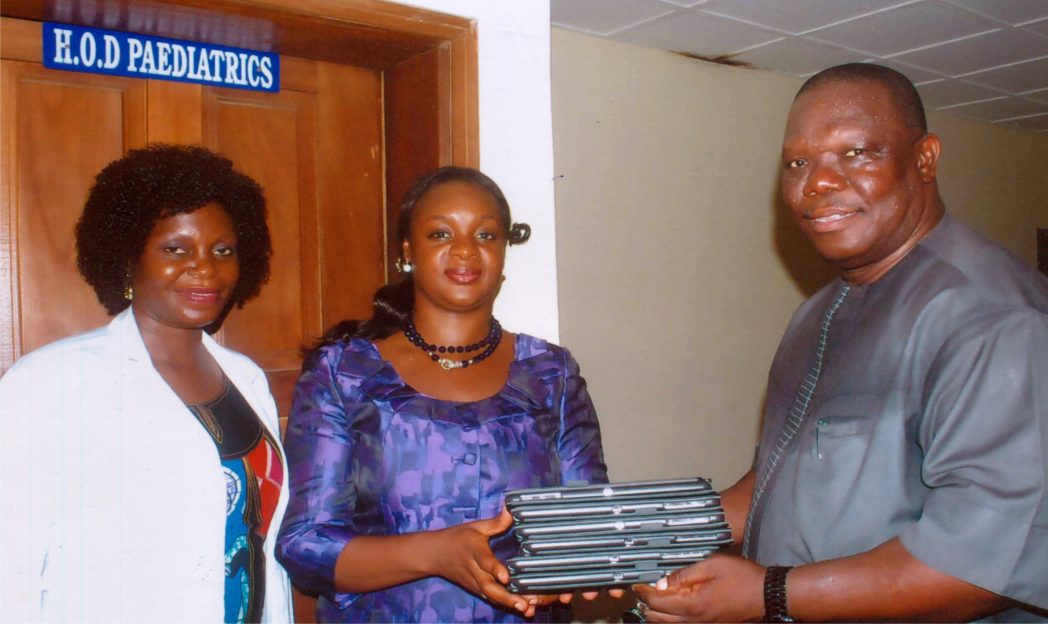
Special Adviser to the Rivers State Governor on ICT, Engr. Goodliffe Nmekini (right), presenting Ipads to the Head of Department, Paediatrics, BMSH, Dr. Ajibola Alabi (middle), during the inspection of ICT facilities at the hospital recently. With them is Dr. Josephine Aiyafo. Photo: Egberi A. Sampson




-

 Niger Delta8 hours ago
Diri Restates Stance On Lagos-Calabar Coastal Highway
-

 Niger Delta8 hours ago
C’River, NUJ Pay Tribute To Late Guardian Editor
-

 News9 hours ago
NDLEA Recovers Tons Of Illicit Drug Consignments In Nine States
-

 Opinion7 hours ago
Checking Voter Apathy In Nigeria’s Electoral Process
-

 Sports5 hours ago
Nigerian Trio Target Titles At PFL Africa Finals
-

 Education6 hours ago
FCE Yola Graduates 3,555 Teachers , Seeks Upgrade to University
-

 Politics5 hours ago
2027: DICKSON’S EX-ALLY VOWS TO WORK AGAINST NDC INTEREST IN BAYELSA
-

 Politics5 hours ago
2027: GROUP PLEDGES 40,000 SUPPORTERS FOR COALITION CANDIDATES IN RIVERS