
News
Sultan Bungles Ramadan, Admits Not Sighting Moon …Those Who Dishonour Ramadan Aren’t Muslims -Amaechi

The palace of Sultan Sa’ad Abubakar has admitted that the Sultan of Sokoto erred by announcing the end of Ramadan based on claims by some Nigerian Muslims that they sighted the new moon of Shawwal on Saturday night.
The Sultan, Muhammadu Sa’ad Abubakar IV, who is also the President of the Nigerian Supreme Council for Islamic Affairs (NSCIA), Saturday night, announced the sighting of the new moon.
His pronouncement meant that the day was the end of Ramadan, making Nigeria the only country in the world which celebrated Eid on Sunday.
“The new month of Shawwal was sighted in different places within Nigeria, and therefore, tomorrow (Sunday) is the first day of Shawwal equivalent to 27 July, 2014,” the Sultan said via a message aired on Nigerian Television Authority (NTA).
But Islamic scholars including the Secretary-General of the organisation, Ishaq Oloyede, a professor of Islamic Studies, openly opposed the declaration, saying he was not aware that the moon had been sighted.
“I spoke to the Sultan about four times tonight and he did not tell me that the moon has been sighted,” Oloyede told newsmen.
“In any case, any such claim is ridiculous and unscientific. It cannot be right. The National Moon Sighting Committee (NMC) has not informed us of any credible sighting of the moon. Rather, they said the moon wasn’t sighted.
“The new moon was only born at 11:45 P.M. tonight (Saturday) and it will take several hours for it to be sighted. Is our own sky different? Is our own moon manufactured in Nigeria?”
Professor Oloyede then urged Muslims to continue their fast on Sunday and prepare for Eid-Fitri on Monday in line with the verdict of the National Moon Sighting Committee.
Similarly, Chairman of the NMC, Hafiz Wali, in his committee report to the Sultan and Oloyede insisted that the moon had not been sighted.
“Assalamu Alaikum. As expected, the NMC has not received any credible moon-sighting report,” Dr. Wali said in a short message report to the NSCIA leaders.
“Our team in Gwandu has reported that the Moon has not been sighted.” Sultan Sa’ad could not be reached as at the time this report was published at 1:56 a.m. on Sunday and it is not clear where he got the report that the moon was sighted.”
But the result of the joint moon-sighting exercise undertaken by the Sultanate Moon-Sighting Committee and the Nigeria National Moon Sighting Committee on Sunday, has now showed that the pronouncement terminating the Ramadan fast was an error.
The Sultan commissioned the joint moon-sighting investigation after his Saturday declaration.
The result of the investigation, also endorsed by the Sultan’s representatives concluded that the claim that the moon was sighted on Saturday was questionable as it was impossible for anyone to see the moon anywhere in the world at that time.
The committee carried out its assignment between 6:45PM and 7:45PM on Sunday.
The report of the joint committee, compiled by Usman Mahmud, a research officer with the National Moon-sighting Committee, reads in part:
“I write to inform you that we (the National Moon-Sighting Committee) and the Sultanate Moon Sighting Committee went to the Sighting of Moon today (Sunday, July 27, 2014).
“The moon was not sighted with naked eye or with telescope and binocular. However, we used some programmes and software applications like Skymap, Stellarium and Virtual Moon to get the details of the moon.
“The details of the Moon are: Age: 19H (hour) 05M (minutes); Hour Angle/DE:04H 45M 11S(seconds)/ +12 21’112 ; Distance between sun and moon: 3.52 .”
Experts say the result of the investigation suggested that the Sultan erred by declaring the end of Ramadan and beginning of Shawwal even when a new moon had not been born.
“It was a big error,” said Sheikh Abdulrazaq Ishola, a member of the Moon-sighting Committee Worldwide, who himself was at the AlBayrouny Observatory in Mecca that Saturday in search of the moon.
“The (Sultan’s) announcement embarrassed Nigeria all over the world because in no other place was such ridiculous claim of sighting the moon on Saturday made.
“How can anyone claim that he saw the moon even when conjunction of the moon and the sun had just taken place? That is impossible. In any case, where should we ask people to find a moon that had not been born?”
Ishola explained that after conjunction takes place, (which he said occurred at 11:47 PM on Saturday), it usually takes about 17 hours for the moon to be sighted with a telescope and between 18 and 23 hours to be visible to the naked eye.
“What happened in Nigeria is disrespect to Islam and Muslims. We are in the 21st century, yet we are still living in the past in Nigeria,” the cleric, who is also a a member of the Abu Dhabi-based Islamic Crescent Observatory Project said.
Meanwhile, Rivers State Governor, Rt. Hon. Rotimi Chibuike Amaechi, says those who kill and maim their fellow humans and destroy properties of Muslims during the holy month of Ramadan are not Muslims.
Amaechi said this Monday while addressing a cross-section of the Muslim community in the state who visited him in Government House, Port Harcourt as part of activities to celebrate this year’s Eid-el-Fitri.
Represented by his Deputy, Engr. Tele Ikuru, Governor Amaechi urged Muslims in the country to use the occasion of the 2014 Eid-el-Fitri to unite against terrorists and other extremists who hide under the Islam religion to perpetrate violence, thereby bringing the holy religion to disrepute.
“It amazes me that people commit evil even in the Holy Month. The month of Ramadan is a sacred month. It’s a month of fasting and sacrifice, totally committed to honouring Allah. Hence, if indeed the things they say they are doing is for Allah, that Holy Month, they would have respected Allah,” he said, adding “the fact that they are doing it and desecrating the Holy Month clearly shows that they are not fighting for Muslims, they are not fighting to protect Islam”.
The governor thanked members of the Muslim community in the state for their support for his administration, and promised to continue to pursue policies that will engender peaceful co-existence in the state.
Earlier, the leader of the Muslim community in the state and Vice President General, Nigeria Supreme Council for Islamic Affairs (NSCIA), Alhaji Nasir Awhelebe Uhor, said this year’s celebration calls for sober reflection in recognition of the unending terror being unleashed by the Boko Haram sect on Nigerians under the guise of fighting a Holy War.
He thanked the Rivers State Government for creating a conducive environment for Muslims to reside and carry out their lawful businesses without fear of molestation, pledging their support to help sustain the peace and tranquillity the state currently enjoys.
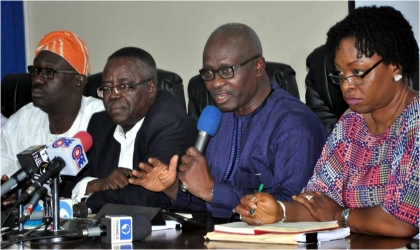
L-R: Special Adviser to Lagos Governor on Information & Strategy, Mr Lateef Raji, Director, Nigeria Centre for Disease Control, Abuja, Prof. Abdusalami Nasidi, Lagos State Commissioner for Health, Dr Jide Idris and Special Adviser to Lagos State Governor on Public Health, Dr Yewande Adeshina at a briefing to update the public on Ebola virus in Lagos, last Monday


The Rivers State chapter of the All Progressives Congress Christian Leaders Forum has expressed strong confidence in the capacity of All Progressives Congress (All Progressives Congress) candidates in the state to deliver effective governance if elected into office in the coming elections.
The State Coordinator of the forum, Archbishop Lucky Aroh, made this known during a breakfast and thanksgiving meeting held in Port Harcourt, where leaders gathered to pray for the stability of the party and the safety of its candidates ahead of the 2027 general elections.According to him, the meeting was convened to seek divine intervention for peace, unity, and security among APC candidates across Rivers State.
“Today we are praying for APC stability in Rivers State and the security of our candidates that have been elected to contest the 2027 elections. It is a breakfast meeting,” Aroh said.
He further expressed optimism that the party’s candidates would not disappoint the people if entrusted with leadership responsibilities.
“They will not fail when elected into office. We are here as fathers of the land to let them know, and I must tell you the truth that these are the authentic people that will do well in Rivers State,” he added.
Speaking earlier, the National Chairman of the forum, Professor Olanrewaju Abraham, commended the Rivers State chapter for organizing the programme, noting that the national body of the forum believes strongly in the power of prayer.
He stated that political leadership provides an opportunity to influence society positively, including advancing moral and spiritual values, while expressing confidence that APC candidates at all levels would emerge victorious in the upcoming elections.
Also speaking, the Rivers State Women Leader of the APC, Hon. Darling Amadi, praised the forum for its commitment to prayers for peace, stability, and the protection of party candidates.
Represented by the Deputy Women Leader of the party in the state, she described the initiative as commendable and urged other political and support groups within the party to emulate the gesture in promoting unity and stability.
By: John Bibor, Menebe Emmanuel & Fortune Paibi
Prominent businessman and philanthropist, Elder Anthony Osagwe-Ogo, was celebrated in grand style as he marked his 70th birthday anniversary, with distinguished Nigerians, business leaders, and golf enthusiasts gathering to honour his remarkable contributions to society.
The colourful celebration took place at the Port Harcourt Golf Club, where friends, associates, and well-wishers converged to pay tribute to the revered elder statesman.
Chairman of the occasion, High Chief (Dr.) Ikenna Okafor, described the celebrant as a detribalised Nigerian whose generosity, humility, and commitment to humanity have earned him admiration across different communities and backgrounds.
According to Dr. Okafor, Pa Osagwe-Ogo’s impact on society and the development of his community remains unparalleled. He noted that members of the golfing community are proud to be associated with a father figure who consistently promotes the welfare and well-being of those around him.
He further stated that the history and growth of the Port Harcourt Golf Club cannot be told without acknowledging the significant role played by the celebrant, whose wisdom, encouragement, and leadership have helped sustain the club over the years.
“We are here to celebrate a man who has impacted humanity positively, a peace-loving individual and an epitome of hope for the younger generation. We pray to emulate his virtues. Today, we celebrate a bridge-builder, a trailblazer, and an iconic leader whose life continues to inspire many,” Dr. Okafor said.
He expressed delight at the large turnout of guests from various walks of life, describing it as a testament to the respect and affection Pa Osagwe-Ogo commands within and beyond Rivers State.
In his response, the celebrant, Pa Anthony Osagwe-Ogo, expressed profound gratitude to God for preserving his life and granting him the privilege of attaining the milestone age of 70.
He also thanked members of the Port Harcourt Golf Club, family members, friends, and associates for identifying with him during the celebration and for their unwavering support over the years.
The event featured the cutting of the birthday cake, presentation of awards to deserving members of the club, goodwill messages, and moments of celebration among guests.
The ceremony was attended by notable personalities from the business community, the golfing fraternity, and other sectors, all of whom joined in celebrating the life and legacy of the respected elder statesman.
Rivers State Governor, Sir Siminalayi Fubara, and the Permanent Secretary of the Rivers State Ministry of Information and Communications, Dr. Honour Kuru Sirawoo, have been honoured with awards of recognition in connection with the 2026 Democracy Day celebrations held in Port Harcourt.
The awards, which formed part of activities marking Nigeria’s Democracy Day on June 12, were formally presented on Tuesday at the Ministry of Information and Communications in Port Harcourt.
Presenting the awards was Hon. Abdul Hameed Oladipupo Alli, popularly known as “Mr. Nigeria,” Publisher of Asiwaju Trumpet Magazine and Achievers World International Magazine.
Governor Fubara was recognised for his efforts in sustaining peace, stability, and a conducive political atmospherJohn Bibor / Menebe Emmanuel / Fortune Paibie in Rivers State. The organisers noted that his administration has fostered harmony and strengthened civic participation across the state.
Dr. Sirawoo, on the other hand, was honoured for his exemplary administrative leadership and significant contributions to effective information management within the Ministry of Information and Communications.
Representing Dr. Sirawoo at the presentation ceremony, Dr. Christian Davies received the award on his behalf and expressed gratitude for the recognition. He described the honour as a reflection of Dr. Sirawoo’s unwavering commitment to professionalism, excellence, and dedicated public service.
Dr. Davies assured the organisers that the award would be formally conveyed to the Permanent Secretary.
The event also featured the presentation of commemorative publications highlighting major governance and civic milestones in Rivers State, including Easter celebrations, Workers’ Day activities, the Governor’s third anniversary in office, and Democracy Day programmes.
Organisers of the awards commended the Rivers State administration for what they described as sustained peace, political stability, and improved civic engagement, noting that these achievements have contributed significantly to the state’s continued development.
By: Jessica Sambol
-

 News4 hours ago
FG Begins Trial Of Over 600 Terrorism Suspects
-

 News4 hours ago
Nigeria Won’t Surrender Any Territory To Criminals -Tinubu
-

 News5 days ago
Nigeria Exceeds OPEC Quota As Production Hits 11-month High
-

 Featured5 days ago
JUNE 12: Democracy Remains Nigeria’s Strongest Path To Unity, Progress, Says Fubara ….Extols Abiola, Wife
-

 Politics5 days ago
Senate Extends 2025 Budget Implementation To Sept. 30
-
 News5 days ago
Reps Pass State Police Bill
-

 News4 hours ago
Rivers Judges Commence Annual Vacation, July 20
-

 News4 hours ago
NDLEA Nets N6.15bn From Hotel, Seized Assets Auction