Connect with us

Oil & Energy

TUC Hails FG’s Decision On Refineries

Published

on

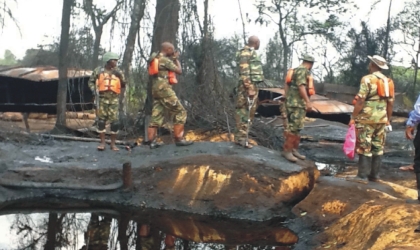
Securitymen supervising the destruction of illegal oil refineries at Alakiri in Okirika Local Government Area, of Rivers State last Thursday

Securitymen supervising the destruction of illegal oil refineries at Alakiri in Okirika Local Government Area, of Rivers State last Thursday

The Federal Government
has received kudos from the Trade Union Congress (TUC) over its decision not to sell the nation’s four refineries as earlier said.
The TUC boss, Mr Bobboi Kaigama, who spoke with journalists in Lagos last week, said that it was a pointer to the fact that the government has listening ears.
He said that it was the best decision the Federal Government has taken so far, saying that it would not have been possible without stakeholders’ critical inputs.
Kaigama called on all the parties in the agreement to ensure that they keep their commitments as to ensure a way forward in the petroleum sector.
It would be recalled that the Federal Government, sometime ago, announced its readiness to sell the major refineries in Port Harcourt, Warri and Kaduna in the name of privatisation.
The TUC boss, maintained that round table discussion was the best way to handle issues that concerned a particular industry, adding that it was ideal all over the globe.
He also lauded the government for issuing an ultimatum to the new private investors in the power sector to provide stable electricity supply within the next six months.
The labour leader, expressed hope that the government’s order will spur the energy providers to action.
According to responses from Port Harcourt, this may not be the first time of such ultimatum, but urged the Federal Government to sue for a radical approach that would guarantee steady power supply in the country.

Continue Reading

Oil & Energy

MIND Slams PENGASSAN, Urges Senate Probe Over Alleged Maltreatment Of Nigerians At TotalEnergies

Published

on

The Movement of Intellectuals for National Development (MIND) has  criticized the Petroleum and Natural Gas Senior Staff Association of Nigeria (PENGASSAN) over what it describes as an evasive response to allegations concerning the treatment of Nigerian employees at TotalEnergies.
In a statement issued by its Western Coordinator, Ebi Warekromo, MIND expressed disappointment at PENGASSAN’s attempt to distance itself from a petition submitted to the President of the Nigerian Senate, maintaining that its petition is grounded in verified evidence and first hand accounts from affected workers.
Warekromo noted that the submission draws extensively from documented correspondence originating from PENGASSAN’s local branch communications that previously raised concerns about unfair labour practices and managerial misconduct within TotalEnergies.
Among the critical issues highlighted are allegations of workplace bullying and intimidation allegedly perpetrated by certain expatriate staff.
The petition also cites serious security concerns and alleged violations of the Nigerian oil and gas industry content development (NOGICD) act, particularly claims that expatriate positions have been unlawfully extended beyond their approved tenures.
Warekromo who dismissed PENGASSAN’s characterization of the documents as merely ‘internal correspondence’ as weak and disingenuous, insisted that workers’ rights violations and systemic oppression cease to be internal matters once they begin to harm Nigerian employees.
The group argued that confidentiality must not be used as a shield for injustice, stressing that internal dispute resolution mechanisms must deliver measurable outcomes.
Where such mechanisms fail, MIND insists that public and legislative oversight becomes necessary
beyond the immediate allegations, questioning PENGASSAN’s independence and effectiveness in representing its members.
The group urged the union to welcome a Senate hearing, describing it as an opportunity to clarify its position, restore credibility, and rebuild trust among workers.
“We are not attacking PENGASSAN. We are responding to the absence of effective representation that has allowed these oppressive practices to persist unchecked”,
MIND emphasised its belief that when unions appear reluctant to act decisively, civil society organizations have a responsibility to intervene in pursuit of justice and equitable labour relations.
Calling for a collaborative response, the group urged workers, unions, regulatory authorities and industry stakeholders to work together toward fostering a healthier and more accountable environment within Nigeria’s oil and gas sector.
It further reiterated its unwavering commitment to defending the rights of Nigerian workers and urged PENGASSAN to take concrete and transparent steps to fulfill its mandate as a labour union.
Continue Reading

Oil & Energy

Elumelu Tasks FG On Power Sector Debt Payment 

Published

on

Chairman of Heirs Holdings, Transcorp and United Bank for Africa (UBA), Tony Elumelu, has urged the Federal Government to fast-track the settlement of debts owed to electricity generation companies (GenCos).
Elumelu said that the timely payment was imperative to boosting power supply and accelerating economic growth.
Speaking to State House correspondents, shortly after the meeting with President Bola Tinubu, at the Presidential Villa, Abuja, Weekend, Elumelu insisted that the debt payment would aid in revitalising the power sector and stabilising the economy while strengthening the Small and Medium-scale Enterprises (SMEs).
He said “All of us who are in the power sector are owed significantly, but in spite of that, we continue to generate electricity. We want to see the payments made so that there will be more provision of electricity to the country. Access to electricity is critical for the development of our economy.”
Elumelu, whose conglomerate has major investments in Nigeria’s power industry, stressed that improving electricity supply remains one of the most important enablers of economic expansion, job creation and industrial productivity.
According to him, President Tinubu recognised the urgency of resolving the liquidity challenges in the power sector and is committed to addressing legacy debts to ensure generation companies can scale operations.
“The President realises it, embraces it and is committed to doing more, especially helping to fast-track the payment of the power sector debt so that power generators can do more for the country. That is very, very critical,” he added.
In his assessment of the outlook for 2026, he said growing macroeconomic stability, improved foreign exchange management and sustained reforms in the power sector could position Nigeria for stronger growth — provided implementation remains consistent and structural bottlenecks are addressed.
Elumelu posited that one priority stands out, which is: resolving power sector liquidity challenges to unlock increased electricity generation and energise the Nigerian economy.
Continue Reading

Oil & Energy

‘Over 86 Million Nigerians Without Electricity’ 

Published

on

Nigeria has been said to have more than 86 million of its population still without access to electricity.
The Deputy Secretary-General of the United Nations, Amina J. Mohammed, stated this at the Award Ceremony of the Leadership Newspaper, in Abuja, last Thursday.
Mohammed noted that sixty per cent of the world’s best solar resources are on this continent adding that by 2040, Africa could generate ten times more electricity than it needs, and entirely from renewables.
Mohammad regretted that Africa now receives just two per cent of global clean energy investment saying, “And here in Nigeria, more than 86 million people still have no access to electricity at all.”
Expressing concerns over the large population of Nigerians living without access to electricity, the deputy scribe, said however, that Nigeria is responding to this challenge the right way insisting that under President Tinubu’s leadership, Nigeria has developed a best-in-class action plan for climate, one that treats climate not as a constraint but as an engine for growth.
According to her, by placing energy access, climate-smart agriculture, clean cooking, and water management at the heart of its development agenda, Nigeria is showing what serious climate leadership looks like but Nigeria cannot close the climate action gap alone.
 “Developed countries must the triple adaptation financing, we need for serious contributions to the Loss and Damage Fund, and mobilize 300 billion dollars per year by 2035 for developing countries to succeed. Early warning systems need to reach everyone, so that communities have the means to prepare for climate shocks before they hit.
“And as Africa drives the global renewables revolution, including through its critical minerals, Africans must be the first and primary beneficiaries of the wealth that they generate”, Mohammed stated.
Continue Reading

Trending