
Politics
Oil Subsidy’s Many Contradictions

The debate on the subsidy regime thrown up by the removal of fuel subsidy by the Federal Government and the resultant nation-wide strike and protests by organized labour and civil society groups is far from being over, as the issue is still on the front burner of national discourse.
At the National Assembly, for instance, the House of Representatives’ Ad-hoc committee on the subsidy regime concluded its indebt probe a fortnight ago and is currently putting its report together, while the Senate Committee on Petroleum (Down stream) resumed its suspended public hearing on the sector last week. At both the House probe and Senate public hearing, the nation was treated to startling revelations that shocked not a few.
As the nation awaits the separate reports of both Houses of the National Assembly, The Tide took up issues arising from the probe with the sole sponsor of the motion on subsidy in the House, Hon. Kingsley Ogundu Chinda. A frontline member of the 7th National Assembly (Vice Chairman, House Committee on Customs and Excise) Hon. Chinda told The Tide that he sees contradictions in the handling of the fuel subsidy regime in the country and the entire imbroglio should be tackled frontally, and he tasked the government on this.
“So far, investigation by the House ad-hoc committee has been concluded and startling facts were revealed; the report of the committee will be made and forwarded to the Executive arm for action. I hope and pray that the Executive arm, in the interest of the nation, will act on the report expeditiously and not allowed the report rot on the shelve like many other reports,” he said.
The Obio/Akpor Federal Constituency (Rivers State) legislator said it was good that President Jonathan in fulfillment of his promise of creating employment with the money saved from subsidy, launched the government’s employment programme last week by inaugurating the implementation committee.
He acknowledged that the Dr. Christopher Kolade-led committee is empowered to manage proceeds from the subsidy, but added, “Let me say clearly that there are several contradictions in the system. Nigeria is still borrowing as we speak and appears to be poised to continue borrowing .
“We were informed that the country borrowed to fund fuel subsidy in 2011. If we stop subsidy payment, what we would have achieved is that we would have stopped borrowing. The issue of reinvesting the fund is illogical and contradictory. There are places in this country where fuel sells for N500 per litre as we speak. One of such places is Mr. President’s home state (Bayelsa)”, he lamented, adding persuasively, “something needs to be done.
“Government needs to gain citizens’ confidence and get them to buy into government policies. This can only be achieved if government is transparent and operates strictly by laid down rules that are clearly predictable.” He continued: “As I stated earlier at the heat of the subsidy removal, ‘for systems of administration or policies of government, let fools contend; what is best administered is best in any society’. What this means is that: It’s not the removal of subsidy that is the crux of the matter but it’s effective administration; it is not the policy but the administration of the policy that matters. That is why a policy can work in Ghana and may not work in Nigeria.
“Again, when national issues are discussed, people take regional and ethnic positions and abandon the nation; even among very highly placed officers, you see more of Ikwerre, Ibo, Yoruba, Hausa or Ijaw opinion or agenda, than the Nigerian project. All I will say is that we do not have a true Nigerian nation. What ww have is an amalgam of various nationalities. I pray that we begin to produce true Nigerians with Nigerian spirit, Nigerian orientation and Nigerian interest to get us out of this quagmire”.
The Tide asked Chinda of his input into the security puzzle that has bedeviled the nation and he drew The Tide’s attention to his recent motion on the prevailing security situation. Titled: ‘Need to urgently investigate and check the rising security challenges in the country’, the motion tasked the Federal Government to come up with a clear programme, solution, and/or policy on how to tackle the problem and not just to beg the problem or adopt a fire brigade measure.
Drawing example from late President Umaru Musa Yar’Adua’s amnesty programme, which was instituted to quell the security challenges the nation was facing at the time from Niger Delta militants, Chinda said, “Now, I’m yet to see a clear programme on how to tackle the upheaval, We must come up with a clear programme on how to tackle the security challenges”.
The just-concluded 2012 budget defence of federal MDA’s at the National Assembly is one issue that cannot escape mention, especially since some committees embarked on a tour of some of these MDA’s before approving their budgets.
The Tide asked Hon Chinda, who led his Customs and Excise committee along with the chairman, Hon Sabo Nakudu on a tour of the Customs, their areas of operation, as part of their oversight function, on the committee’s discovery.
According to him, “We discovered during our oversight visit that our ports are heavily under-utilized, They are colossal wastes!” To this end, he has a motion before the House, mandating government to ‘put our ports to full use’.
There is also the issue of failed contract in the sector and already the erudite legislator has come up with a motion on that, titled : “ Failed contract for dredging of the Calabar channel and the Port Harcourt ports”.
He said there was need to re-award the contracts and put the channel and ports on sound footing so that they can generate more revenue to the Federal Government and create room for wealth creation in the region.”
He continued: “There is also need to connect Onne port to the National grid. It is disturbing that Onne port is not connected to the national grid till now; this is a misnomer. We also observed that fixed scanners were supposed to be installed at Onne and Port Harcourt ports but they are not there. Work has just started to fix the scanners and this is the last year of the five (%) year contract with SGS.
“Nigerians lost the opportunity of using the scanners for the duration of the 5 years contract and SGS is not likely to be there after this year to properly conclude the installation and testing of the scanners unless their contract is renewed. These anomalies should be corrected. I have motions before the House to properly empower the Committee to effectively deal with the situation”.
In addition, “We discovered that the employment pattern in the Nigeria Customs appears to be lop-sided and not in compliance with the constitutional provision for geographical spread. The Committee on Customs is recently working on that and we can say that we have received the assurance of the management of Nigerian Customs to correct the anomaly which has existed over the years.
“Also we discovered that state governments, particularly border states, do not pay attention to Nigeria Customs as one of the security agencies in the country. Nigerian Customs is supposed to protect borders and ensure that illegal goods, fire arms and explosives are not moved into the country. What it means is that they’ll be faced with the challenge of fighting criminals and high-class smugglers.
They, therefore, need proper equipment and they ought to be knitted fully to face the challenges,” he had expressing regret that while State Governments support the Police and other security agencies by providing operational vehicles and allowances, this goodwill is not extended to the Nigeria Custom.”
He that they observed in the course of the oversight function the commendable changes going on in the Nigerian Customs noting that the operations of custom are being digitalised making room for easy monitoring of the Customs and increases transparency, particularly in revenue collection in form of Excise duties, which accounts for the over 100% increase in revenue generated in 2011.
“There’s also concerted efforts to ensure speedy clearance of goods at the wharf. In this light, I’ll urge Nigerians to co-operate with the Agency and also report all cases of extortion or inordinate delay by the custom to the appropriate quarters, either the Controller – General’s office or the House Committee on Customs and Excise”, he said.
Justus Awaji, Abuja



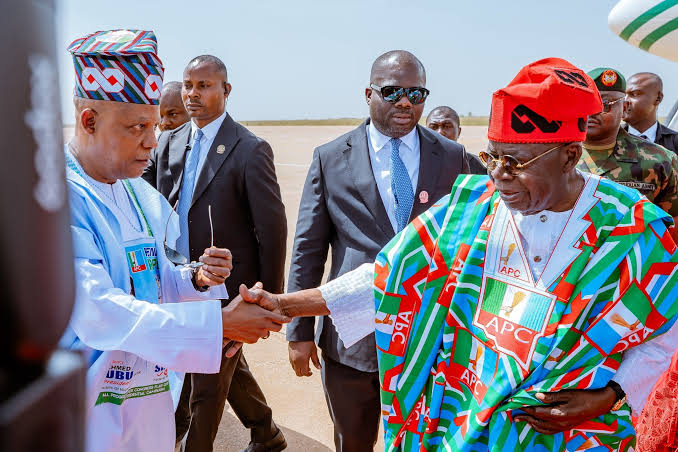
The campaign rally, held at the Kaduna Township Stadium, attracted Vice-President Kashim Shettima, APC governors, party leaders, federal and state lawmakers, political stakeholders and supporters from across the country.
The flag-off marks the beginning of the APC’s drive to secure a second presidential term for President Tinubu, with the party expected to promote its achievements, defend its economic reforms and outline its policy priorities under the proposed Renewed Hope 2.0 agenda.
Kaduna’s selection for the campaign launch underscores the strategic importance of the North-West, a region with a substantial voting population and considerable influence on presidential election outcomes.
The APC faces a significant challenge in Kaduna, where the Peoples Democratic Party’s presidential candidate, Alhaji Atiku Abubakar, defeated President Tinubu in the 2023 election. The rally therefore provides the ruling party an opportunity to strengthen its grassroots structures and regain electoral support in the state.
Addressing supporters, Vice-President Shettima appealed to Northern voters, highlighting President Tinubu’s political relationships with prominent Northern leaders, including Alhaji Abubakar, Mallam Nuhu Ribadu and the late President Muhammadu Buhari.
The Vice-President’s appeal reflects the APC’s determination to consolidate its support in the North as the party intensifies preparations for the presidential contest.
The Renewed Hope 2.0 agenda is expected to feature prominently in the campaign, providing a platform for President Tinubu to explain his administration’s economic policies and outline plans for another term.
However, the President’s record on economic reforms, rising living costs, petrol prices, employment, infrastructure and insecurity is expected to attract considerable scrutiny during the electioneering period.
-

 Niger Delta3 hours ago
C’River, NUJ Pay Tribute To Late Guardian Editor
-

 Niger Delta3 hours ago
Diri Restates Stance On Lagos-Calabar Coastal Highway
-

 News5 hours ago
NDLEA Recovers Tons Of Illicit Drug Consignments In Nine States
-

 Opinion3 hours ago
Checking Voter Apathy In Nigeria’s Electoral Process
-
 Oil & Energy4 hours ago
S&P Global Warns Hormuz Energy Shock Could Become A Global Food Crisis
-

 Rivers4 hours ago
Education Ministry Condemns Female Virginity Testing In CHS, Taabaa
-

 Oil & Energy4 hours ago
Gas Reserves Hit 215 Trillion Cubic Feet
-
 Oil & Energy4 hours ago
NCDMB, Manufacturers Commit To Scale Up Local Oil And Gas Production Components