Opinion
The Violence In Jos
One of the flash-points of Nigeria is Jos, capital of Plateau State. No month passes without reports of killing of innocent citizens in Jos. This is very disturbing.
A country which believes in the killing of innocent citizens cannot progress. We therefore appeal for restraint in Jos.
In the meantime, seven people were killed in Jos on Tuesday, November 2, 2010. Of the seven killed) six were members of the same family.
According to reports, they were allegedly hacked to death by Fulani herdsmen in Rawhinku. Two days earlier similar incident occurred when several people were either killed or injured. Again, the attack was alleged to have been carried out by Fulani herdsmen.
As already observed, no country can scale great height where there are frequent ethnic killings. That this is happening in Nigeria at this particular point in time is very unfortunate. We should all make efforts to love one another in this country so that there will be peace. Unnecessary bloodshed cannot get us anywhere. We should cultivate the attitude of love and goodwill towards each other. When we do this, the nation will achieve peace and greatness. Nothing can be gained from killings and murders in this country.
It would called that on Sunday, March 7, 2010, there was a massacre in Jos, Plateau State. According to reports, about five hundred armed Fulani militias invaded Dogo Nahawa Shen Village of Jos South Local Government Area of Plateau State between 3a.m and 5.am and massacred about five hundred people, mainly children and women.
Apart from the dead,, many houses were also set ablaze by the Fulani invaders. After setting the houses on fire, the invaders started firing with sophisticated guns and other weapons that resulted in the death of the innocent citizens that were having their night rest.
It was also gathered that before the invasion, some villagers received text message and calls on their mobile phones from some of the attackers believed to be Fulani herdsmen that they were coming to attack the village. Those who received such messages and calls were Berom Moslems who were asked to move away from the village.
The Gbong Gwon Jos, Da Jacob Gyang Buba confirmed that he too received such messages two days before the invasion. He said, he alerted security agents but no action was taken to nip the invasion in the bud. He stressed that the nation could not continue like this “because we are not animals”.
Some youths, who managed to escape; said that houses were first set ablaze and as soon as occupants of such buildings ran out for safety, they were killed one after the other.
This is indeed, very barbaric. How will some Nigerians decide to plan and carry out a massacre of such magnitude against fellow Nigerians. The killings were said to be among the worst in ‘the series of crises in Jos.
In fact, this should be condemned in its entirely. No country should condone barbarism such as this. Nigerians should learn to live like human beings and not like thoughtless beasts interested only in shedding innocent blood.
In any case, in his reaction, the then Acting President, Dr Goodluck Jonathan placed the security services on red alert in Plateau State over the renewed crisis. He also met with leadership of the security agencies to map out plans on how to check the violence and death in the state.
In their reactions, the world community, including the Vatican, United States of America, United Kingdom and France, condemned the March 7, 2010 massacre. The Vatican spokesman, Federico Lombardi lamented what he called horrible acts of violence in Nigeria. He stressed that the Vatican viewed the violence with sadness and concern.
The United States mission in Nigeria urged the Federal Government to bring to justice the perpetrators of the violence. It stressed that such loss of lives and properties should not weaken the unity and peace that all Nigerians loved. The United Nations Secretary General, Ban Ki-moon appealed for maximum restraint by all sides in the conflict. He said, Nigerian political and religious leaders should work together to address the underlying causes and to achieve a permanent solution to the crisis in Jos.
However, those who died in the crisis were given a mass burial and the police arrested more than twenty-two suspects in connection with the massacre.
Also, more than two hundred people were killed in Jos during a violence which happened on Monday, January 18, 2010. The violence lasted several days. Apart from those killed, properties worth millions of naira were destroyed during the violence.
Police authorities alleged that the violence started when some Muslim youths attacked Christians in a church in Nasarawa Gwong without provocation. Many houses and places of worship were burnt by the attackers. Because of this, the government of Plateau State imposed a twenty-four-hour curfew on the state to stem further violence.
However, all well-meaning people should condemn the situation in Jos, particularly the latest violence that has taken seven lives. Perpetrators of evil should allow law-abiding citizens of this country to go about their lawful activities in peace. Spilling of innocent blood cannot lead this country anywhere.
Meanwhile, we appeal to the authorities of Nigeria to investigate the latest killings in Jos and bring those responsible to justice. This country should be allowed to be in peace.
Dr Tolofari, fellow, Institute of Corporate Administration of Nigeria, resides in Port Harcourt.
Mann Tolofari

Opinion
Wike VS Soldier’s Altercation: Matters Arising
The events that unfolded in Abuja on Tuesday November 11, 2025 between the Minister of the Federal Capital Territory, Chief Nyesom Wike and a detachment of soldiers guarding a disputed property, led by Adams Yerima, a commissioned Naval Officer, may go down as one of the defining images of Nigeria’s democratic contradictions. It was not merely a quarrel over land. It was a confrontation between civil authority and the military legacy that still hovers over our national life.
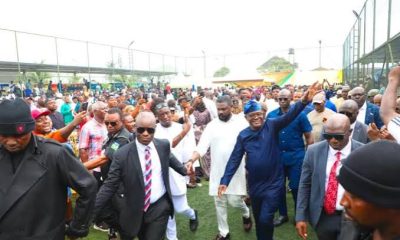
Nyesom Wike, fiery and fearless as always, was seen on video exchanging words with a uniformed officer who refused to grant him passage to inspect a parcel of land alleged to have been illegally acquired. The minister’s voice rose, his temper flared, and the soldier, too, stood his ground, insisting on his own authority. Around them, aides, security men, and bystanders watched, stunned, as two embodiments of the Nigerian state clashed in the open.
The images spread fast, igniting debates across drawing rooms, beer parlours, and social media platforms. Some hailed Wike for standing up to military arrogance; others scolded him for perceived disrespect to the armed forces. Yet beneath the noise lies a deeper question about what sort of society we are building and whether power in Nigeria truly understands the limits of its own reach.
It is tragic that, more than two decades into civil rule, the relationship between the civilian arm of government and the military remains fragile and poorly understood. The presence of soldiers in a land dispute between private individuals and the city administration is, by all civic standards, an aberration. It recalls a dark era when might was right, and uniforms conferred immunity against accountability.
Wike’s anger, even if fiery, was rooted in a legitimate concern: that no individual, however connected or retired, should deploy the military to protect personal interests. That sentiment echoes the fundamental democratic creed that the law is supreme, not personalities. If his passion overshot decorum, it was perhaps a reflection of a nation weary of impunity.
On the other hand, the soldier in question is a symbol of another truth: that discipline, respect for order, and duty to hierarchy are ingrained in our armed forces. He may have been caught between conflicting instructions one from his superiors, another from a civilian minister exercising his lawful authority. The confusion points not to personal failure but to institutional dysfunction.
It is, therefore, simplistic to turn the incident into a morality play of good versus evil.
*********”**** What happened was an institutional embarrassment. Both men represented facets of the same failing system a polity still learning how to reconcile authority with civility, law with loyalty, and service with restraint.
In fairness, Wike has shown himself as a man of uncommon courage. Whether in Rivers State or at the FCTA, he does not shy away from confrontation. Yet courage without composure often feeds misunderstanding. A public officer must always be the cooler head, even when provoked, because the power of example outweighs the satisfaction of winning an argument.
Conversely, soldiers, too, must be reminded that their uniforms do not place them above civilian oversight. The military exists to defend the nation, not to enforce property claims or intimidate lawful authorities. Their participation in purely civil matters corrodes the image of the institution and erodes public trust.
One cannot overlook the irony: in a country where kidnappers roam highways and bandits sack villages, armed men are posted to guard contested land in the capital. It reflects misplaced priorities and distorted values. The Nigerian soldier, trained to defend sovereignty, should not be drawn into private or bureaucratic tussles.
Sycophancy remains the greatest ailment of our political culture. Many of those who now cheer one side or the other do so not out of conviction but out of convenience. Tomorrow they will switch allegiance. True patriotism lies not in defending personalities but in defending principles. A people enslaved by flattery cannot nurture a culture of justice.
The Nigerian elite must learn to submit to the same laws that govern the poor. When big men fence off public land and use connections to shield their interests, they mock the very constitution they swore to uphold. The FCT, as the mirror of national order, must not become a jungle where only the powerful can build.
The lesson for Wike himself is also clear: power is best exercised with calmness. The weight of his office demands more than bravery; it demands statesmanship. To lead is not merely to command, but to persuade — even those who resist your authority.
Equally, the lesson for the armed forces is that professionalism shines brightest in restraint. Obedience to illegal orders is not loyalty; it is complicity. The soldier who stands on the side of justice protects both his honour and the dignity of his uniform.
The Presidency, too, must see this episode as a wake-up call to clarify institutional boundaries. If soldiers can be drawn into civil enforcement without authorization, then our democracy remains at risk of subtle militarization. The constitution must speak louder than confusion.
The Nigerian public deserves better than spectacles of ego. We crave leaders who rise above emotion and officers who respect civilian supremacy. Our children must not inherit a nation where authority means shouting matches and intimidation in public glare.
Every democracy matures through such tests. What matters is whether we learn the right lessons. The British once had generals who defied parliament; the Americans once fought over states’ rights; Nigeria, too, must pass through her own growing pains but with humility, not hubris.
If the confrontation has stirred discomfort, then perhaps it has done the nation some good. It forces a conversation long overdue: Who truly owns the state — the citizen or the powerful? Can we build a Nigeria where institutions, not individuals, define our destiny?
As the dust settles, both the FCTA and the military hierarchy must conduct impartial investigations. The truth must be established — not to shame anyone, but to restore order. Where laws were broken, consequences must follow. Where misunderstandings occurred, apologies must be offered.
Let the rule of law triumph over the rule of impulse. Let civility triumph over confrontation. Let governance return to the path of dialogue and procedure.
Nigeria cannot continue to oscillate between civilian bravado and military arrogance. Both impulses spring from the same insecurity — the fear of losing control. True leadership lies in the ability to trust institutions to do their work without coercion.
Those who witnessed the clash saw a drama of two gladiators. One in starched khaki, one in well-cut suit. Both proud, both unyielding. But a nation cannot be built on stubbornness; it must be built on understanding. Power, when it meets power, should produce order, not chaos.
We must resist the temptation to glorify temper. Governance is not warfare; it is stewardship. The citizen watches, the world observes, and history records. How we handle moments like this will define our collective maturity.
The confrontation may have ended without violence, but it left deep questions in the national conscience. When men of authority quarrel in the open, institutions tremble. The people, once again, become spectators in a theatre of misplaced pride.
It is time for all who hold office — civilian or military — to remember that they serve under the same flag. That flag is neither khaki nor political colour; it is green-white-green, and it demands humility.
No victor, no vanquish only a lesson for a nation still learning to govern itself with dignity.
By; King Onunwor
Opinion
Ndifon’s Verdict and University Power Reform
Opinion
As Nigeria’s Insecurity Rings Alarm
-
Business3 days agoCBN Revises Cash Withdrawal Rules January 2026, Ends Special Authorisation
-
Business3 days ago
Shippers Council Vows Commitment To Security At Nigerian Ports
-
Business3 days agoNigeria Risks Talents Exodus In Oil And Gas Sector – PENGASSAN
-
Business3 days agoFIRS Clarifies New Tax Laws, Debunks Levy Misconceptions
-
Sports3 days ago
Obagi Emerges OML 58 Football Cup Champions
-
Politics3 days agoTinubu Increases Ambassador-nominees to 65, Seeks Senate’s Confirmation
-
Business3 days ago
NCDMB, Others Task Youths On Skills Acquisition, Peace
-
Sports3 days agoFOOTBALL FANS FIESTA IN PH IS TO PROMOTE PEACE, UNITY – Oputa