Oil & Energy
Greenville LNG Launches CNG Fuelling For Luxury Buses In Nasarawa
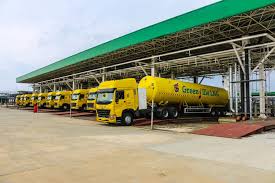
In a significant development for energy sustainability and transportation in Nasarawa State, Nigeria’s leading domestic gas liquefaction and distribution company, Greenville LNG, has commenced the provision of Compressed Natural Gas (CNG) to the state’s new fleet of luxury buses.
This milestone, achieved at Greenville LNG’s pioneering gas station in Lafia, Nasarawa State, marks a crucial step toward more secure, eco-friendly, and cost-effective energy solutions.
The launch has sparked considerable enthusiasm among state officials, commuters, and transport operators in Lafia.
This transition aligns with the state government’s commitment to environmental sustainability and economic development through the adoption of cleaner energy alternatives.
Recall that the Nasarawa State Government, in its push for industrial modernisation and adherence to global carbon emission standards, recently acquired CNG-powered buses from JAC Motors.
The adoption of CNG is driven by the state’s focus on improving human health, safety, and environmental protection by moving away from heavy, carbon-emitting fossil fuels with the buses to serve both intra and interstate routes including routes from Lafia to Abuja and Lafia to Jos.
Governor Abdullahi A. Sule emphasized this shift during the Nasarawa State Investment Summit held in May where he advocated for the transition from traditional fossil fuels to cleaner, more affordable energy sources like CNG and LNG.
Governor Sule advised energy investors in the state to focus on establishing LNG-CNG daughter stations rather than conventional petrol stations, citing the new Greenville LNG hub in Lafia as a model for future investments.
The Greenville LNG CNG hub in Lafia, now operational, is set for an official commissioning ceremony by Governor Sule in August. This hub represents a critical infrastructure development that supports Nasarawa State’s goal of energy transition and economic transformation.
It would be noted that Greenville LNG, a leader in Nigeria’s private sector gas industry, operates a comprehensive virtual pipeline with over 600 specialized LNG delivery trucks.
These trucks, capable of traveling 1,200 to 1,800 kilometers without refueling, ensure the consistent and reliable distribution of LNG and CNG across Nigeria.
With existing hubs in Rumuji, Benin, Shagamu, Koton-Karfe, Kaduna, and Lafia, the company plans to expand its network to 25 hubs nationwide.
This expansion aims to deliver cleaner, more affordable energy to homes, the automotive sector, and industrial operations, enhancing Nigeria’s energy landscape.

Oil & Energy
Take Concrete Action To Boost Oil Production, FG Tells IOCs
Speaking at the close of a panel session at the just concluded 2026 Nigerian International Energy Summit, the Minister of State for Petroleum Resources (Oil), Senator Heineken Lokpobiri, said the government had created an enabling environment for oil companies to operate effectively.
Lokpobiri stressed that the performance of the petroleum industry is fundamentally tied to the success of upstream operators, noting that the Nigerian economy remains largely dependent on foreign exchange earnings from the sector.
According to him, “I have always maintained that the success of the oil and gas industry is largely dependent on the success of the upstream. From upstream to midstream and downstream, everything is connected. If we do not produce crude oil, there will be nothing to refine and nothing to distribute. Therefore, the success of the petroleum sector begins with the success of the upstream.
“I am also happy with the team I have had the privilege to work with, a community of committed professionals. From the government’s standpoint, it is important to state clearly that there is no discrimination between indigenous producers and other operators.
“You are all companies operating in the same Nigerian space, under the same law. The Petroleum Industry Act (PIA) does not differentiate between local and foreign companies. While you may operate at different scales, you are governed by the same regulations. Our expectation, therefore, is that we will continue to work together, collaborate, and strengthen the upstream sector for the benefit of all Nigerians.”
The minister pledged the federal government’s continued efforts to sustain its support for the industry through reforms, tax incentives and regulatory adjustments aimed at unlocking the sector’s full potential.
“We have provided extensive incentives to unlock the sector’s potential through reforms, tax reliefs and regulatory changes. The question now is: what will you do in return? The government has given a lot.
Now is the time for industry players to reciprocate by investing, producing and delivering results,” he said.
Lokpobiri added that Nigeria’s success in the upstream sector would have positive spillover effects across Africa, while failure would negatively impact the continent’s midstream and downstream segments.
“We have talked enough. This is the time to take concrete actions that will deliver measurable results and transform this industry,” he stated.
It would be noted that Nigeria’s daily average oil production stood at about 1.6 million barrels per day in 2025, a significant shortfall from the budget benchmark of 2.06 million barrels per day.
Oil & Energy
Host Comm.Development: NUPRC Commits To Enforce PIA 2021
Oil & Energy
PETROAN Cautions On Risks Of P’Harcourt Refinery Shutdown
The energy expert further warned that repeated public admissions of incompetence by NNPC leadership risk eroding investor confidence, weakening Nigeria’s energy security framework, and undermining years of policy efforts aimed at domestic refining, price stability, and job creation.
He described as most worrisome the assertion that there is no urgency to restart the Port Harcourt Refinery because the Dangote Refinery is currently meeting Nigeria’s petroleum needs.
“Such a statement is annoying, unacceptable, and indicative of leadership that is not solution-centric,” he said.
The PETROAN National PRO reiterated that Nigeria cannot continue to normalise waste, institutional failure, and retrospective justification of poor decisions stressing that admitting failure is only meaningful when followed by accountability, reforms, and a clear, credible plan to prevent recurrence.
-
Sports24 hours agoArsenal Women End Man City’s Invincibility
-
Sports24 hours agoU-20 WWC: Falconets claim qualifier win
-
Environment23 hours agoRivers State Government Suspend Fire Service Collection Levies
-
Sports24 hours agoInsurance Deepen Enyimba’s Trouble
-
Environment23 hours agoLASEMA pushes attitudinal change to cut fire outbreaks in Lagos
-
Sports24 hours agoYouth Olympics preparation Gears up
-
Sports1 day agoTornadoes Set For NPFL exit over Stadium Ban
-
Politics1 day agoI DEFECTED OUT OF CONVICTION …NO ONE COULD’VE IMPEACHED MY LATE DEPUTY ~ DIRI