
Oil & Energy
Japanese Agency Strengthens Nigeria’s Electricity Transmission With $500m Investment

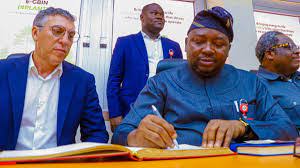
In a bid to strengthen transmission infrastructure in Nigeria, the Japanese International Corporation Agency (JICA), has invested $500 million to strengthen transmission infrastructure along Lagos-Oguny Industrial corridor, covering Agbara, Mowe and Sagamu indand rustrial clusters
Minister of Power, Adebayo Adelabu, made this known during a visit on him by the Ogun State Governor, Dapo Abiodun, in Abuja, at the Weekend.
Adelabu said all these efforts would involve building additional power transmission substations, upgrading existing ones, as well as reconductoring existing weak high voltage powerlines and new extensions for capacity strengthening and expansion.
The Minister urged the Governor to collaborate with the ministry to impress on gas pipeline operators to improve the pipeline infrastructure passing through the state to boost the pressure quality and quantity of gas supplies to power plants and industries within the state.
“We also have the Presidential Power Initiative (PPI) projects, the highlights of which include boosting power transmission infrastructure within and outside the Ogun industrial corridors. Also ongoing are some Transmission Company of Nigeria’s (TCN)’s projects aimed at enhancing power supply to Ogun State”, he stated.
The Minister also promised to undertake an official visit to the state soon as requested by the Governor to enable him meet with the industrialists within the corridors to explore possible areas of cooperation and collaboration.
In his remarks, the Governor applauded the minister for not just the overwhelming noticeable improvements in power supply across the country but the ongoing turnaround being witnessed in the nation’s power sector enjoining him to sustain the momentum, which he said would further galvanise the economy.
“I came to visit my dear brother, our very brilliant Minister of Power who is performing wonders in the power sector and to further encourage him to sustain the noticeable improvement”, he said.
Abiodun, who described the state as the nation’s key industrial cluster, canvassed for special attention on the state.
“As part of my visit, I want to make a special appeal to you for special attention to further enhance power infrastructure and supply to Ogun State, which is a key industrial hub in the country.
“I am aware that since your assumption of duty, you have visited some major industries and power plants in the state like Momas Electricity Meters Manufacturing Company, Coleman Wires and Cables and Splendor Electric, producers of Porcelain high voltage electric insulators as well as the Olorunsogo NDPHC NIPP power plant in Papa Lanto. However, we have a lot more to show you”, he promised.
The Governor further extended a state official invitation to the minister to meet with the industrialists in the state, visit some of the government key initiatives in areas of modern agriculture, CNG and Electric vehicles projects as well as in renewable energy exploits.
“We would like to invite you to address our industrialists and expatiate on the ministry’s immediate and long-term plan to further boost supply beyond current improvements.
“Your visit will also enable us to showcase what we have in the state and to further explore areas of collaboration with the ministry”, he stated.




-
Rivers22 hours ago
Rivers Police Uncovers Firearm Concealed In Loaf Of Bread
-

 Niger Delta18 hours ago
Pro-Chancellor Hands Over Okey Onuchuku Peace, Conflict Institute Building
-

 News18 hours ago
Fubara Reaffirms Commitment To Blue Economy, Private Sector Growth …Calls For Protection Of Marine Resources
-
Sports22 hours ago
Six Nigerians To Play For NBA Teams
-
Business21 hours ago
Gas Economy: Decade of Gas, Pi-CNG/ EV Deepen Media Engagement
-
Business22 hours ago
Navy Nabs 13 Black Sand Miners In Bayelsa –Impound Two Boats
-
 Business19 hours ago
IPMAN Raises Concern Over Delay In Chinese Refinery Deal …Predicts Lower Fuel Prices Through Competition
-
Business22 hours ago
Accountable Leadership, Urgent Reforms Will Stimulate Economic Growth — Osi