
Politics
Ex-Senate President’s Body Arrives Nigeria After 33 Months

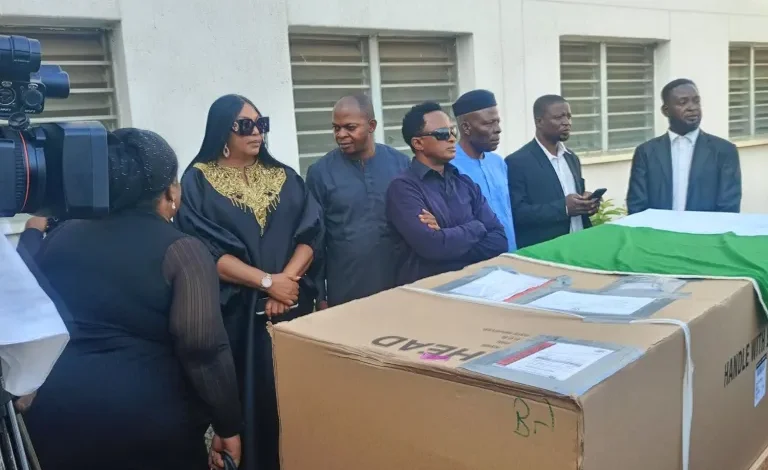
The body of Nigeria’s Second Republic Senate President, Dr Joseph Wayas, has arrived Nigeria 33 months after his death in the United Kingdom.
The remains of the elder statesman, which arrived the Nnamdi Azikiwe International Airport in Abuja on Wednesday morning, were received by his family members; Cross River North Senator, Jarigbe Agom; Hon. Peter Akpanke; kinsmen, and other stakeholders.
The body was thereafter deposited at the morgue of the National Hospital, Abuja, after two years and nine months at a London morgue.
Senator Jarigbe, Hon. Akpanke and the family members of the late former two-time Senate President, were full of praises for Cross River State governor, Prince Bassey Otu, for his spirited efforts in facilitating the transportation of Dr Wayas’ remains to Nigeria.
They also commended the efforts of the Convener of the Who is Who Forum of Cross River North, Papa Dorn Cklaimz Enamhe and his Co-convener, Mr Johnny Agim, SAN, in mobilising Cross Riverians and Nigerians to ensure the successful return of the remains of the former Senate President.
Recall that Senator Wayas, who hailed from Cross River State, was Nigeria’s Senate President between 1979 and 1983.
Late Wayas was born on May 21, 1941. He died on November 30, 2021 in the United Kingdom following a protracted illness. Disagreements among members of his immediate family had delayed his burial rites since then.
Two years and nine months later, his body has been flown home from Heathrow Airport in London aboard a British Airways flight 083 and arrived at the Nnamdi Azikiwe International Airport Abuja, Wednesday at about 4:40am.
Speaking to journalists on arrival of the body of the elder statesman, the Senator representing Cross River North, Senator Jarigbe Agom Jarigbe, said “We have come to receive the body of late Senate President, Joseph Wayas, who died two and half years ago, and we just succeeded in bringing the body back to the country through the efforts of the Governor of Cross River State, His Excellency, Prince Bassey Otu.
“We are going to prepare for the funeral, report back to the Governor, and the Governor is going to take it up from there because the late statesman is the responsibility of the government and he will be accorded a state burial.”
However, he said the issues that caused the delay in bringing the body of the late Senate President back home “have been sorted out finally.”
Meanwhile, the lawmaker also thanked the leadership of the Who is Who in Cross River North led by the Convener, Dr Doncklaimz Enamhe, for their collaborative effort and support as he proceeded to sign the condolence register at Dr Wayas’ Asokoro residence in Abuja.
Also speaking, the member representing Obanliku/Bekwarra/Obudu Federal Constituency, Hon. Peter Akpanke, also said, “We are here to deposit the corpse of our political father, mentor, and former Senate President, Dr Joseph Wayas. His body was flown today into Abuja from the United Kingdom, UK, and was received by the Distinguished Senator and all of us. So we came to the mortuary and the corpse has been deposited.”
On the contributions of the late Senate President to his people and national development, Hon. Akpanke noted that, “He was a two term Senate President without impeachment, impacted the lives of most of the people today, and he brought them up. Like FC Obudu, he brought that school, and built a lot of leaders today, and he was our political leader.”
Meanwhile, the Convener, Who is Who Forum of Northern Cross River, Dr Doncklaimz Enamhe, expressed gratitude to God for resolving everything that caused the delay, and appreciated the Governor of Cross River State, Senator Bassey Otu for his intervention that made everything to go well.
“The people of Northern Cross River under the aegis of Who is Who Forum of Northern Cross River realised that our father and our leader who had passed on two years and nine months back was still in a London morgue. So the first thing we did was to allay the fears of Nigerians by going to view the corpse, which we did in London, then now we have brought back our father.
“Everything has been resolved because the family is back, our leader is here, now we will bury him. Every family has issues once in a while, the good thing is that God has a way of resolving issues. When all of us met the corpse of our father we all became sober, weeping and crying, and to God be the glory our Senator, House of Rep Member, and Governor, they are all together with the Federal Government, the Senate President, and everybody is going to give Rt Hon Joseph Wayas, two term Senate President and acting President a befitting burial.”
Other stakeholders and leaders in attendance included; Senator Eteng Jonah Williams, Rt. Hon. Mike Etaba, Ntufam Fidelis Ugbo, Jonny Agim, SAN, Hon. Cletus Obun, amongst others.


The Commission disclosed the figure in its weekly update for week 14 of the second phase of the exercise, which ended on Friday, April 17, 2026.
According to the breakdown, 2,259,288 Nigerians completed their registration through the online pre-registration portal, while 1,489,416 finalized their registration physically at designated centres nationwide.
INEC noted that the figures remain preliminary and are subject to further verification and data cleaning processes to ensure accuracy ahead of the consolidation of the national voter register.
With the conclusion of the registration phase, the Commission has now shifted focus to the display of the Register of Voters for Claims and Objections, a statutory stage aimed at strengthening the credibility and integrity of the voters register.
The display exercise is scheduled to hold from April 29 to May 5, 2026, across designated centres nationwide, providing citizens the opportunity to verify their details and raise objections where necessary.
The Commission urged all registered voters from the concluded phase to take advantage of the exercise to confirm the accuracy of their information and assist in identifying ineligible entries, including duplicate registrations, deceased persons, and non-citizens.
INEC explained that the Continuous Voter Registration exercise is being conducted in phases, with the first phase running from August 18 to December 10, 2025, while the second phase commenced on January 5, 2026 and ended on April 17, 2026.
The Commission further stated that the date for the commencement of the third phase will be announced in due course.
Reaffirming its commitment to credible elections, INEC stressed that maintaining a clean and accurate voter register remains central to ensuring free, fair, and transparent electoral processes in Nigeria.
The Executive Director of IPC, Mr Lanre Arogundade, informed the journalists that the dialogue was sponsored by the European Union, under the auspices of the EU-Support to Democratic Governance in Nigeria (EU-SDGN II), Component 4: Support to Media.
According to the veteran media practitioner, the programme is aimed at strengthening the capacity of the media to promote credible elections through factual, accurate and fair reporting.
He explained that the programme is part of a broader five-year intervention designed to support democratic governance and improve the role of the media in Nigeria’s electoral process, stressing that fact-checking and inclusive reporting are critical responsibilities for journalists, especially during electioneering.
He described the media as a central role agent with regard to upholding transparency and accountability in the democratic process.
A resource person and Director of Journalism Clinic, Lagos, Mr Taiwo Obe, enjoined journalists to embrace the evolving technology so that they would not be in the backwaters in the practice of the profession.
He advised journalists not to downplay Artificial Intelligence (AI) in their bid to remain relevant in the media environment by being abreast of the changing patterns of news consumption.
The journalism teacher explained that with digital transformation of the media industry, it had become imperative for journalists to constantly upgrade and update their skills, stressing the fundamental place of attitude and self-development and underscored the dynamic nature of media consumption in the digital age, thereby compelling journalists to embrace tools and platforms, but without much reliance on AI.
In his lecture, a Professor of Mass Communication at the Federal University Oye-Ekiti (FUOYE), Adebola Aderibigbe, advised journalists in Ekiti State to ensure that coverage of the upcoming governorship poll is issue-based rather than dwelling on personalities.
He added that sensationalism should not occupy the front-burner of any discussions concerning the 2026 election, admonishing that sustenance of democracy is anchored on responsible journalism.
”Journalists must prioritise accuracy, fairness and balance in their reports by verifying facts and giving all parties involved in political matters the opportunity to present their views”, he said.
According to the university don, the election will not be defined by personalities, but by issues. ”Let issues be the pivotal ring upon which every discussion should be made. Sensationalisation of issues should not be the bedrock of discussions in the 2026 election”, he added.
“Do not hear from Party A without hearing from Party B, otherwise the report will be skewed to one side and once issues of elections are skewed, problems will naturally arise”, he stressed.
-

 Sports1 day ago
Financial Issues Stall Chelle’s Eagles Contract Talks
-

 Sports1 day ago
NFF mourns ex-Eagles striker Eneramo
-

 Maritime1 day ago
CILT Nigeria Seeks Anti- graft Agency Collaboration
-
Sports1 day ago
Four Private Clubs Gain Promotion To NPFL
-

 Sports1 day ago
Tennis Event Boosts Grassroots Development Push
-

 Sports1 day ago
W/Cup Qualifier: Flamingos In Impressive Opener
-

 Sports1 day ago
European Giants Circle For Osimhen
-

 Sports1 day ago
Chelle Confirms Financial Issues in Eagles Contract Discussion