
News
Giving Details Of 23 Abuja-Kaduna Victims’ll Subject Families To Fresh Trauma

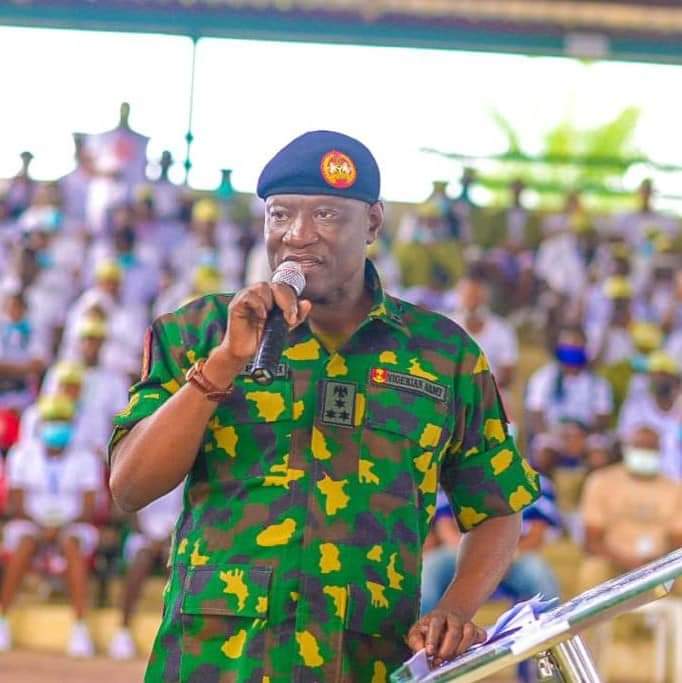
The rescue of the 23 remaining victims of the Kaduna-Abuja train attack, last Wednesday, after six months in terrorist’s captivity has been described as a non-kinetic operation, with the Defence Headquarters’ stating that giving details of how they were rescued, would subject their families to a fresh trauma.
This is just as the DHQ said that though there was a lot of secrecy involved in the operation because of the high powered committee members involved, the terrorists involved would definitely be fished out and made to face the consequences of their criminal actions.
The Director, Defence Media Operations, Major General Musa Dan Madami, and the Director of Defence Information, Major General Jimmy Akpor, both made the disclosure, yesterday, at a media briefing.
Asked to tell Nigerians how Nigerian security agents secured the release of the victims and what happened to the terrorists, Major General Dan Madami said, “The most important thing is that those people (victims) had been held captive for about six months and have been rescued. It was part of the non-kinetic operation of the military. Giving details may subject their families to fresh trauma. So for now, we will wait for the appropriate time for the details to come out”.
On his part, Akpor said, “Operations such as this, involves elements of national power. These elements could be social, could be developmental. These elements can be deployed to achieve national objectives. There was a lot of secrecy in the operation to achieve the objective. As to what happened to the terrorists, that will be made known later. But it is a given that anybody that committed such a criminal offence against the nation will definitely, will be fished out and made to face the consequences of that act”.
On other military operations across the country, Madami said troops in the North-East Theatre of operation, neutralised 19 terrorists, arrested 42 suspected terrorist logistics suppliers, rescued three civilians while six suspected Boko Haram terrorist/Islamic State of West Africa Province informant and collaborators, including a foreigner were arrested at different locations.
Furthermore, Madami said troops of Guards Brigade have arrested 64 youths in black attires, armed with nine locally made guns during a raid on Karshi hill and surrounding villages in Abuja Municipal Area Council of the Federal Capital Territory following intelligence on plans by hoodlums to disrupt the Independence Day Celebration on October 1, 2022.
In the battle against economic sabotage, he said troops discovered and destroyed a combined total of 74 illegal refining sites, 67 wooden boats, six speed boats, 456 storage tanks, 274 cooking ovens and 89 dugout pits.
Troops recovered a total of over 3.76million litres of crude oil and 458,000 litres of Automotive Gas Oil, thereby denying oil thieves a total of over N2.1billion worth of stolen crude oil and products.
Madami said, “Troops of Operation Hadin Kai in the North-East conducted ambushes, clearance operations, fighting patrols and cordon and search as well as other operations at different locations in Biu, Damboa, kaga, Kukawa and Gubio Local Government Area all in Borno State.
“During the operations troops arrested 29 Boko Haram terrorist/Islamic State of West Africa Province logistic suppliers. Items recovered from the Boko Haram include; 50 big bags of dry fish, two big sacks of fried meat, 55 jerry cans of Premium Motor Spirit, one big bag of coal, 13 bags of breads, one bag of salt, one bag of beans, five cartons of detergent, three packs of batteries, 50 leathers of mosquito coil, 10 mobile phones, four vehicles, one bicycle and a total sum of N2,479,740.00 as well as other sundry items.
“Equally, troops arrested a suspected Boko Haram terrorist/Islamic State of West Africa Province ammunition technician at Gorom village in Monguno Local Government Area of Born State, with 300 empty cases of ammo suspected to be used for fabricating 7.62mm specials while sixsuspected Boko Haram terrorist/Islamic State of West Africa Province informant and collaborators, including a foreigner were arrested at different locations.
“Troops also rescued two Chibok girls by name, Yana Pogu and Rejoice Senki on serial 19 and 70 of the abducted Chibok girls lists with their children at Bula Davo village in Bama Local Government Area and Kawur village in Konduga Local Government Area of Borno State with 12 others abductees.
“Consequently, troops within the period recovered six AK-47 rifles, 14 AK-47 magazines, one HK gun, one G3 rifle, 112 rounds of 7.62mm special, 285 rustled cattle and eight gallons of Premium Motor Spirit. Troops also neutralised 19 terrorists, arrested 42 suspected terrorist logistics suppliers, rescued three civilians while a total of 418 suspected Boko Haram terrorists/Islamic State of West Africa Province terrorists, who claimed to have lost interest in the ideology of Boko Haram terrorists surrendered to own troops at different locations with their families comprised of 44 adult’s males, 135 adult females and 239 children.
“Furthermore, between September 23 and 28, 2022, the air component of Operation Hadin Kai carried out air interdiction operation at identified terrorist’s enclaves at Kolaram and Bukar Meram both in the Southern Lake Chad region of Borno State. The air strikes resulted in the neutralisation of several terrorists with several of their structures destroyed.
“Troops of the Joint Task Force Operation Delta Safe in the conduct of Operation Octopus Grip conducted operational activities at creeks, waterways, communities, villages, town and cities within Delta, Bayelsa, Cross River and Rivers State, respectively.
“During the operations troops discovered and destroyed 60 illegal refining sites, 58 wooden boats, six speed boats, 384 storage tanks, 223 cooking ovens and 60 dugout pits. Troops also recovered 20 pumping machines, three motorcycle, one tricycle, 18 vehicles and arrested 34 pipeline vandals while a total of 3.76million litres of crude oil, 458,000 litres of Automotive Gas Oil, 1,000 litres of Premium Motor Spirit and 13,000 litres of Dual Purpose Kerosene were also recovered.
“In a related development, troops of Operation Dakatar Da Barawo discovered and destroyed a total of 14 illegal refineries, 72 metal storage tanks, nine wooden boats, 29 dugout pits, 51 ovens and 25 reservoirs. Cumulatively, within the period oil thieves were denied a total of N2,146,795,472.42 in the South-South region.
“Also, the air component of Operation Delta Safe conducted air interdiction operations at location observed to be carrying out illegal refining activities at Ahoada in Rivers State. The airstrike destroyed the illegal refining site with several criminals fleeing during the engagement. A similar air interdiction operation was carried out on a location observed to be an active illegal refining site with the boathouse accommodation and facilities destroyed while few criminals fled in disarray.
“Equally, troops conducted a snap road block and arrested a suspected criminal logistics supplier at Amana in Obanliku Local Government Area of Cross River State. Items recovered from the suspect include 20 pairs of black boots, 20 pairs of special force uniforms, two mobile phones and the sum of N15,200 only.”


The Rivers State chapter of the All Progressives Congress Christian Leaders Forum has expressed strong confidence in the capacity of All Progressives Congress (All Progressives Congress) candidates in the state to deliver effective governance if elected into office in the coming elections.
The State Coordinator of the forum, Archbishop Lucky Aroh, made this known during a breakfast and thanksgiving meeting held in Port Harcourt, where leaders gathered to pray for the stability of the party and the safety of its candidates ahead of the 2027 general elections.According to him, the meeting was convened to seek divine intervention for peace, unity, and security among APC candidates across Rivers State.
“Today we are praying for APC stability in Rivers State and the security of our candidates that have been elected to contest the 2027 elections. It is a breakfast meeting,” Aroh said.
He further expressed optimism that the party’s candidates would not disappoint the people if entrusted with leadership responsibilities.
“They will not fail when elected into office. We are here as fathers of the land to let them know, and I must tell you the truth that these are the authentic people that will do well in Rivers State,” he added.
Speaking earlier, the National Chairman of the forum, Professor Olanrewaju Abraham, commended the Rivers State chapter for organizing the programme, noting that the national body of the forum believes strongly in the power of prayer.
He stated that political leadership provides an opportunity to influence society positively, including advancing moral and spiritual values, while expressing confidence that APC candidates at all levels would emerge victorious in the upcoming elections.
Also speaking, the Rivers State Women Leader of the APC, Hon. Darling Amadi, praised the forum for its commitment to prayers for peace, stability, and the protection of party candidates.
Represented by the Deputy Women Leader of the party in the state, she described the initiative as commendable and urged other political and support groups within the party to emulate the gesture in promoting unity and stability.
By: John Bibor, Menebe Emmanuel & Fortune Paibi
Prominent businessman and philanthropist, Elder Anthony Osagwe-Ogo, was celebrated in grand style as he marked his 70th birthday anniversary, with distinguished Nigerians, business leaders, and golf enthusiasts gathering to honour his remarkable contributions to society.
The colourful celebration took place at the Port Harcourt Golf Club, where friends, associates, and well-wishers converged to pay tribute to the revered elder statesman.
Chairman of the occasion, High Chief (Dr.) Ikenna Okafor, described the celebrant as a detribalised Nigerian whose generosity, humility, and commitment to humanity have earned him admiration across different communities and backgrounds.
According to Dr. Okafor, Pa Osagwe-Ogo’s impact on society and the development of his community remains unparalleled. He noted that members of the golfing community are proud to be associated with a father figure who consistently promotes the welfare and well-being of those around him.
He further stated that the history and growth of the Port Harcourt Golf Club cannot be told without acknowledging the significant role played by the celebrant, whose wisdom, encouragement, and leadership have helped sustain the club over the years.
“We are here to celebrate a man who has impacted humanity positively, a peace-loving individual and an epitome of hope for the younger generation. We pray to emulate his virtues. Today, we celebrate a bridge-builder, a trailblazer, and an iconic leader whose life continues to inspire many,” Dr. Okafor said.
He expressed delight at the large turnout of guests from various walks of life, describing it as a testament to the respect and affection Pa Osagwe-Ogo commands within and beyond Rivers State.
In his response, the celebrant, Pa Anthony Osagwe-Ogo, expressed profound gratitude to God for preserving his life and granting him the privilege of attaining the milestone age of 70.
He also thanked members of the Port Harcourt Golf Club, family members, friends, and associates for identifying with him during the celebration and for their unwavering support over the years.
The event featured the cutting of the birthday cake, presentation of awards to deserving members of the club, goodwill messages, and moments of celebration among guests.
The ceremony was attended by notable personalities from the business community, the golfing fraternity, and other sectors, all of whom joined in celebrating the life and legacy of the respected elder statesman.
Rivers State Governor, Sir Siminalayi Fubara, and the Permanent Secretary of the Rivers State Ministry of Information and Communications, Dr. Honour Kuru Sirawoo, have been honoured with awards of recognition in connection with the 2026 Democracy Day celebrations held in Port Harcourt.
The awards, which formed part of activities marking Nigeria’s Democracy Day on June 12, were formally presented on Tuesday at the Ministry of Information and Communications in Port Harcourt.
Presenting the awards was Hon. Abdul Hameed Oladipupo Alli, popularly known as “Mr. Nigeria,” Publisher of Asiwaju Trumpet Magazine and Achievers World International Magazine.
Governor Fubara was recognised for his efforts in sustaining peace, stability, and a conducive political atmospherJohn Bibor / Menebe Emmanuel / Fortune Paibie in Rivers State. The organisers noted that his administration has fostered harmony and strengthened civic participation across the state.
Dr. Sirawoo, on the other hand, was honoured for his exemplary administrative leadership and significant contributions to effective information management within the Ministry of Information and Communications.
Representing Dr. Sirawoo at the presentation ceremony, Dr. Christian Davies received the award on his behalf and expressed gratitude for the recognition. He described the honour as a reflection of Dr. Sirawoo’s unwavering commitment to professionalism, excellence, and dedicated public service.
Dr. Davies assured the organisers that the award would be formally conveyed to the Permanent Secretary.
The event also featured the presentation of commemorative publications highlighting major governance and civic milestones in Rivers State, including Easter celebrations, Workers’ Day activities, the Governor’s third anniversary in office, and Democracy Day programmes.
Organisers of the awards commended the Rivers State administration for what they described as sustained peace, political stability, and improved civic engagement, noting that these achievements have contributed significantly to the state’s continued development.
By: Jessica Sambol
-

 News4 hours ago
FG Begins Trial Of Over 600 Terrorism Suspects
-

 News4 hours ago
Nigeria Won’t Surrender Any Territory To Criminals -Tinubu
-

 News5 days ago
Nigeria Exceeds OPEC Quota As Production Hits 11-month High
-

 Featured5 days ago
JUNE 12: Democracy Remains Nigeria’s Strongest Path To Unity, Progress, Says Fubara ….Extols Abiola, Wife
-

 Politics5 days ago
Senate Extends 2025 Budget Implementation To Sept. 30
-
 News5 days ago
Reps Pass State Police Bill
-

 News4 hours ago
Rivers Judges Commence Annual Vacation, July 20
-

 News4 hours ago
NDLEA Nets N6.15bn From Hotel, Seized Assets Auction