
Nation
Senate Passes Proceeds Of Crime Bill For Second Reading

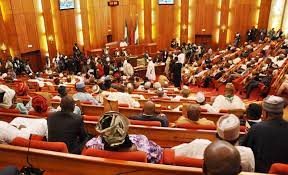
The Senate, yesterday, passed the Proceeds of Crime Bill for second reading.
The Bill titled, “A Bill for an Act to provide for a comprehensive legal and institutional framework for the recovery and management of proceeds of crime or benefits derived from unlawful activities, harmonize and consolidate the legal provisions on the recovery of proceeds of crime and related matters, 2021” was sponsored by Senate Leader, Yahaya Abdullahi (Kebbi North).
Abudullahi in his lead debate noted that the country has been striving to put in place an appropriate Proceeds of Crime legislation since 2007.
He said that efforts to develop a comprehensive bill have been impeded by agency rivalry since 2011.
Abdullahi said, “Effort to sign the Proceeds of Crime Bill into law in 2019 was delayed as a result of complaints by agencies that claimed that the Bill is intended to take away their powers.
“There are many compelling reasons to put in place a comprehensive legislation on recovered assets.
“During the evaluation of Nigeria in 2007 by the International Financial Action Task Force (FATF), they observed in their report that the legal framework for the recovery and management of stolen assets in Nigeria is inadequate and do not comply with international standards.
“At the same time, due to lack of centrally managed database on recovered assets, it is difficult to track and maintain the actual number of the seized assets, their location and their value.
“There have been reported and verifiable instances over the years that showed that some recovered assets were being misused, stolen or lost.
“Further investigations have shown that some of the agencies opened multiple accounts for the payment of forfeited assets without keeping proper records.
“It was against this background that Mr. President constituted the Presidential Audit Committee on Recovery of Assets (PACRA) in 2017.
“Not surprisingly, the committee’s findings re-iterated the need for comprehensive and more innovative approach in the management of recovered assets in a transparent and accountable manner so that these assets would become a source of revenue for the country as is the case in many developing and developed countries of the world.
“Following the submission of the report of PACRA in 2018, the President directed that the following measures amongst other be put in place pending the passing of the Proceeds of Crime Bill into law.”
The measures according to him, include, “The establishment of an Asset Recovery and Management Unit in the Federal Ministry of Justice (ARMU/ FMOJ);
“The opening of a central asset recovery (final forfeiture) account and a central (interim forfeiture) account in the Central Bank of Nigeria. This is to enable the FGN track all recovered assets and the benefits derived from them;
“Use of recovered assets/funds as a source of revenue in the Appropriation Act of 2018 and in subsequent Appropriation Acts.”
He added that the reason the country always have to sign these agreements is to convince other countries that the government is focused on the development of the country with the recovered assets and that it will be accounted for in a transparent manner.
He said: “Proceed of Crime legislation is seen as one of the vital conditions to secure Nigeria’s full membership of the Financial Action Task Force (FATF).
“Nigeria’s application has remained elusive as the agencies argue to retain their powers at the expense of national interest.
“The Bill has, however, taken into account the issues raised by the LEAs in relation to their continuing engagement in civil recovery without compromising the international applicable standards in United Nations Conventions.
“It is a generally accepted that crimes, particularly those in the category of economic and financial crimes are usually committed for profit purposes.
“Asset deprivation attacks criminality through this profit motive. In the same way that starving a thriving small business of capital hampers its growth, removing assets from criminal enterprises, including terrorist organizations, kidnapping organizations and bandits who must necessarily undertake their operations with funding from individuals within or outside the country will certainly hinder and deter their illicit operations.
“A strong asset recovery measure can also disrupt the activities of these criminal organizations and reduce the level of insecurity in the country.”
The Kebbi North lawmaker added that removing unlawful assets also, “Engenders confidence in a fair and effective criminal justice system and shows that nobody is above the law.
“Removes the influence of negative role models from communities; deters people from crime by reducing the anticipated returns.
“Provides a powerful disincentive to commit crime in the first instance; prevents reinvestment in criminal activity; and disrupts organised criminal activity.”
Besides, he urged his colleagues to note that “virtually all of the processes and procedures for recovery of proceeds and instrumentalities of crime are, in accordance with international practices, properly brought under judicial oversight and will no longer be left to the whims and caprices of any agency.
“Also noteworthy are the specific statutory timelines established under the proposed enactment to ensure that the constitutional rights of the citizens are guaranteed in the implementation of the recovery processes and procedures.
“Importantly, the exigency of Nigeria having in place this all important piece of legislation cannot be over-emphasised as Nigeria to date is still deficient in meeting this outstanding obligation under Recommendation 4 on Confiscation and Provisional Measures of the FATF Recommendations adopted by the FATF Plenary in February, 2012 and updated in June 2019.
“This FATF Recommendation requires countries to establish mechanisms that will enable their competent authorities to effectively manage and where necessary, dispose of property that is frozen, or seized or has been confiscated and requiring that the mechanisms to be established should be applicable both in the context of domestic proceedings and requests to and by foreign countries.”
Senators in their contributions supported the Bill and approved that it be read a second time when it was put to voice vote by Senate President, Dr Ahmad Lawan, at plenary.
Lawan thereafter referred the Bill to the Senate Committee on Judiciary, Human Rights and Legal Matters for further legislative work and to report back in two weeks.



The Movement for the Survival of the Izon Ethnic Nationality in the Niger Delta (MOSIEND) has called on the Management of Niger Delta Development Commission NDDC to embark on the water projects in Buguma city in Asari Toru Local Government Area, Rivers state
The Group called on the Rivers state government to revamp the Buguma fish farm to create employment for the teeming youths
On the water project in Buguma, MOSIEND said the population of Buguma has increased tremendously as the residents need more water projects to enhance the daily livelihood of the people
The Group also appealed to the Chairman of the council to assist in making the project a reality and attracts more developmental projects to the city
This call was on Rhythm 93.7 FM Port Harcourt, Radio program, Talk of the Town, by MOSIEND Eastern Zonal Coordinator of MOSIEND Half Hour Comrade Tammy Bruce Longjohn alongside Mark Ojuka,Chairman of Buguma and Hon Sandra Owunari JP Chairman Obuama and monitored by our correspondent
Comrade Ojuka also called on the Management of Liquidifed Natural Gas NLG to embark on a free medical outreach in all Kala bari communities to improve their health status
He appealed to LNG to award scholarship to indigens of Kalabari communities in tertiary institutions to better their education, noting the company is doing same in Bonny, abandoning Kalabari communities
“We need contracts, free medical, scholarships and employment including skill acquisition programs for our teeming youths in Kalabari extractions ”
On Security, Mark Ojuka said security in Buguma is at zero level with the help of the Ama Ma soldiers the city is more peaceful and investors friendly as the youths of area have cordial relationship with the security agencies in the area
“Security is very secured in Buguma clan”
He called on the Rivers state to revamp the Buguma fish farm to create employment for the teeming youths
“The youths are asking for human capacity building in the area to reduce unemployment”
“The revamping of the Buguma fish farm will also reduce youth violence”
Also Speaking, Eastern Zonal Coordinator of MOSIEND Half Hour Comrade Tammy Bruce Longjohn called for more improve in infrastructures in Kalabari community, especially in electricity
There is little improvement in terms of electricity in Buguma city
He decried the deplorable condition
of Buguma Health Centre, saying that the hospital is near functional
“Our sisters that are pregnant and our sick parents can not access the health centre for a better treatment ”
Describing the Health Centre as an eye saw, he called on Rivers state government and Buguma Local Government chairman Hon William to improve on facilities in the centre and make it more medically accessible to the sick persons in the area
Buguma, Tammy Bruce said is the spiritual headquarter of Kalabari people as such deserve more modern facilities from the government to improve lives
The Coordinator called on government, stakeholders and oil companies to assist and improve the poor infrastructural facilities in area
“We need first class hospitals, qualified medical doctors and nurses in the health centres and hospitals”
On the oil spilled in Obuoma Chairman MOSIEND Obuoma, Hon Sandra Owunari said the spill destroyed their crops and Rivers even polluted their only source of drinking water
She expressed displeasure that Rivers state government did not send any relief materials to the people in the affected community
On Chieftaincy title to women in Obuama, Hon Sandra Owunari said the community do not install Chieftaincy title to women, saying that Chieftaincy title is only reserved for men only in the community
CHINEDU WOSU
-

 Politics4 days ago
Why Reno Omokri Should Be Dropped From Ambassadorial List – Arabambi
-

 Politics3 days ago
PDP Vows Legal Action Against Rivers Lawmakers Over Defection
-

 Sports3 days ago
Nigeria, Egypt friendly Hold Dec 16
-

 Sports3 days ago
NSC hails S’Eagles Captain Troost-Ekong
-

 Oil & Energy3 days ago
NCDMB Unveils $100m Equity Investment Scheme, Says Nigerian Content Hits 61% In 2025 ………As Board Plans Technology Challenge, Research and Development Fair In 2026
-

 Politics3 days ago
RIVERS PEOPLE REACT AS 17 PDP STATE LAWMAKERS MOVE TO APC
-

 Politics3 days ago
Withdraw Ambassadorial List, It Lacks Federal Character, Ndume Tells Tinubu
-

 Sports3 days ago
Makinde becomes Nigeria’s youngest Karate black belt