
News
N’Delta Leaders Laud NDDC, Back Forensic Audit

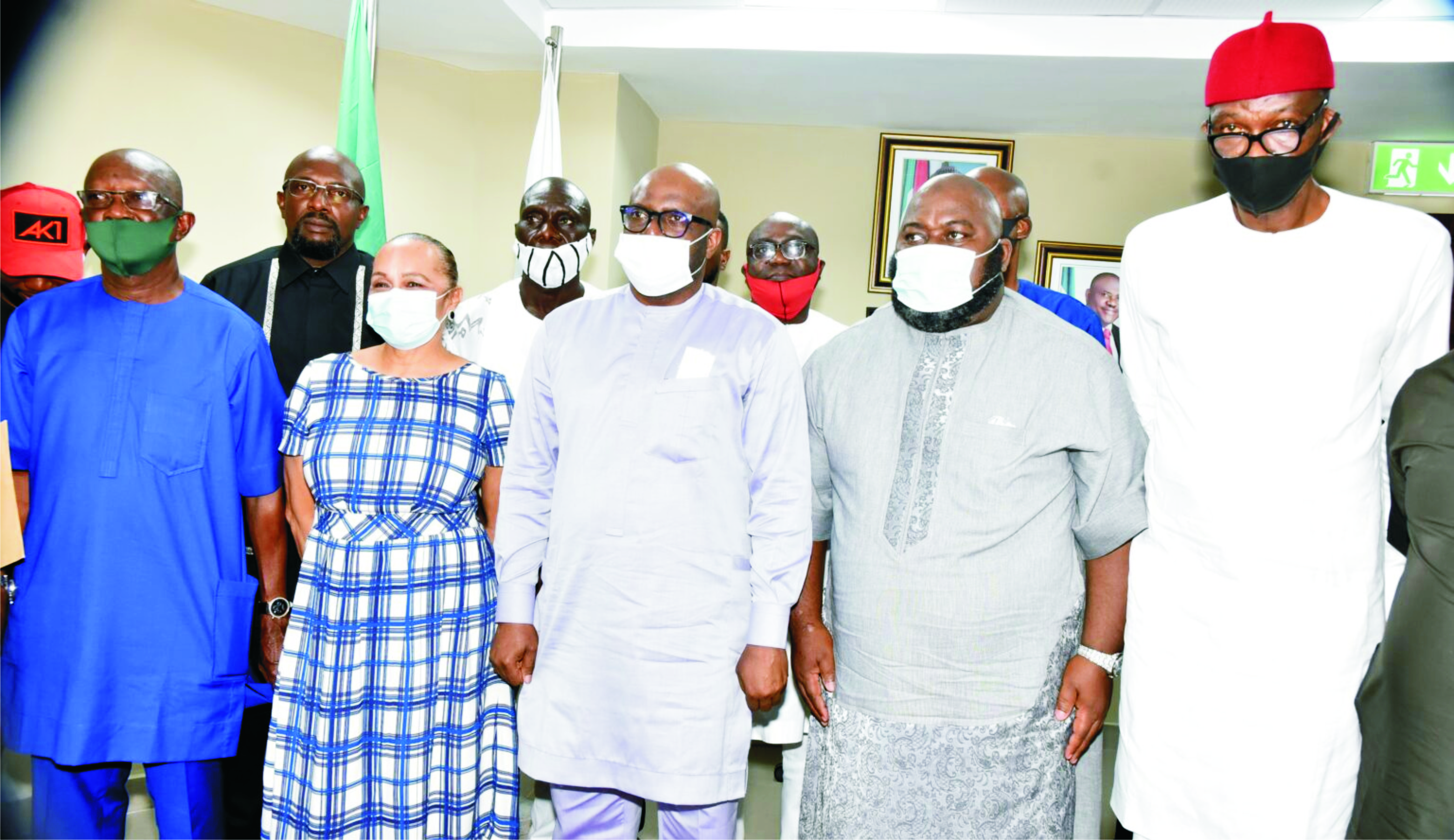
Some prominent Niger Delta leaders and critical stakeholders have thrown their weight behind the Interim Management Committee (IMC) of the Niger Delta Development Commission (NDDC), and declared their support for the on-going forensic audit in the commission.
The cream of advocates from the oil-rich region, led by Chief Timi Kaiser Ogoriba, stated their position during a solidarity visit to the NDDC management at the commission’s new permanent headquarters in Port Harcourt.
The delegation, which included Ms. Ankio Briggs and Alhaji Asari Dokubo, lauded the IMC for taking some notable strides, while urging it to do more because the development of the Niger Delta region was still a far cry from what was envisaged by those whose agitations led to the establishment of the NDDC.
Ogoriba said: “The on-going forensic audit is very necessary because the funds that have passed through the NDDC from inception till date, do not match the development on ground. Given this fact, anyone that is against the forensic audit has a problem, and such a person is an enemy of the Niger Delta people.”
He observed that a lot of the funds that had come into the NDDC were not properly managed, stating: “We want a situation where things are done differently for better results.”
Ogoriba applauded the NDDC for completing its permanent headquarters building, urging the commission to also monitor the proper execution of its projects.
“You need an independent project monitoring committee that will stick to rules and ensure compliance with set standards,” he said.
Responding, the NDDC Acting Managing Director, Prof Kemebradikumo Pondei, said that the IMC was poised to reposition and refocus the commission as directed by President Muhamadu Buhari.
He said: “The NDDC has existed for 20 years, doing things the same way and it has not been able to deliver on its core mandate of fast-tracking development in the Niger Delta region.
“We have tried to make some changes but we met a lot of challenges. We believe that with all hands on deck and leaving the past behind, we are going to surge forward and bring the needed development to our people.”
Pondei expressed sadness that the NDDC, which was set up as an interventionist agency, ended up performing the functions of local and state governments, thus limiting its capacity to intervene where necessary.
He declared: “We want to return the NDDC to its proper role as an interventionist agency.
“That is why we are revisiting the region’s roadmap, the Niger Delta Regional Development Master Plan. The development compass needs review and we will need inputs from all stakeholders to once again underline what the NDDC is supposed to be doing.”
In the area of project monitoring, Pondei said that the commission had since changed its approach.
He explained: “In the recent inspection of just 15 projects by the Executive Director Projects and his team, the commission saved N1.6billion from overstated milestones. They could not match what was on ground with what was presented in Interim Payment Certificates (IPCs). We could have done more of these project inspections but for the distractions coming from our detractors. Nevertheless, we are set to resume the inspection visits.”
The NDDC boss said that the commission had been engaging the governors of the nine Niger Delta states.
According to him, “our plan is to hold regular meetings but this has not been realized because of the challenges of the Covid-19 pandemic. However, we have been able to hold virtual meetings through Zoom.”
Pondei lamented that various agricultural programmes have failed in the Niger Delta region on account of poor funding. Notwithstanding, he said, the commission had started a pilot rice planting project which would be spread across the region subsequently.
He said further: “This project will help in getting our youths to be meaningfully engaged in farming. The Central Bank of Nigeria (CBN), is ready to provide loans for it.
“We also have plans to train our youths to benefit from the Nigeria Liquefied Natural Gas (NLNG) Train 7 project. Barring funding challenges, we want to train the youths in under-water welding.”
Also speaking, the NDDC Executive Director Projects, Dr Cairo Ojougboh, assured that the IMC would do the right things for the benefit of the people of the Niger Delta.
He said that the demonstration of support from leaders of the region was re-assuring, noting that the solidarity visit to NDDC meant that the IMC was on the right path.
In her own remarks, an environmental and human rights activist, Annkio Briggs, bemoaned a situation where the NDDC and the Niger Delta region were now a laughing stock in Nigeria because everybody who wanted to make excuses for the injustice in the region cites the poor performance of the NDDC.
The truth, she said, was that the commission had to deal with a system where its budget must be taken to the National Assembly where the lawmakers were at liberty to pick and choose what they want before approving the budget.



The Chief of Army Staff (COAS), Lt.-Gen. Waidi Shaibu, has tasked troops of Operation SAVANNAH SHIELD to dominate the battlespace and intensify offensive operations against kidnappers, bandits and other criminal elements in the North Central region.
Shaibu gave the directive yesterday during his maiden operational visit to the Headquarters, Joint Task Force North Central (JTF-NC), at Sobi Barracks, Ilorin.
This is contained in a statement by the Acting Director, Army Public Relations, Col. Appolonia Anele, in Abuja, yesterday.
Shaibu said the Nigerian Army would remain resolute in its constitutional responsibility of safeguarding lives and property, stressing that troops must sustain pressure to decisively deny criminal elements freedom of action.
He assured personnel of continued deployment of combat enablers and operational resources to enhance clearance operations and dismantle criminal hideouts across Kwara and Niger states.
The COAS reaffirmed his commitment to troop welfare, noting that improved welfare remained critical to sustaining morale, operational effectiveness and combat readiness.
He urged the troops to remain disciplined, professional and loyal to the Constitution and the democratically elected government.
Earlier, the Theatre Commander, JTF-NC Operation SAVANNAH SHIELD, Maj.-Gen. Yakubu Yahaya, commended the COAS for his strategic leadership and support.
Yahaya assured that troops would remain committed and steadfast in restoring peace and stability in the region.

The Nigerian Navy says it is expanding training and infrastructure to address emerging security threats and strengthen operational efficiency across formations and units nationwide.
The Chief of Naval Staff, Vice Adm. Idi Abbas, spoke during the inauguration of projects at the Nigerian Navy Basic Training School (NNBTS) in Onne, Rivers as part of activities marking the Nigerian Navy’s 70th anniversary.
Abbas, represented by the Flag Officer Commanding, Naval Training Command (NAVTRAC), Rear Adm. Ebiobowei Zipele, said the projects reflected significant progress made by the navy since its establishment in 1956 from the British Royal Navy.
“Training and infrastructure have improved significantly to meet contemporary security challenges and fulfil the navy’s constitutional responsibilities.”
According to him, the anniversary provides the navy an opportunity to reflect on its achievements and contributions over the past seven decades.
Projects inaugurated included a remodelled female trainees’ hostel accommodating more than 500 occupants and an expanded golf course upgraded from one to nine holes.
Others were the NNBTS fuel dump, Chief Boatswain’s Mate House, renovated pharmacy department and a new theatre block at the Naval Medical Centre, Onne.
Abbas described the new theatre as a major milestone for the navy’s medical services.
“Previously, injured personnel requiring surgeries were referred outside the facility.
“With this theatre, surgeries can now be conducted within the base.’’
He added that a 30KVA inverter had also been installed to guarantee uninterrupted electricity supply at the training school.
The naval chief assured officers, ratings and trainees that the navy leadership remained committed to their welfare and wellbeing.
“These infrastructure upgrades show the commitment of the Chief of Naval Staff to addressing operational and welfare challenges promptly,” he said.
In addition, NAVTRAC distributed educational materials to pupils of Community Primary Schools One and Two, Ogale, in Ebubu-Eleme area of Rivers.
Items distributed included exercise books, school bags and other writing materials as part of the navy’s civil-military engagement initiative.
Zipele said the outreach was designed to strengthen relations between the navy and host communities while supporting children’s education.
“Education remains critical to national growth and youth empowerment. Some of these pupils may eventually serve in the Nigerian Navy,” he said.
He noted that the initiative demonstrated the navy’s commitment to educational development, peace, security and sustainable community relations.
Zipele urged the pupils to remain disciplined, focused and committed to their studies while embracing patriotism, integrity and hard work.
He thanked the Ebubu community for its continued support for the naval training command headquarters and the navy.
-
News23 hours ago
Obuah’s Victory Excites Former Lawmaker as APC Primaries Conclude in Rivers West
-

 Politics3 days ago
APC PRIMARIES: FUBARA’S WITHDRAWAL, HISTORIC SACRIFICE FOR NATIONAL STABILITY ……. GROUP
-

 News3 days ago
Court Sentences Seven To Death Over Murder Of Cleric In Rivers
-
News1 day ago
105 Nigerians Killed In S/Africa In Seven Years
-

 Sports3 days ago
PH Arsenal Community Set For Streets Procession, Saturday
-

 Politics3 days ago
IPAC Flays INEC Over Election Guidelines Judgement
-

 Politics3 days ago
NDC To Adopt Electronic Voting For Future Primaries
-

 Politics3 days ago
Ex-IGP Defects To SDP After APC Primary Fiasco