
Opinion
S’Court’s Verdicts On Imo, Bayelsa

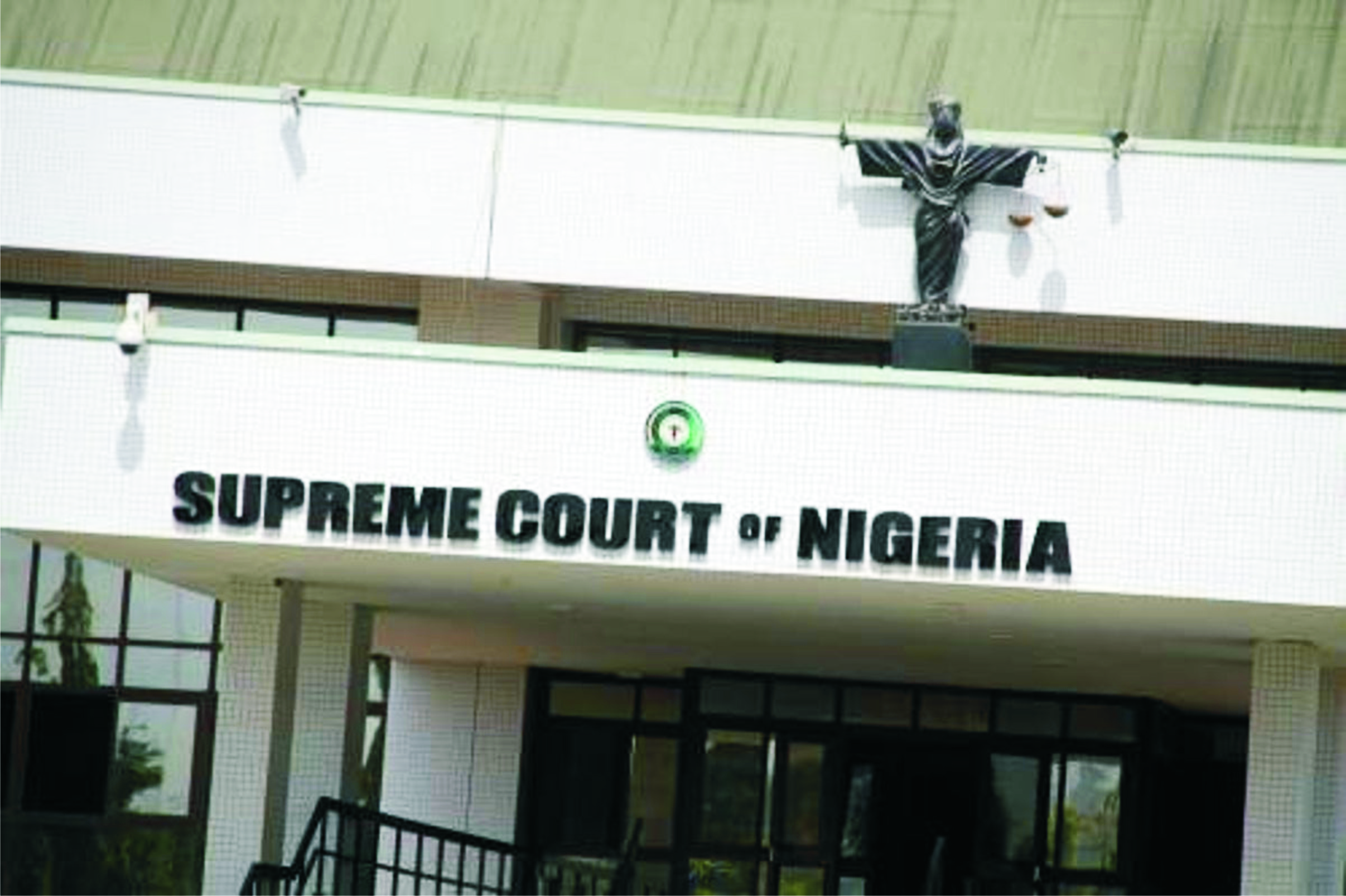
The Supreme Court of Nigeria has since its decision on the Imo State governorship tussle on 14 January, 2020 found itself in the eye of the storm. In the decision, the candidate of the Peoples’ Democratic Party (PDP), Emeka Ihedioha was sacked from office as Imo governor and replaced with candidate of All Progressives Congress (APC), Hope Uzodinma, who scored the fourth position in the polls. Uzodinma challenged the election result on account of some polling units that the Independent National Electoral Commission (INEC) cancelled which he claimed were his strongholds.
These developments triggered pandemonium with scores of protests, criticisms, and finally, a petition to the apex court to revisit the matter. Apart from the declaration of APC candidate that emerged the fourth position as winner, the total votes after adding the excluded polling units which the apex court relied on to declare Uzodinma the rightfully elected governor in the election exceeded the total accredited votes in the election. Cursorily, this is absurd and catastrophic.
As the uproars are unending, and petitions fly sporadically from the PDP camp to any visible entities including the President of the United States of America, the Supreme Court on February 14 again shocked the nation by its decision on the Bayelsa pre-election petition in which it nullified the declaration of the APC candidate, David Lyon, as governor-elect, and ordered his replacement with the next candidate with highest votes and geographical spread.
By the verdict, the PDP candidate, Senator Douye Diri who polled 143,172 votes to emerge second position to APC’s Lyon with 352,552 votes was declared the rightful governor-elect, and sworn in shortly. APC’s votes were consequently categorized as wasted votes. By implication, only a total of 149,999 people representing valid votes determined the destiny of Bayelsans. The greatest blow was that Lyon was rehearsing for his inauguration scheduled the next day when the news broke out.
The second was that the mess resulted from Lyon’s running-mate, Biobarakuma Degi-Eremienyo who presented controversial information to INEC among his requirement for the November 16, 2019 governorship election in the state. In other words, the sacked governor-elect had no case as an individual but merely for sharing a joint ticket, hence, shared liability. His case was akin to that of Moses in the Bible who saw the Promised Land but didn’t eventually enter. Thus, by the sins of his deputy, Lyon’s joy was cut short. This will take a lion’s heart to endure.
However, the two scenarios; Imo and Bayelsa verdicts, require highest degree of sensitivity, otherwise, they may set a wrong precedent. Thus, as the apex court has accepted to revisit the Imo verdict, the same gesture should be extended to Bayelsa as what is good for the goose is also sauce to the gander. Nonetheless, it is insentiently driving the apex court to be reviewing its decisions, meaning that end to litigation may henceforth become a myth. So, caution is germane in the quagmires.
But looking at the respective verdicts, could the apex court eventually reverse its decision in any of the matters? Though, it is rarely done, nevertheless, it isn’t impossible. “Justice must not only be done but seen to be done” as held in R v Sussex, ex parte McCarthy (1924) 1 KB 256, (1923) All ER Rep 233 by Lord Hewart CJ is a guiding principle in legal jurisprudence. But, holistically, the Imo verdict will rarely be reversed unlike the Bayelsa rulings on account of merits.
The first reason is jurisdiction which is key in legal system. As the votes of candidates weren’t among issues in the trial and appellate courts, the Supreme Court lacks jurisdiction to entertain it. As far as accredited and scored votes from the poll are concerned, the apex court was ‘blind and deaf’. The contentions before it were anchored on geographical spread and then, the exclusion of 388 polling units which APC candidate argued were his strongholds. The votes obtained by candidates weren’t in contention. And apart from Uzodinma, other contenders merely challenged PDP on ground of geographical spread for a rerun.
Importantly, by the geographical spread provided in Section 179(1)(2)(b) of the 1999 Constitution, Federal Republic of Nigeria as amended, Ihedioha shouldn’t have been declared the governor in the first place. This is a fundamental error or perceptively, a manipulation by INEC in favour of PDP candidate. Possibly, the target or plot was for Ihedioha to be positioned as incumbent ahead of a likely rerun for incumbency advantages.
On the perceived blunder of declaring APC candidate; fourth position a winner, to start with, it is imperative to note that the candidate of Action Alliance (AA), Uche Nwosu, who emerged the second position was earlier disqualified from the election for dual membership of political parties. On the other hand, the candidate of the All Progressive Grand Alliance (APGA), Ifeanyi Ararume who emerged the third position, only challenged Ihedioha’s victory for not meeting the two-thirds of the 27 LGAs of the state, and sought for a rerun.
Incidentally, by the inclusion of the votes in the hitherto excluded 388 polling units which Uzodinma successfully claimed, his votes automatically outnumbered PDP’s Ihedioha votes with geographical spread. Legal system allows technicalities, and differs from moral justice. Thus, what gave APC’s Uzodinma a win was the hitherto excluded votes, and not the contentions by Ararume who approached the court on geographical spread against Ihedioha’s declaration. And the court cannot metamorphose to electoral umpire if parties deemed it unnecessary to amply present their cases.
From record, APC’s candidate, Uzodinma contended that he won the election had his strongholds not been unjustifiably excluded. Without objection from any quarters and, or justification for the exclusion from the respondent, INEC, his prayers were granted accordingly. That’s the legal system.
It is also noteworthy that election petition is more or less a civil matter, hence determined by preponderance of evidence unlike criminal matters that are strictly by proofs beyond reasonable doubts as a standard. Suffice it to say that the learned Justices convincingly did justice to Imo governorship case, and will be justified and affirmed anywhere rationally.
On the Bayelsa verdict, the line the Justice Mary Peter-Odili-led panel toed may munchup the nation if not thoroughly reconsidered. The decision of the Court of Appeal was profoundly clearer and more logical. For instance, there’s no law that prohibits persons from change of names. Presently, the only requirements are affidavit and publication. That’s the law. The number of times is persuasive but not law. No doubt, it doesn’t reflect decency to have numerous affidavits for change of names.
Umegboro, a public affairs analyst, wrote from Abuja.
Carl Umegboro



-

 Editorial22 hours ago
Domesticate FG’s Exit Benefit Scheme
-

 News22 hours ago
DHQ Confirms Deaths Of Terrorists, Soldiers In Borno Attack
-

 News18 hours ago
RSU Unveils Five-Year Strategic Dev Plan …Calls For Collective Commitment To Institutional Excellence
-

 News20 hours ago
Tinubu Commissions Bayelsa Gas Turbine, Other Projects Today
-
Rivers21 hours ago
Dep Gov Seeks Collaboration, Transparency Between RIVCHPP, PHCMB
-
Nation19 hours ago
Rumuji Youth Leader Condemns Protest, Disowns Alleged Government Empowerment Claim
-
 Featured21 hours ago
FG Reaffirms Nigeria’s Stability As US Embassy Suspends Visa Appointments In Abuja Office
-
Sports23 hours ago
Full Draw For 2026 U-17 AFCON