
News
How APC, Lyon Lost S’Court Review Appeal …Lawyers Fined N60m For Frivolous Applications

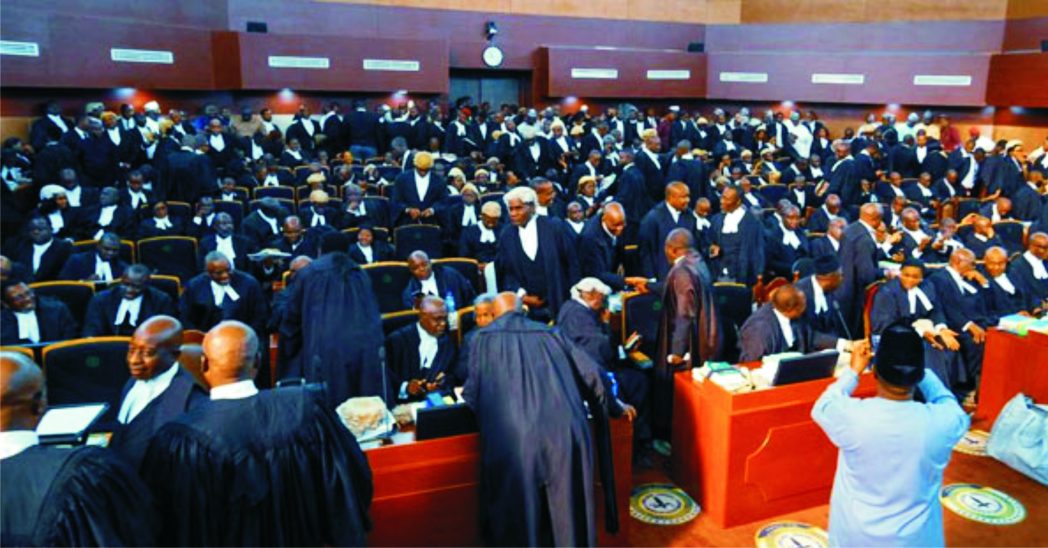
The sacked governor-elect, David Lyon and the All Progressives Congress (APC) have lost their bids to overturn the Supreme Court ruling of February 13, which sacked Lyon as the duly elected governor of Bayelsa State.
In a ruling, yesterday, the Supreme Court dismissed the applications for review of the judgment, which rendered Lyon’s election invalid because of what the five-man panel of justices attributed to the alleged certificate forgery committed by Lyon’s running mate, Senator Biobarakuma Degi-Eremienyo.
According to Justice Amina Augie, who read the judgment, the applications lacked merit, adding that the decisions of the court are final, position that may well foreshadow the outcome of other reviews pending before the apex court.
“There must be an end to litigation. Even if we review this judgment, every disaffected litigant will bring similar applications, and the finality of Supreme Court judgments will be lost,” Augie said.
She added that the applicants failed to point out errors in the February 13 judgment.
Augie then pronounced that the judgment is final for all ages and that no court on earth can review the judgment.
She added that the applications are frivolous and vexatious.
The Supreme Court panel that heard the review arguments was composed of seven justices, headed by Justice Sylvester Ngwuta.
The panel gave its judgement after listening to the submissions by lawyers.
The Supreme Court also fined Chief Afe Babalola (SAN) and Chief Wole Olanipekun (SAN) N30million each for agreeing to file an application for the review of the apex court’s judgment on Bayelsa election.
Justice Amina Augie announced the fine while reading the judgment in the applications for a review of its February 13, 2020 judgment which overturned the All Progressives Congress’ victory in the last governorship election in Bayelsa State.
With tears in her eyes, the justice regretted that “very senior” lawyers were responsible for filing the applications.
Subsequently, the apex court awarded the costs of N10million to be personally paid by David Lyon’s lawyer, Chief Afe Babalola (SAN), and APC’s lawyer, Olanipekun (SAN).
It ruled that each of the lawyers must pay the N10million to each of the three respondents – the Peoples Democratic Party, Governor Duoye Diri, and the Deputy Governor of Bayelsa State, Lawrence Ewhruojakpo, bringing the total amount to be paid to N60million.
She said the applications amounted to an invitation for the apex court to sit in appeal on its own judgment in violation of the Constitution.
A seven-man panel of the apex court led by Justice Sylvester Ngwuta, described the applications filed by the APC and its governorship candidate at the poll, Lyon, as vexatious, frivolous, and constituted a gross abuse of court process.
Justice Augie held that it would amount to violating the finality of its judgment if the applications were granted.
She said granting the applications would open a floodgate for the review of decisions of the Supreme Court.
“There must be an end to litigation,” she said, adding, “the decision of the Supreme Court is final for ages in a matter” and only legislation could change it.
Legal luminary, Afe Babalola, who represented Lyon and his deputy governor-elect, Senator Biobarakuma Degi-Eremienyo, argued that the apex court has the power to set aside its earlier judgment.
The senior advocate of Nigeria insisted that the application was not for a review of the judgment but to set aside the judgment sacking Lyon who overwhelmingly won the election.
Babalola added that the judgment of the court delivered on February 13, amounts to a denial of fair hearing, and urged the court to reverse its decision.
Another senior advocate, Chief Wole Olanipekun, who represented the APC, asked the apex court to set aside its judgment on the ground that the court had no jurisdiction to have entertained the appeal in the first place.
He explained that the suit was first filed at the Federal High Court as a pre-election matter, which is the foundation of the matter that made the appeal get to the apex court.
Olanipekun, therefore, restated his argument that the apex court lacks the jurisdiction to entertain the matter.
He added that all humans are fallible, so, it is not beyond the apex court to make a mistake.
Olanipekun also faulted the interpretation of the judgment of the court by INEC which issued a certificate of return to Senator Douye Diri of the PDP, urging the court to grant the application to set aside its earlier judgment.
Counsel to the PDP, Tayo Oyetibo, also a SAN, argued that the application by David Lyon was an invitation to violate the nation’s Constitution.
He added that it was also an invitation to the court to ‘sit in judgment’ over its earlier decision which must not be allowed while urging the court to summarily dismiss the application.
Oyetibo argued that all areas were well considered before the apex court arrived at its decision on February 13, insisting that the court cannot change the operative part of any judgment delivered by the apex court which was the final court in the land.
Citing Section 22 of the Supreme Court Act, Oyetibo said, “the court has wide powers to make any order, including the order asking INEC to withdraw the certificate issued to David Lyon. The order made by the court was not out of order.”
He explained that the facts and justice of the case warranted the decision of the court, and there was no error in it whatsoever.
He added that if any error is felt, it can only be addressed in a future case.
Oyetibo insisted that the grant of this application will engender judicial stability as people will now wait for a possible review before acting on any judgment of the apex court.
He urged the court to dismiss the application and not to disturb the status quo.
Yunus Ustaz Usman, who represented Governor Douye Diri, aligned himself with the submissions of Oyetibo, insisting that the court cannot make any order outside the judgment, especially after a full-blown trial.
He reaffirmed the finality of the court as the highest of the land, urging the court to dismiss the application in the interest of the overall survival of the country.
Counsel to Bayelsa State Deputy Governor, Senator Lawrence Ewhrudjakpo, Chris Uche, vehemently opposed the application for a review of the judgment of the apex court, and urged the court to dismiss the applications filed by Lyon and the APC for totally lacking in merit.
Uche argued that the Supreme Court lacks the power to sit on appeal over any judgment delivered by the same court.
He added that it was a case of outright abuse of court process, stating that the court must ‘jealously’ guard its judgments, otherwise; there will be a floodgate of applications for review which will lead to a bastardization of the judicial process.
He urged the court to resist the dangerous invitation to violate the nation’s Constitution.
Present to witness the proceeding was the National Chairman of the APC, Comrade Adams Oshiomhole.
It would be recalled that the Supreme Court had earlier struck out the appeal filed by the All Progressives Congress (APC) for the review of the Bayelsa Governorship election.
The court, in its ruling, said the appeal lacked merit, and as a result, struck out.
Lyon and APC, in their applications argued by Chief Afe Babalola SAN and Chief Wole Olanipekun SAN, respectively, had prayed the court to review and set aside the judgment of February 13, which voided their participation in the November 16, governorship election.
But after taking legal fireworks from parties in the matter, Justice Sylvester Ngwuta, had announced the stand down of the matter, adding that the panel would reconvene soon for its decision in the matter.
Babalola had in his submissions said that the Supreme Court has inherent decision and power to set aside its own decision because the judgment which voided the election of his client was a nullity on account of denial of fair hearing of his client.
According to him, the procedure adopted by the apex court on February 13 was wrong because there was no cause of action at the time the Supreme Court gave judgment against Lyon.
On his part, Olanipekun argued that the apex court erred in law when it invoked Section 36 of the Electoral Act to disqualify the APC’s participation in the election when the Federal High Court judgment restored by the Supreme Court did not disqualify the party’s eligibility.
He further argued that the Supreme Court cannot give consequential order on a relief not granted by a trial court except due to human error.
However, counsel to the Peoples Democratic Party (PDP), Mr Tayo Oyetibo SAN, informed the apex court that the application by APC and its governorship candidate were dangerous invitation to the Supreme Court to violate Section 285 of the 1999 Constitution, for the court to sit on appeal over its own matter.
Oyetibo argued that having delivered final judgment in the matter on merit on February 13, the court has no jurisdiction to sit on appeal in the judgment, adding that it is scandalous to ask the apex court to review the judgment.
He further stated that the apex court was right in disqualifying Lyon as the governor-elect because section 187 of the 1999 Constitution is clear and unambiguous to the effect that a governorship candidate who has no deputy candidate is not qualified to contest any governorship election in Nigeria.
“When Supreme Court gives judgment, it is deemed correct. It has never happened in the history of Supreme Court to reverse itself; its judgment is final and finality. And whatever Supreme Court says in the interpretation of the law is the law”.
His submissions were adopted by other respondents in the matter.
Reacting, the Peoples Democratic Party (PDP), yesterday, raised the alarm accusing the ruling All Progressives Congress (APC) of currently mounting pressure on the Supreme Court to restrain itself from reversing the flawed judgment on the Imo State Governorship election.
It also alleged that this clandestine move came despite obvious mistakes in the controversial judgement, which is allegedly threatening the stability of the nation.
The party, however, hailed yesterday’s verdict of the Supreme Court on Bayelsa State governorship election but noted that the grounds for the demands by the PDP and majority of Nigerians for the reversal of Imo State governorship election judgment are completely different from those of Bayelsa.
The PDP spokesman, Kola Ologbondiyan, said this in a statement made available to newsmen in Abuja, yesterday.
Further, the party explained that its demand on Imo was not in any way in contestation of the authority and finality of the Supreme Court.
It affirmed that the PDP’s position was only a patriotic effort to assist the Supreme Court to affirm its infallibility by correcting the inherent mistakes in the judgment which came as a result of misleading presentation to it by the APC.
Part of the statement reads, “It is, therefore, instructive to note that the various election matters before the Supreme Court were brought on clearly distinctive grounds and each should be treated on its merit before the law.
“The party said the only reason APC was pushing for a review of the Supreme Court’s valid and flawless judgment on the Bayelsa and Zamfara governorship elections was to cause confusion and blackmail the Supreme Court from treating the Imo case on merit.
“The PDP maintained that the grounds for the reversal of Imo judgment are unambiguously constitutional and completely distinct from APC’s attempt to blackmail the Supreme Court with their demands on the Bayelsa and Zamfara states governorship election.
“The party, therefore, urged the Supreme Court not to succumb to the threats and blackmail by APC to push it restrain itself from looking at the merit of the Imo case; correcting the mistakes and reversing the flawed judgment.”
Also reacting, the Bayelsa Governor, Senator Douye Diri, has said the Supreme Court’s ruling was only affirmation of God’s judgement on the state.
Diri, in a statement by his Acting Chief Press Secretary, Daniel Alabrah, also said that there was no victor no vanquished as the victory was for all Bayelsans regardless of party affiliation.
He commended the courage and sagacity of the apex court justices in affirming their earlier judgement of February 13, 2020.
He said: “Once again, I describe myself as a miracle governor. So, the Supreme Court just affirmed the judgement of the Almighty God, who made it possible for me to become the governor of Bayelsa State.
“For me, there is no victor no vanquished as the victory is for all Bayelsans. It is not a winner takes all.
“My message is that of reconciliation as I will run an all-inclusive government. Let everyone that is aggrieved sheathe their swords. Let us think about Bayelsa first and ourselves last. By this judgement, it is clear the final hurdle has been cleared.”
Diri said his government would bring in people that had the wherewithal to contribute to development of the state and not those who would run it down.
He urged Bayelsans whose stock in trade was to pull others down to change their ways and think about building the state.
But the All Progressives Congress (APC), yesterday, kept mum over the reaffirmation of Senator Duoye Diri as the elected governor of Bayelsa State by the Supreme Court.
The National Chairman, Comrade Adams Oshiomhole, who had earlier called for a press conference in his office at the party’s national Secretariat later called it off.
No reason was given for the call off.
The All Progressives Congress had earlier applied for a review of the February 13 judgement of the Supreme Court that disqualified its governorship candidate, Mr. David Lyon.


The Rivers State Government has commended the Church of Nigeria (Anglican Communion) for its outstanding contributions to the development of Rivers State, particularly in the areas of peacebuilding, education, healthcare, and moral development.
Governor of Rivers State, Siminalayi Fubara, stated that the Church has remained a dependable partner in promoting peace, unity, justice, moral discipline, and social harmony across society.
The Governor, who was represented by the Secretary to the State Government, Dr. Dagogo Wokoma, made the remarks during the thanksgiving service marking the 30th Anniversary and First Session of the 11th Synod of the Diocese of Niger Delta North, held at St. Peter’s Anglican Church on Sunday.
Governor Fubara described the Synod’s theme, “Kingdom Advancement: The Priority of Every Believer,” as timely and relevant, considering the prevailing realities in society.
According to him, the Church continues to play a vital role in shaping societal values and inspiring hope among citizens.
“The Church remains a vital partner in promoting peace, unity, justice, and moral discipline. Its role in shaping values and inspiring hope cannot be overemphasized,” he stated.
The Governor further acknowledged the Anglican Communion’s contributions in education, healthcare delivery, youth empowerment, humanitarian services, and spiritual guidance across communities in Rivers State.
“The Rivers State Government appreciates the invaluable contributions of the Anglican Communion in education, healthcare, youth development, humanitarian support, and spiritual guidance. Your impact across communities in Rivers State continues to strengthen families and promote peaceful coexistence among our people,” he added.
Governor Fubara reaffirmed his administration’s commitment to building a peaceful, united, and prosperous Rivers State where all citizens can thrive irrespective of religion, ethnicity, or social background.
He also urged the Synod to continue praying for sustainable development and progress in Rivers State and Nigeria at large.
Earlier in his sermon, the Guest Minister, Joseph Olushola, spoke on the topic, “Kingdom Investment and Internal Rewards,” urging Christians to remain faithful stewards of God’s blessings and committed to advancing God’s kingdom through service and generosity.
The cleric emphasized that believers are custodians of the virtues and resources entrusted to them by God, stressing that divine rewards are based on faithfulness and impact rather than material possessions.
The Shell Nigeria Gas Limited, in partnership with the Manufacturers Association of Nigeria (MAN), has reaffirmed support for efforts to expand gas distribution infrastructure in Rivers State as part of initiatives aimed at improving access to affordable, cleaner and more reliable energy for industries across the South-South region.
The commitment was highlighted during the SNG–MAN Business Forum held in Port Harcourt, where stakeholders from the industrial and public sectors examined the role of natural gas in driving industrialisation, boosting local production and strengthening energy security.
Speaking at the forum on behalf of the Managing Director of Shell Nigeria Gas Limited, the company’s Head of Gas Distribution, Mr. Chukwuka Amos Ejesi, described natural gas as a critical component of Nigeria’s energy mix and a key driver of sustainable industrial growth.
According to him, Nigeria’s gas development agenda has reached a stage where policy direction must be matched with practical implementation capable of addressing the energy challenges confronting manufacturers.
He noted that pipeline gas offers industries a cleaner, more dependable and cost-effective energy alternative capable of supporting uninterrupted operations, reducing emissions and improving production efficiency.
“Gas is the backbone of manufacturing, and we are encouraged by the growing recognition among stakeholders of the need for cleaner and more reliable energy solutions,” he said.
Ejesi stressed the need for sustained collaboration among energy providers, government institutions and industrial stakeholders to maximise the country’s gas resources for economic development.
He added that improved gas infrastructure would strengthen manufacturing value chains, enhance productivity and promote more competitive industrial operations across Rivers State and the wider South-South region.
Participants at the forum also emphasised the importance of expanding energy infrastructure as a pathway to unlocking industrial capacity, reducing operating costs and promoting sustainable industrial development.
Representing Governor Siminalayi Fubara, the Director-General of the Rivers State Investment Promotion Agency, Dr. Chamberlain Peterside, reaffirmed the state government’s commitment to partnering with private sector investors to revitalise industrial activities in the state.
He identified key projects targeted under the initiative to include the revival of the Ahoada Industrial Park, the New Port City project and the proposed Bonny Industrial Park, all aimed at stimulating economic growth and expanding industrial opportunities along the Bonny corridor.
According to the governor, the long-term vision is to position Rivers State as a leading manufacturing hub in Southern Nigeria through strategic public-private partnerships.
Governor Fubara also commended Shell Nigeria Gas and MAN for sustaining engagements geared towards improving industrial energy access, noting that gas infrastructure development remains central to the state’s economic recovery plans.
He further observed that the gas sector presents enormous opportunities for economic growth, especially as global energy systems continue to shift towards cleaner energy sources.
The governor called on stakeholders to work collectively towards developing a practical and sustainable gas framework capable of supporting the state’s industrial and energy development objectives.
By; Kevin Nengia
Rivers State Deputy Governor, Prof. Ngozi Nma Odu, has charged newlywed couples to build their marriages on the virtues of love and submission as taught in the Word of God.
Prof. Odu gave the charge at the wedding ceremony of Amblessed Favour Sunny-Cookey and Samson Jesuganji at Lifegate Power Ministries, Dominion Cathedral, in Port Harcourt on Saturday, 16th May 2026.
The Deputy Governor congratulated the couple on beginning a new phase of life together and prayed for God’s blessings upon their union, noting that the couple had been raised by godly parents and encouraged them to uphold the Christian values instilled in them.
Referring to the sermon delivered during the ceremony, Prof. Odu emphasized that the principles of love and submission remain fundamental to a successful marriage.
According to her, genuine love reflects the nature of God, stressing that love should remain the foundation of the couple’s relationship as they journey through life together.
Prof. Odu further prayed for enduring peace, happiness, and progress in the home, expressing confidence that the marriage would continue to flourish under God’s guidance.
The Deputy Governor also commended the families of the couple for their support and upbringing, while urging the newlyweds to always remember the significance of the day and the commitment they had made before God and witnesses.
In his sermon at the wedding, the Founder and Presiding Pastor of Salvation Ministries, Pastor David Ibiyeomie, stated that marriage did not originate from Western culture, traditions, or human ideas, but from God, whom he described as the “manufacturer” of marriage.
According to the cleric, couples seeking lasting and peaceful homes must rely on biblical principles rather than societal trends or assumptions.
He explained that many marital crises and rising divorce rates stem from ignorance and failure to apply scriptural teachings in family life.
Drawing from the biblical parable of building a house on a rock, Pastor Ibiyeomie said the Word of God remains the only solid foundation capable of sustaining marriages through challenges and difficult times.
He noted that marriage naturally comes with unexpected realities and pressures, stressing that religious ceremonies or cultural practices alone are not enough to sustain a home without proper understanding of God’s instructions.
The pastor further warned that ignorance of scripture remains one of the greatest weapons against believers, urging Christians to study and practice the Word of God rather than merely attending church services.
It would be recalled that the bride is the daughter of Pastor Sunny Cookey the Founder and Presiding Pastor of Lifegate Ministries. The Ceremony had lots of Ministers in attendance which includes Apostle Zilly Aggrey, Pastor George Izunwa, and Bishop Winston Iwo
-

 Editorial3 days ago
Enough Of Xenophobic Attacks On Nigerians
-

 Nation3 days ago
RSU, Otonti Nduka Foundation Holds Centenary Conference, Unveil Book on Values in Nigeria
-

 Oil & Energy3 days ago
Rivers PETROAN Elects 12-Member Executive
-

 Sports3 days ago
Oparaodu Urges Rivers United To Win Katsina United
-
Politics3 days ago
APC Group Protests Ex–Presidential Aspirant’s Disqualification From Rivers Senatorial Race
-

 Sports3 days ago
” Nigeria’s best domestic players are not in NPFL”
-
Politics3 days ago
Reps Speaker Secures APC Return Ticket For Fifth Term
-
Politics3 days ago
Primaries: Diri Lauds APC’s Unity, Cohesion In Bayelsa