
Politics
Internal Democracy, Panacea For Peace In Rivers APC – Abe


The Senator representing Rivers South-East Senatorial District in the National Assembly, Magnus Abe, has said that respect for internal democracy remains the panacea to ending the crisis in the Rivers State chapter of the All Progressives Congress (APC).
Abe stated this when he appeared on a live radio programme in Port Harcourt monitored by the Tide in Port Harcourt, the state capital.
This is as Abe said he will continue to champion the cause for the enthronement of internal democracy within the ranks of the ruling APC and pledged his loyalty to the party.
He further said that he like others left the People’s Democratic Party (PDP) because of impunity and high-handedness inherent there and would not allow the same character to permeate the APC.
According to him, “You know this was the same struggle that took us out of the PDP, it was the same struggle for internal democracy, for the respect of human rights. Respect for the citizens, respect for constitution, respect for due process rather than impunity.
“That’s what made us to live the PDP and that’s why we’re in APC. So if we made all that effort, all that sacrifice and then we get this far and we abandon this struggle, what was it about?
“So I believe that, it is not only justified, it is necessary today, it will be necessary tomorrow and as long as there are human societies the fight to make the world better and make it function better for everybody will continue, nonstop.
“If a party is to win, everybody in the party needs to be part of that victory and when you don’t follow a process that accommodates everybody, then that’s not a victory for everybody, because a victory for one person or a victory for few people; that’s not a victory for the party.
“The victory for the party is when all members of the party are enthusiastically included in what the party is doing. When all members of the party feel a sense of victory when the party wins; if you initiate a process in the party that exclude party members and then you claim victory at the end of the day; how are they going to be excited by that victory? How are they included in it? How are they allowed to contribute to it?
“That’s what the struggle is about. It’s about all of us, is about you, is about Rivers State, is about Nigeria. How do we make this country better? How do we make it more inclusive? We do that simply by following the rules.
“You know, when we talk of the supremacy of the party, we’re not talking about the supremacy of any individual in the party. Is not the supremacy of the party chairman; it’s not the supremacy of the party leader. It’s supremacy of the party constitution; is the supremacy of the understanding that brought everybody together, because people left their houses and are making sacrifices in pursuit of a dream.
“So you don’t kill their own dreams and then say that the party has won. How will the party win without People?”
“I have a career in politics and I still have it. The Senate is not a career. I have a very promising career in politics. Politics is about people. And I’m surrounded by people. I have the support of my people. So I still have my career. You know, whatever you see is based on things that happen.
“You have to have the resilience. You have to have the commitment. You have to have faith in what you are doing. And what I’m doing is not about me. If it was about me, what am I looking for?
“You know, it’s about the dream that we can build a better Nigeria. It’s about the vision that Rivers State can be better than it is. We can do better. So when people keep personalizing something, oh, you are losing your seat. Oh, you’re not going to the Senate. I’m not the only person who didn’t go to the Senate. I didn’t even want to go to the Senate. I wanted to be governor of Rivers State.”
Dennis Naku



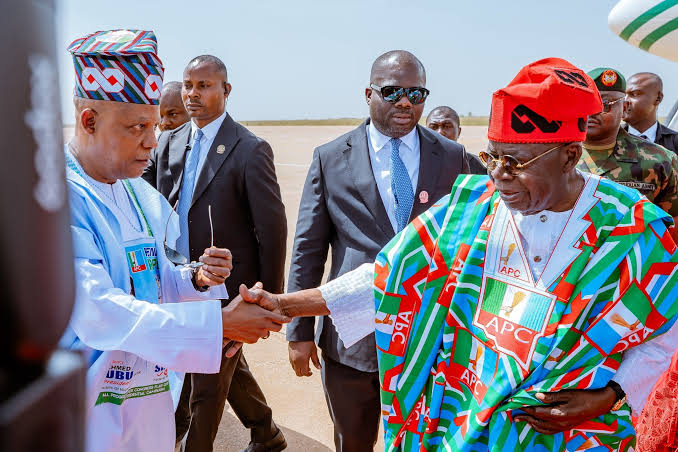
The campaign rally, held at the Kaduna Township Stadium, attracted Vice-President Kashim Shettima, APC governors, party leaders, federal and state lawmakers, political stakeholders and supporters from across the country.
The flag-off marks the beginning of the APC’s drive to secure a second presidential term for President Tinubu, with the party expected to promote its achievements, defend its economic reforms and outline its policy priorities under the proposed Renewed Hope 2.0 agenda.
Kaduna’s selection for the campaign launch underscores the strategic importance of the North-West, a region with a substantial voting population and considerable influence on presidential election outcomes.
The APC faces a significant challenge in Kaduna, where the Peoples Democratic Party’s presidential candidate, Alhaji Atiku Abubakar, defeated President Tinubu in the 2023 election. The rally therefore provides the ruling party an opportunity to strengthen its grassroots structures and regain electoral support in the state.
Addressing supporters, Vice-President Shettima appealed to Northern voters, highlighting President Tinubu’s political relationships with prominent Northern leaders, including Alhaji Abubakar, Mallam Nuhu Ribadu and the late President Muhammadu Buhari.
The Vice-President’s appeal reflects the APC’s determination to consolidate its support in the North as the party intensifies preparations for the presidential contest.
The Renewed Hope 2.0 agenda is expected to feature prominently in the campaign, providing a platform for President Tinubu to explain his administration’s economic policies and outline plans for another term.
However, the President’s record on economic reforms, rising living costs, petrol prices, employment, infrastructure and insecurity is expected to attract considerable scrutiny during the electioneering period.

-

 Education2 days ago
FCE Yola Graduates 3,555 Teachers , Seeks Upgrade to University
-

 Sports2 days ago
Nigerian Trio Target Titles At PFL Africa Finals
-

 Niger Delta2 days ago
Diri Restates Stance On Lagos-Calabar Coastal Highway
-

 Niger Delta2 days ago
C’River, NUJ Pay Tribute To Late Guardian Editor
-

 News2 days ago
NDLEA Recovers Tons Of Illicit Drug Consignments In Nine States
-

 Opinion2 days ago
Checking Voter Apathy In Nigeria’s Electoral Process
-

 Politics2 days ago
2027: DICKSON’S EX-ALLY VOWS TO WORK AGAINST NDC INTEREST IN BAYELSA
-

 Politics2 days ago
2027: GROUP PLEDGES 40,000 SUPPORTERS FOR COALITION CANDIDATES IN RIVERS