
News
Buhari, Wike Seek Monarchs’ Role In Nation Building …As RSG Says Health Sector Repositioning, On Course

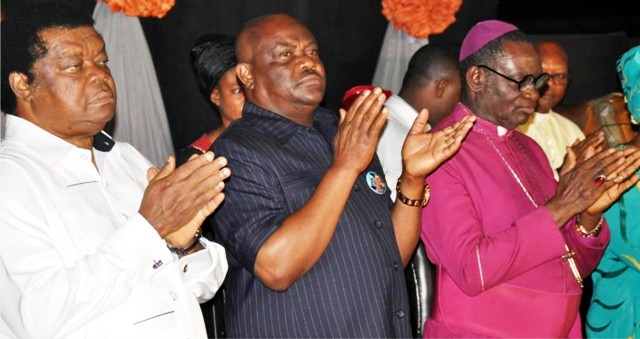
The Rivers State Governor, Chief Nyesom Wike has reiterated his call for the decentralisation and depoliticisation of security services as a way of resolving the deadly security challenges facing the country.
Wike noted that that the security services as presently constituted, cannot address the security challenges facing the country, where lives are wasted regularly, while governors are helpless.
Speaking during the 9th General Assembly of the National Council of Traditional Rulers of Nigeria, yesterday, in Port Harcourt, Wike said that the Rivers State Government has taken steps to improve the security of the state through the setting up of a neighbourhood watch.
He said: “For us in Rivers State, our position on state and community policing is very clear. While we join our voices with other well-meaning Nigerians to strongly and emphatically demand for the decentralization and depoliticisation of security services, we are also not resting on the back of helplessness to do nothing.
“Already, we have forwarded a bill to the state House of Assembly to establish the Neighbourhood Security Corps to cooperate, support and complement the efforts of the regular security agencies in policing our communities and advancing their security.”
The governor noted that: “The reality before the nation is that centralised policing has flatly failed and is incapable of resolving the enormous security challenges of a vast and culturally diverse country like Nigeria.
“And even as we may continue to live in denial, the recurring bloodbaths in Benue, Taraba and other states have once again exposed the weaknesses of our country’s centralised policing system as well as the frustrations and near complete helplessness of state governors in their quest to provide adequate security for the communities and the people that they govern.
“We can only imagine the magnitude of the sufferings and pains ordinary Nigerians are going through when the daily pains of violence and insecurity are added to the unending pressure of poverty, unemployment and lack of development,” the governor said.
Wike said that at a time like this, it will be ungodly for good men to remain silent while the nation is dangerously wobbling, and urged all well-meaning persons to be counted among those who will work for the resolution of the security challenges facing the country.
He said that Rivers State was peaceful, working and brimming with ample economic opportunities for investors to take advantage of.
The governor said the traditional institution must wake up to their responsibilities by lending their strong and respected voices to the national agitations for true federalism, resource control, greater devolution of powers, as well as state and community policing and good governance in the country.
Wike said: “In all these, our traditional rulers have significant roles to play to protect and defend the nation’s unity and advance the rights of our people to democracy, good governance and development.”
Declaring the 9th General Assembly of the National Council of Traditional Rulers of Nigeria open, President Muhammadu Buhari stated that his administration will take steps to promote security of lives and property.
He noted that security challenges seem to be deliberate and an attempt to undermine the nation’s territorial integrity.
Represented by the Minister of Interior, Lt-Gen Abdulrahman Danbazzau , the President said that he was saddened by the wastage of human lives in different parts of the country.
He directed security agencies to identify and bring to book all those involved in deadly crimes.
In a keynote address, Inspector General of Police, Ibrahim Idris said that the police alone cannot tackle insecurity without the support of traditional rulers and their subjects.
In a paper titled: “Community Policing as a Catalyst to Crime Prevention: The Role of Traditional Rulers “, the Inspector General of Police said that community policing involves the engagement of the community in tackling security challenges.
In his address, Chairman of the National Council of Traditional Rulers of Nigeria and Sultan of Sokoto, Alhaji Sa’ad Abubakar requested governments at all levels to work towards enhancing security.
He urged the traditional rulers to take the camaraderie that exist in the forum to their respective communities for national peace.
Chairman of the Rivers State Council of Traditional Rulers, King Dandeson Douglas Jaja said Nigerians must rise above partisan consideration in the quest for peace.
The Co-Chairman of the National Council of Traditional Rulers of Nigeria and Ooni of Ife, Oba Adeyeye Enitan Ogunwusi urged Nigerians to keep politics aside, engage in peer review on ways to develop the country.
Meanwhile, the Deputy Governor of Rivers State, Dr Ipalibo Harry Banigo has described the state Chief Executive, Chief Nyesom Wike as an astute and sagacious statesman whose commitment to the unity and progress of Nigeria is unequivocal.
Banigo made this known in a statement in Government House, Port Harcourt, in reaction to the governor’s hosting of the 9th General Assembly of the National Council of Traditional Rulers of Nigeria.
The deputy governor said “Governor Wike has continued to demonstrate an extra ordinary prowess in his inter personal human relationship with people from diverse socio cultural, political, religious and economic divide in the country which has made him one of the greatest exponents of a unified Nigeria”.
Meanwhile, the Rivers State Governor, Chief Nyesom Wike has stated that the process for the re-positioning of all levels of the health sector was effectively on course, with the acquisition of state-of-the-art equipment for the Braithwaite Memorial Specialist Hospital (BMSH).
Wike also declared that the total rehabilitation of structures at the BMSH will create the right environment for quality tertiary healthcare delivery.
In an interview after an inspection visit to the hospital in Port Harcourt, last Monday, Wike said that the health sector will continue to recover priority attention from his administration.
The governor, who was accompanied on the project inspection by the National Chairman of PDP, Prince Uche Secondus, said that majority of the equipment procured by the state government for the hospital have arrived.
Wike said: “Our objective is to improve the standard of the Braithwaite Memorial Specialist Hospital as a centre of excellence in tertiary healthcare delivery.
“In terms of equipment, the contractors have done well. Eighty per cent of the equipment have arrived the hospital premises and they will be installed as soon as the rehabilitation”.
He, however, noted that the progress of work on the structural rehabilitation is slow; hence the contractors should expedite action.
“We believe the contractors should deploy more workforce for the rehabilitation of the hospital. The state government is doing what is necessary to enhance the quality of the Braithwaite Memorial Specialist Hospital”, he said.
The governor also inspected the ongoing reconstruction of the Doctors’ Quarters at the Braithwaite Memorial Specialist Hospital, and advised the contractors to improve on the pace of work.
He assured that funding of the projects will be sustained early completion.
The governor was briefed during the project inspection by the Medical Director of Braithwaite Memorial Specialist Hospital, Dr Paul Kua, and Director of Nursing, Mrs. Ajumoke Okpu.
It would be recalled that the Wike administration has completed the reconstruction and equipping of 13 general hospitals spread across the three senatorial districts of the state.



The Rumuokania 2 New layout Landlords Association in the Obio/Akpor local government area of Rivers State is seeking the intervention of the Rivers State Government in the desilting of the canal which transverses several communities including Mgbaraja,Ogbogoro,Egbule,Elioparanwo,Ozuoba and other communities in the area.
The Association which said this at a media briefing in Port Harcourt also lauded Governor Siminalayi Fubara for the construction of the Rumuoke/pipeline internal roads.
The landlords said the canal impede the free flow of water from the affected communities thereby causing severe flooding whenever it rains in the area.The Association also commended the governor for the ongoing construction and rehabilitation of road across the state, adding, the gesture has not only rekindled hope of Rivers people for a better tomorrow,but has bought prosperity across communities in the state.According to a Press release made available to news men during the briefing,”We are gathered here today to express immense appreciation to His Excellency, the Governor of Rivers State,Sir Fubara, GSSRS,for the construction of the Rumuoke/pipeline Internal roads.“We also wish to use this medium to request the desilting of the Canal transversing the area and the construction of adjoining roads to the area.“We acknowledge with profound gratitude the transformative governance going on in Rivers State under the purposely and impactful leadership of Governor Fubara.“The visible impact of his administration across all sectors, particularly the rehabilitation and construction of new roads,has rekindled hope among the people and brought prosperity to our communities”The Association said.The landlords particularly praised the Governor for the successful completion of the Rumuoke Road from Okilton junction off Ada George Road to Road 9-2nd & 3rd Avenue, Road 10-2nd Avenue and 3rd Avenue, and Pipeline Road upto the canal, expertly executed by Monier Construction Company (MCC).They noted that,prior to the intervention of the Governor,the road was in an extremely deplorable state, impassable, and prone to flash floods whenever it rains.“Most houses and business premises were often flooded as people could hardly leave or access the area,while economic activities were completely paralyzed.“The newly constructed internal roads have completely eased traffic in the area, boosted economic activities, and improved the quality of life of residents of Rumuokania and Rumuoke communities”The release which was jointly signed by pastor Joel Gbandi, chairman of The Association and Lucky Ashley Atiegoba secretary,on behalf of the Landlords also expressed gratitude to the Governor for the construction of all internal roads in the area..It however drew the , attention of the Governor to an emerging issue which they said poses threat to the durability of this critical road infrastructure.According to the landlords,”at the terminus of the newly constructed pipeline road, the adjoining canal is severely blocked, impeding the free flow of water .“The canal serves as a vital waterway, traversing several communities, including Rumuokania, Mgbraja, Ogbogoro, Egbelu, Elioparanwo, Mini-Orlu, Rumue-vorlu, Rumuokwachi, Ozuoba, Iwofe, Rumuolumeni, Rumuepirikom, and Mini-kete, among other communities.“This obstruction has caused water to back up onto the surface of the newly constructed road, leading to accelerated erosion and hazardous conditions for surrounding buildings, motorists, and pedestrians alike within RumuokaniaRumuoke communities.“It is against this backdrop that we respectfully request the kind intervention of our dear Governor in this regard:” We humbly request the desilting of the canal to restore proper drainage and prevent water overflowonto the newly constructed internal roads and flooding within the communities.“. We also request the construction of adjoining roads to the area to provide alternative pathways and improve overall accessibility in the area.“Addressing these germane concerns will not only safeguard the investment of the state government in road infrastructure in the area but will also mitigate flooding, enhance safety, and further elevate the living standards of residents of Rumuokania and Rumuoke communities”the landlords said.

Judges of the High Courts of Rivers State will proceed on this year’s Christmas and New Year vacations on Tuesday, 23rd December 2025.
This was contained in a statement signed by the Registrar, State High Court, David Ihua-Maduenyi, on behalf of the Chief Judge of the State, Justice Chibuzor Amadi, and made available to newsmen over the weekend.
The statement stated that judges will commence the yuletide vacation from Tuesday, 23rd of December 2025, and resume on Monday, January 12, 2026.
According to the statement, the directive is in compliance with the provision of Order 49 Rule 4(C) of the High Court of Rivers State Civil Procedure Rule, 2023.
The statement added that during the period of the vacation, all judicial divisions of the High Court of the State shall remain closed, while a vacation judge shall be designated to entertain only urgent applications and matters filed during the vacation.
By: Akujobi Amadi

Land grabbing and crisis of fraudulent land sales may soon be a thing of the past as Rivers State begins experimenting the community land development committee system.
The experiment saw the light of day in Alesa Eleme where the Alesa Land Development Commiittee (ALDEC) was inaugurated last Friday by the paramount ruler of Alesa, Emperor J.D. Mkpe.
The Alesa community where the Port Harcourt refineries are situated has implemented the recommended formula with the strong support of the paramount ruler said to be a respected leader known for his commitment to peace, education, community development, and support for law enforcement, often advocating for better infrastructure and governance in his area.
Inaugurating the committee headed by a businessman, Mr. Emmanuel Olaka, the paramount ruler recounted the contributions of his community to economic development of the nation.
“Alesa is one of the 10 communities in Eleme and we are the first community in Nigeria that has refineries. The Port Harcourt Refinery (1&2) that has a lot of pipelines surrounding us. We have done a lot of contribution in making sure Nigeria stands great among all nations.
“We are made up of about 13 communities due to expansion. When I say 13 communities, Alesa is a community that has embraced other people. You can see here some people from the northern community. All the communities are here. That is why Alesa is known as a cosmopolitan community.
“Because we have got a lot of information about sale of land, and because we now have a situation whereby other persons will go into another person’s land and sell without the owner’s notice. We have also got information about minors who are not qualified to sell landed property, now selling land without letting their elders know.
“And that is why today, we are going to inaugurate a land development committee whose duty is to see into all these issues and bring up report about them. This will make both buyers and sellers feel very free in Alesa.
“We seize this opportunity to warn thus: if you sell any land to anybody without this committee’s knowledge or consent, you are doing it at your own risk. If you are buying any land from Alesa, this committee will know. By this, we will track those selling the land to you so that you don’t buy land from a wrong person. We also do not want you to buy land from an under-aged persons (children) who will sell land and run away.
According to him, we are also partnering with the Rivers State government on the project because those who buy land in Alesa with due process would be backed all the way to acquisition of certificate of occupancy (CofO).
“We are duly registered and we hereby show the world our certificate of registration and recognition. This is not a shabby arrangement. We have the registration and the authority which we have here as a body approved by the government to go into this development. This also is the registered constitution of the body.
“We will also make sure that whatever land you buy here, will be registered with the government of Rivers State through the office of the Surveyor-General and the Ministry of Land and that of Housing. This is to permanently stop land grabbers,
“We want you to buy and develop, not to keep for decades. Failure to develop your land after five years, the land will be forfeited to the government of Rivers State as a ‘waste land’ that you do not want to develop. So we are here not to maltreat any individual, we are not here to punish anyone, but to make sure your money is safe.
“We are optimistic that this strategy will work for us all. One of the greatest persons who has been able to identify with us is the Mayor of Housing. He has been friendly to us and to our aspirations.
Speaking immediately after the inauguration, the chairman of Alesa Land Development Committee, Mr. Emmanuel Olaka, vowed never to betray his community.
“I want to extend my sincere appreciation to the Alesa Council of Chiefs, the women, the youths, for nominating me to be the chairman of the Alesa Land Development Committee. I want to say this afternoon that I, Emmanuel Olaka, a bonafide son of Alaka, from Uwueke community, I will never disrespect this community. I will always do what is right, so that my God will always stand by me. I will not be biased.”
Also speaking, the Mayor of Housing, My-ACE China, who is behind the Alesa Sustainable Green Smart City, commended the community for leading the way and the war against land grabbing and land fraud.
He said the development would augur well for the green city being initiated in the area and other projects coming to Alesa.
He urged other communities in Rivers State and beyond to move fast and inaugurate such committees to put an end to land grabbing.
-
 Business4 days ago
CBN Revises Cash Withdrawal Rules January 2026, Ends Special Authorisation
-
Business4 days ago
Shippers Council Vows Commitment To Security At Nigerian Ports
-

 Business4 days ago
Nigeria Risks Talents Exodus In Oil And Gas Sector – PENGASSAN
-

 Business3 days ago
FIRS Clarifies New Tax Laws, Debunks Levy Misconceptions
-
Sports3 days ago
Obagi Emerges OML 58 Football Cup Champions
-

 Politics3 days ago
Tinubu Increases Ambassador-nominees to 65, Seeks Senate’s Confirmation
-
Business4 days ago
NCDMB, Others Task Youths On Skills Acquisition, Peace
-

 Sports3 days ago
FOOTBALL FANS FIESTA IN PH IS TO PROMOTE PEACE, UNITY – Oputa