Connect with us

Environment

Illegal Oil Bunkering: Between Lewe and Bomu

Published

on

Illegal oil bunkering is doing much more harm than good to communities in the Niger Delta region of Nigeria.
Apart from the destruction of the environment, communities are now in the war path as a result of the huge sums of money accruing from the business.
Recently, the face-off between Bomu and Lewe communities in Gokana local government area has shown that if left  unchecked, the illegal business will eventually destroy more communities in the region.
Although, the two communities had been having disagreements in the past, the current level of devastation as a result of this renewed hostilities has been described as very inhuman and unparrelled in the history of both communities.
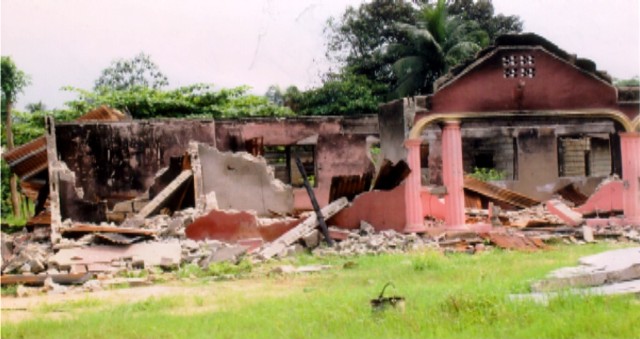
Residents of the area are now counting their loses which run into millions of naira with 14 persons reported killed in the mayhem.
Sources within the communities informed The Tide that the present crisis was caused by a disagreement between two illegal oil bunkering gangs at their site.
According to the source, one Sunday Barinem Tupor, from Bomu allegedly led his gang members to the bunkering site of his friend, Barinem Opnwin Doopa of Lewe and carted away his products.
In Retaliation, on the 15th of November, 2016, Sunday Barinem Tupor was attacked by the gang loyal to Barinem Opnwin Doopa at Lewe and his car snatched as payback.
The Tide also learnt that the mather was later reported to the police at Kpor.
Corroborating the stories in separate interviews with The Tide, the paramount ruler of Bomu, HRH Mene Charles Tenalo, and his Lewe counterpart H.R.H Mene Sibe Lebaton, confirmed that the crisis was caused by illegal oil bunkering.
Mene Tenalo who is a second class traditional ruler in Rivers State however said that following the incident on the 15th of November 2016, a meeting of the council of chiefs of the two communities was convened on the 16th of November 2016 on how to find a solution to end the crisis.
The traditional ruler said progress was made following the meeting but on the first of December 2016, his attention was drawn to an incident which involved the discovery of the corpse of an indigene of Lewe at the outskirt of the community close to Boue in Khana local government arae.
He said he immediately instructed the paramount ruler of lewe to report the matter to the police, for investigation and arrest of the culprits.
King Tenalo also alleged that youths from Lewe community also went on rampage attacking and killing Bomu indigenes coming from Mogho neighbouring community.
He specifically said that two Bomu youths who were coming from Mogho on motorcycles were killed and buried by Lewe youths.
However in a paper titled; “Lewe community’s Explanation on the Current Bomu – Lewe crisis”, the Menebon of Lewe H.R.H  Lebaton Sibe, said “ the whole episode started on the 15th of November, 2016 as a result of the misunderstanding or disagreement between two cult groups led by one Mr Barinaaoowin Doppa – Bira of lewe and Mr Barinem Sunday Tupoi from Bomu.
“Mr Barinem Sunday Tupoi is gangster, a dreaded cultist and a self acclaimed elder in the Iceland cult group who allegedly led a gang of robbers to attack Lewe youths at their oil bunkering site in our fishing port and carted a way all their properties after infliching on their body injuries in May 2016”.
Meanwhile, the Rivers State Government has waded into the crisis.
The Special Adviser to the State Governor on conflict resolution, Chief Okorie Abelekum on his past condemned the crisis in the strongest terms and warned that government will not fold its arms and watch people take the laws into their hands.
Chief Abelekum told  the people during an interactive session at Kpor, headquarters at Gokana local government area that if the youths in the area refuse to toe the path of peace, they will only have themselves to blame as government will take drastic action to checkmate any further act of criminality in both communities.
He said the era when illegal oil bunkerers and cultists hold communities to ransom are over adding that under the present administration, all forms of lawlessness will be nipped in the bud.
The special Adviser to the state Governor on Amnesty, Hon Ken Chinda, who was at the interactive session also called on cultists and illegal bunkerers in the area to surrender their arms  without delay.
Hon Chinda said community elders and well meaning  individuals in the area should come together and assist government in the strive towards a better society.
The Tide observed that given the large army of refugees created by the crisis and the scale of destructions, the people are ready for peace.
The two paramount rulers also confided in The Tide that they are really for peace.
The paramount ruler of Lewe, Lebaton Sibe said his people can no longer go to their farms or fishing and appealed to government to wade into the crisis with a view to ensuring a final and peaceful resolution to end the conflict.
In a letter addressed to the Rivers State Governor through the Special Adviser on conflict Resolution, Chief Sibe called for the establishment of a security post between the two communities to forestall further attacks by his Bomu neighbours.
He also appealed for  relief  materials for his people.
On his part, the  Menebon of Bomu, H.R.H King Charles Tenalo, urged the government to take note of the following which will help in establishing an enduring peace between Bomu and Lewe.
“That Lewe people should report all criminal offenses to the police for investigation and legal actions instead of taking rash and primitive decisions.
“That they should stop all forms of aggression against law abiding citizens of Bomu.
“That the Lewe people should stay away from our land.
Illegal oil bunkering is indeed a problem to the Niger Delta. The entire water source of the region is now polluted.
Today, it is Bomu and Lewe, tomorrow it could be another community.  The effects of illegal oil bunkering is spreading like a bush fire across the region and  that is why government must find solution to the problem.

Continue Reading

Environment

Nigeria, UAE to waive tariffs on some products

Published

on

The Federal Government has signed a Comprehensive Economic Partnership Agreement (CEPA) with the United Arab Emirates (UAE) to remove tariffs on selected products.

Rep. Sam Onuigbo a member of the Governing Board of the North-East Development Commission, disclosed this in an interview with newsmen in Abuja on Tuesday.

Onuigbo said that the agreement signed in Abu Dhabi from Jan. 11 to 15, marked a major breakthrough for Nigeria-UAE economic relations.

NAN reports that Onuigbo, a member of the House of Representatives of Nigeria who represented Ikwuano/Umuahia North and South Federal Constituency, served as Chairman, Committee of Climate Change during the 8th Assembly.

“Under the CEPA signed in January 2026, UAE will eliminate tariffs on 7,315 Nigerian products. This includes immediate duty-free access for 2,805 products (38.3 per cent).

” The rest will phase out over three to five years, covering agricultural and industrial goods.

“Similarly, under the Nigeria/UAE CEPA also signed in January 2026, Nigeria has eliminated tariffs on 6,243 products imported from UAE. That agreement creates these wonderful opportunities between Nigerians and the Emirates,” he said.

Onuigbo said that the agreement was massive as it would facilitate an environment for business owners in Nigeria.

He said the pact would enable verified Nigerian business owners to establish offices in UAE, operate for up to three months and return home with expanded commercial networks.

He commended President Bola Tinubu for the agreement, saying it aimed at repositioning the country while also creating an enabling environment for employment opportunities.

He reaffirmed Nigeria’s readiness for business, noting that the country also unveiled its carbon market framework policy to attract climate-focused investments

”Nigeria is a nation of nearly 250 million people and has had, over the years, the challenge of enough energy or power to be able to attain its economic and industrialisation targets.

“And because of that, Nigeria has been engaging in different activities, for instance, the Energy Transition Plan, enactment of the Climate Change Act, and the Electricity Act which the President signed barely eight days after he assumed office in 2023.

“This shows the importance of addressing the energy gap having enough energy. Electricity is a fundamental point to developing industrially which Nigeria deems necessary,” he said.

Onuigbo lauded Nigeria’s participation at the Abu Dhabi summit saying that the summit would strengthen global economic opportunity for people.

He added that the President’s collaboration would address the challenges and devastating effects of climate change as well as boost economic growth in 2026

Continue Reading

Environment

HYPREP Completes Phase One Mangrove Restoration In Ogoniland, Warns Against Re-Pollution

Published

on

The Hydrocarbon Pollution Remediation Project, HYPREP, says it has achieved a major environmental milestone in Ogoniland with the full completion of Phase One of its mangrove restoration programme, even as it warned that renewed pollution could erase years of painstaking cleanup.

The announcement was made in Port Harcourt by HYPREP’s Director of Technical Services, Dr Damian-Paul Aguiyi, at the agency’s fourth-quarter 2025 stakeholders and regulators’ meeting, a forum convened to assess progress, identify gaps, and align partners behind the Ogoni cleanup mandate.According to Aguiyi, 100 per cent planting and restoration has been achieved under Phase One, marking a critical turning point in the ecological recovery of Ogoniland, one of the areas most devastated by decades of hydrocarbon pollution.

“We have completed Phase One planting and restoration at 100 per cent. We are now in the monitoring stage, with some sites already observed for up to nine months,” he said.

Beyond mangroves, Aguiyi reported significant progress in soil and groundwater remediation, describing the last quarter as one of HYPREP’s most productive periods since the Ogoni cleanup commenced.

He disclosed that shoreline cleanup has reached about 77 per cent completion, while access to safe drinking water has expanded across Ogoni communities.

“We have restored 100 per cent potable water supply to Ebubu, and reconstruction work has commenced at the Gwara Waterfall,” Aguiyi stated.

On infrastructure, he said key equipment for the long-awaited Ogoni Power Project has been procured and secured at the Wiyaakara substation, signalling movement toward energy support for the restoration effort.

Despite the progress, Aguiyi warned that re-pollution remains the single greatest threat to the success of the Ogoni cleanup.

“Our major concern is waking up one day to find areas cleaned with Ogoni people’s resources re-polluted by activities beyond our control,” he said, stressing that environmental recovery must be protected as much as it is delivered.

He attributed the sharp decline in illegal artisanal refining in Ogoniland over the past two to three years to sustained community engagement and alternative livelihood programmes, which he said have reduced economic dependence on destructive practices.

“We have not recorded incidents of artisanal refining in Ogoniland in the last two to three years, and that is the result of consistent sensitisation and viable livelihood options,” he added.

Aguiyi reaffirmed HYPREP’s willingness to collaborate with companies and partners operating in Ogoniland, noting that initiatives aligned with the project’s environmental and social objectives would be reviewed and adopted where appropriate.

He also said recommendations from recent independent and internal reports are already being implemented, underscoring HYPREP’s commitment to transparency, accountability, environmental recovery, and improved livelihoods for Ogoni communities.


Continue Reading

Environment

Over Six Million Benue Residents Exposed To Neglected Tropical Diseases – State Government 

Published

on

The Benue State Government has warned that more than six million residents remain at risk of Neglected Tropical Diseases (NTDs) across the state, despite notable successes recorded in disease elimination efforts.

The Commissioner for Health and Human Services, Dr. Paul Ogwuche, disclosed this during a press conference to mark the 2026 World Neglected Tropical Diseases Day, organised in collaboration with Sightsavers and themed “Unite, Act, Eliminate Neglected Tropical Diseases (NTDs).”

Represented by the Permanent Secretary of the ministry, Dr. Beatrice Tsavmbu, the commissioner announced the successful elimination of blinding trachoma in Gwer East, Gwer West and Ukum Local Government Areas, attributing the feat to years of targeted interventions, strong community participation and sustained implementation of the state’s NTDs Control and Elimination Programme.

“I am proud to announce the elimination of blinding trachoma in three of our most affected areas—Gwer East, Gwer West and Ukum. No longer will these communities face the blindness that trachoma has long inflicted,” she said.

However, Dr. Tsavmbu noted that Benue State remains highly endemic for several NTDs, with all 23 local government areas experiencing overlapping disease burdens. She listed the diseases to include onchocerciasis (river blindness), lymphatic filariasis (elephantiasis), schistosomiasis (bilharziasis), soil-transmitted helminth infections (intestinal worms), leprosy, buruli ulcer and snakebite envenoming.

“These conditions collectively put over six million people in Benue State at risk,” she stated.

She revealed that the state had treated an average of more than five million people over the past five years through preventive chemotherapy, morbidity management and disability prevention, supported by Water, Sanitation and Hygiene (WASH) initiatives and integrated vector control.

Dr. Tsavmbu also announced a major breakthrough in the fight against river blindness, noting that onchocerciasis endemicity in the state had been reclassified from ongoing transmission to suspected interruption of transmission.

On lymphatic filariasis, she disclosed that 1,064 hydrocele cases had been successfully managed through free surgeries, while 442 lymphoedema patients received free management kits to prevent disease progression. She added that 44 trachoma trichiasis cases were also treated through free surgical interventions.

According to her, Ukum, Logo and Konshisha LGAs have passed Transmission Assessment Survey 1 for lymphatic filariasis, allowing for the cessation of mass drug administration in those areas. In addition, seven other LGAs—Ado, Apa, Kwande, Obi, Ohimini, Oju and Tarka—successfully passed epidemiological monitoring surveys in 2025.

She attributed the progress recorded to strong inter-sectoral collaboration involving agencies such as the Benue Rural Water Supply and Sanitation Agency (BERWASSA), the State Universal Basic Education Board, the Ministry of Education, civil society organisations and security agencies. She also cited the inauguration of the State NTDs Advisory Committee and improvements in supply chain and logistics management systems.

In a related remark, Prof. Edward Omudu of the Department of Biological Sciences, Moses Orshio Adasu University, Makurdi, revealed that the National Universities Commission had recently approved Nigerian universities to offer degree programmes in Water, Sanitation and Health, describing the move as a critical step toward strengthening disease prevention and public health capacity in the country.


Continue Reading

Trending