
Oil & Energy
PIB: Eight Years In Limbo

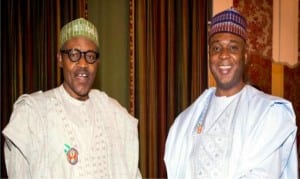
President Muhammadu Buhari and Senate President Bukola Saraki
When President
Umaru Yar’adua, of blessed memory, assumed office in 2007, the unending crisis rocking the nation’s oil sector, could be said to be at its peak.
He was welcome into office by a turmoil occasioned by mass protest over an overnight and unwarranted increase in the pump prices of petroleum products, inherited from his predecessor, ex-president Olusegun Obasanjo.
As expected of a leader who has the feelings of the people at heart, Yar’Adua, reverted the new pump price to normal, rendering the land mine on his administration impotent, and the masses, ended the protest.
But, he also had the problem of the then Niger Delta militancy (the freedom fighters as they chose to be called), confronting him. There is no gain saying the fact that the colossal destruction caused by the activities of the Niger Delta militants on the nation’s oil and gas infrastructure in the region, brought Nigeria’s economy on its knees.
Again, as expected of a peaceful and caring leader, Yar’Adua intrdocued his famous Amnesty Initiative. Consequent upon this, the staccato sounds of the militants’ guns and the booms of their bombs stopped thereby giving way for peace.
Apparently, after giving a deep thought on the oil sector, considering the fact that it is the lifewire of the nation’s economy, Yar’Adua initiated the Petroleum Industry Bill (PIB) as a master plan towards bringing sanity in the sector.
The PIB which Yar’Adua presented to the National Assembly as Executive Bill in 2008 stirred up wide jubilation amongst natives of oil-bearing communities because it promised them 20 per cent of equity in oil production. The bill equally promised other goodies to other stakeholders.
However, like a pregnant woman happily welcome into the labour room, eight years after, neither the voice of the child nor that of the mother has been heard as the National Assembly members are yet to agree on issues concerning the PIB. The euphoria that greeted the idea of PIB has given way to anxiety, suspicion and fear.
Is it that the PIB idea is bad and contradicts all expectations of the National Assembly? Such that the lawmakers cannot find any useful thing in the bill? Is it that the alleged cartel that determines what happens in the Nigerian oil sector is not happy and has decided to frustrate and kill the people’s bill? What exactly is the matter with this bill which in many analysists’ views holds a lot of promises to the people?
When Nigerians waited till the end of the sixth National Assembly (2007-2011) and did not see the bill transform into an Act of the Parliament, the impression then was that, because of the high level of importance attached to the bill and the need for the law makers to do thorough work on the bill, it could not be concluded.
But when the then Senate President, David Mark was concluding activities of the 7th National Assembly in 2015 and hurriedly ‘passed through’ his basket full of bills, concerned Nigerians were disappointed that the PIB was not one of the many bills that graduated to Acts of Parliament.
A group, the Environmental Rights Action/Friends of the Earth Nigeria (ERA/FoEN) expressed dismay over the failure of the National Assembly to pass the bill, attributing it to politics.
Executive Director of the group, Godwin Ojo, had during a press conference in Lagos accused some of the lawmakers of falling prey to the influence of the oil multinationals who fear that the PIB would rob them of so much unabridged fortune they have been having as far as the nation’s oil industry is concerned.
To Ojo, “some of them became the mouth piece of Shell and other oil companies that threatened to pull out of Nigeria’s oil and gas operations if the PIB was passed.
“They not only betrayed the wishes of the people but succumbed to cheap blackmail of the oil companies that the PIB would render the oil and gas industry unviable”.
It would be recalled that apart from the one submitted by President Yar’Adua, which did not attract the attention of the lawmakers, ex-President Goodluck Jonathan re-introduced the bill to the National Assembly in 2012, which could also not attract the attention of the parliament.
The National Co-ordinator, Niger Delta Youth Coalition (NDYC). Prince Emmanuel Ogba, regretted the attitude of members of the National Assembly to the bill, saying their standing on the way of such a bill shows that the interest of the people was not the main business of those up there, and urged the present senate, led by Bukola Saraki, to make a difference.
Ogba expressed the view that giving 10 per cent of the equity to the host communities would go a long way in bringing peace both for the community and the oil multinationals. This according to him, would provide the conducive atmosphere for better oil operation that would benefit the host, the oil companies and the government.
The youth leader blamed the Federal Government for shortchanging the oil-bearing communities by not providing social amenities as road, water, schools, health infrastructure etc.
“You see, because the oil companies are the ones the community people always see physically, they transfer their grievances to the companies for not providing the infrastructure while in the actual sense of it these should not be the responsibilities of the companies.
In his own reaction, the publisher of News Africa Magazine, Mr Moffat Ekoriko, described the PIB as a National disgrace in that the sixth and seventh National Assemblies could not give Nigerians any explanation as to why they were not able to pass the bill.
“If we are to believe what we got from the grapevine, two factors were responsible for trauncating the bill. Inducement by the multinational oil companies and ethnic interest. Ethic, in the sense that most provisions of the bill were seen as being more favourable to host communities”, he said.
Ekoriko, in an interview with The Tide, said the oil multinationals were uncomfortable with the aspect of the bill which gives 10 per cent equlity to the host communities and the incentive for deep offshore.
“If we are to believe those rumours, it then calls to question the sense of patriotism of the Sixth and Seventh Assemblies”, he said.
The News Africa publisher advised President Muhammadu Buhari to invest his political capital in getting the bill passed, noting that since APC controls both Houses of the National Assembly, there is no reason why a president who is so fair as Buhari cannot wield his party into line.
Another alternative, he said, is to break up the bill so that the non-contentious aspects can pass. He suggested that Buhari should consider leaving the 10 per cent equity to host communities and the incentives for the deep offshore operations and pass the other less contentious aspects of the bill.
“Over the years, the government has been failing the oil communities. They collect tax and always fail to provide amenities. What the oil firms should do is to provide ‘jara’, but ‘jara’ can’t substitute the real thing”, he said stressing that oil companies cannot translate into government of the Niger Delta such that you expect them to provide water, road, healthcare and wondered what should be the responsibilities of the government.
Ekoriko also blamed the interventionist agencies as the Niger Delta Development Commission (NDDC) for lack of clear focus on what to provide.
“While NDDC goes into skills acquisition agriculture, primary healthcare what should go to LGAs and state government, it becomes Jack-of-all-trade and master of none”, he explained.
He said what the region needs is infrastructure as rail line connecting Niger Delta, good road network to make the economy of the region to take off and challenged the Niger Delta Ministry and other relevant agencies to be focused on their statutory responsibilities.
The PIB which should serve the interest of well-meaning Nigerians and stakeholders in the oil sector is one that would fairly address their peculiar needs and fears since it is by so doing that all stakeholders would work as partners in progress.
This spirit will bring to an end the so much acrimony where communities see the oil firms as those short changing them.
The Federal Government which defined and enjoys 60 per cent equity in the joint venture, should be alive to its expected responsibilities to the host communities.
Nigeria desires a PIB that would take definite stand on the issues of gas flaring , oil spill clean-up, local or Nigerian content particularly on expatriate quota, contract awards and also bring an end to the enigma of casualisation in the oil industry.
Those who are so worried about the ubiqiutous influence of the oil multinationals should also know that as stakeholders, the multinational oil companies would not fold their arms on an issue that affects their business interest in Nigeria.
But what one expects is that members of the National Assembly, particularly those from the Niger Delta region should stand up in the interest of Nigeria and not allow themselves to be bought over by other forces protecting their own interest since they are voted to serve their people.
If a thorough job aimed at providing an effective PIB, fair to stakeholders, is done the fear is that there might be a PIB that would be watered down such that it would lose its essence.
The initiator of PIB, Yar’Adua, was a Niger Delta friendly President, same way Goodluck Jonathan was a Northern friendly President and did more for the north. Buhari should declare his position on PIB.
Chris Oluoh



Oil & Energy
IYC Tasks Niger Delta Governors On Oil Field Bidding ….Decries Exclusion of Host Communities


-
 Editorial3 days ago
Domesticate FG’s Exit Benefit Scheme
-

 News2 days ago
RSU Unveils Five-Year Strategic Dev Plan …Calls For Collective Commitment To Institutional Excellence
-
 News3 days ago
DHQ Confirms Deaths Of Terrorists, Soldiers In Borno Attack
-

 News3 days ago
Tinubu Commissions Bayelsa Gas Turbine, Other Projects Today
-
Business3 days ago
Niger Delta Investment Summit Targets $5bn Inflows, 500,000 Jobs
-
Rivers3 days ago
Dep Gov Seeks Collaboration, Transparency Between RIVCHPP, PHCMB
-
Nation2 days ago
Rumuji Youth Leader Condemns Protest, Disowns Alleged Government Empowerment Claim
-
Sports3 days ago
Full Draw For 2026 U-17 AFCON