
Politics
NASS, APC And Politics Of Exclusion

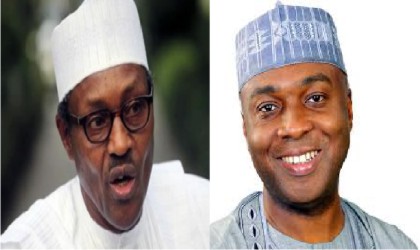
President Muhammadu Buhari and Senate President, Bukola Saraki
The 2015 Nieria general
election in Nigeria has come and gone. The campaigns really heated up the Polity through the mantra for ‘Change’ versus that of ‘Continuity’. At the end of the day, the All Progressives Congress (APC) defeated the Peoples Democratic Party (PDP), which was in power for 16 years.
The APC also controls majority in both Houses of the National Assembly (NASS-the Senate and House of Representatives).
In a federalism such as Nigeria’s, power sharing and zoning is an integral part of the polity as a result of its diversity (regional, ethnic, religion etc). Consequently, the two major parties in the NASS have key roles to play in stabilizing the polity because of the yearnings and aspirations of the populace.
Unfortunately, the proclamation of the 8th National Assembly on the 9th of June, 2015 and subsequent election of key officers in both Houses have rekindled another crisis in the polity and therefore pose a serious concern to the Nigerian citizenry. The festering conflict within the ranks of APC legislators in the NASS especially in the lower chamber, is no doubt an embarrassment to the party and to the surprise of many Nigerians.
There is therefore need to resolve the crisis and end the impasse in the NASS, while the APC leadership should also muster the courage and required capacity to arrest the drift.
It is against this backdrop that it has become pertinent to consider the context of party supremacy and discipline in an attempt to bring stability in the polity, and NASS particularly.
Politics, refers to any human relationship that involves, to a significant extent, control, influence, power and authority. The APC, which is the party in power, seems to be a marriage of inconvenience made up of defunct Action Congress of Nigeria (ANC), Congress for Progressive change (CPC), the All Nigerian Peoples Party (ANPP), a splinter group of the All Progressive Grand Alliance (APGA) and much later the defectors from the Peoples Democratic Party called (New PDP).
These groups have their various interests, values and aspirations, but merged first to wrestle power from the PDP behemoth. The most familiar base of influence and power is power itself, hence the struggle for the soul of the APC.
This is very obvious in the manner the positions of presidential candidate, Presidential running mate and party national chairmanship of which Muhammadu Buhari (CPC), Yemi Osibanjo (ACN) and John Odigie Oyegun (ANPP) respectively emerged.
Their peaceful emergence brought a glimmer of hope that the party was on course and can assert itself in all spheres and scheme of things especially after the accompanying victory at polls through fostering of party discipline, supremacy and therefore stability of the nation’s fragile polity.
As a party in power, it hehoves APC to whip its members into line either by use of threat or sanctions. But here again, distribution of positions and offices should not be done to the exclusion of any group as compromise is needed to incorporate all groups after careful consideration of the federal character principle.
The federal character principle is an attempt in search of national integration where there is all inclusiveness. Apart from national integration in a diverse political framework, it also has the ideology of power sharing, political restructuring, equity, justice, gender access and even democratic stability in Nigeria.
The doctrine was formulated to address and hopefully mitigate the problems of lopsidedness so as to ensure a peaceful, stable and integrated Nigeria.
The history of federal character, power sharing and power supremacy in the National Assembly predates the 2nd Republic when the coalition of the National Party of Nigeria (NPN) and National Peoples Party (NPP) shared power and political offices in the federal Houses, with the NPN producing the Senate President (Dr Joseph Wayas) of the present day South –South region, while the NPP produced Mr. John Wash Pam of the North Central as Deputy Senate President.
In the House of Representatives, Honourable Edwin Gme-Ezeoke (NPP) of the South-East was voted Speaker and Hon. Idris Kuta (NPN) of the North-West was Deputy Speaker.
In 1999, with the beginning of the 4th Republic, the PDP emerged as the party in control after the 1999 election National offices were also shared equitably with the federal character principle in mind. By this formula, president Olusegun Obasanjor came from the South West, Vice President Atiku Abubakar from North-West, Senate, President, Evans Enwerem /Chuba Okadigbo and Ayim Pius Ayim/Adolphus Wagbara/Ken Nnamani from the South East.
The North West produced the Speaker, House of Representatives (Salis Buhari) Ghaali Na-abar and Aminu Masari) Deputy Senate President came from the North Central with A. Haruna and I. Mantu as beneficiaries white the South –South produced the Deputy Speaker, House of Representative (Chibudom Nwuche/Austin Opara.
Then, there was a conscious plan to zone national offices for reasons of equity and justice. This is a result of the role of party supremacy in which the party in Majority would assert its influence, authority and control on its members.
There were, however, occasional changes in occupants of some of those positions as could be noticed in the position of the Senate President and Speaker of the House of Representatives. This was occasioned by executive interference culminating in impeachment over a period of eight years. Nevertheless, zoning was respected and the six zones benefited from the top six hierarchy.
By 2007, the PDP remained in control of power both at the executive and legislative arms of government with the emergence of David Mark and Miss Patricia Ettch as Senate President and Speaker of the House of Representatives respectively. For the first time, a female was elected on the floor of the House to the exalted position of fourth citizen of the nation. This act, again, was a conscious arrangement by the ruling PDP to imbibe affirmative action and a sense of belonging to the polity.
In 2011, for instance, the PDP-controlled Senate made another conscious effort to distribute principal positions from which the following emerged: Senate President, David Mark (North Central), Deputy Senate President, Ike Ekweremadu (South East), Majority Leader, Victor Ndoma-Egba (South South), Deputy Leader, Abdul Ningi (North East), Majority Whip, S. Gwarzo (North West); and Deputy Whip, Hosea Agboola (South’ West).
In other words, parties in Power and opposition alike are expected to take into consideration the principle of federal character and geo-political spread in the allocation of principal positions so as to achieve the required stability in NASS.
In 2015, the APC with a majority in both Houses is expected to follow similar pattern, but the leadership chose to do otherwise. The first salvo came from President Buhari who said he would not dabble into the affairs of the legislative arm and as such would be willing to work with whoever emerges on the floor of both Houses.
The Vice President, Yemi Osibanjo corroborated Buhari’s remarks, by saying that meril must supersede zoining in appointments to political offices. Oridinarily, these comments are ideal but may not augur well with a group with vested interest in the party.
The party’s leadership endorsed Ahmed Lawan of Yobe State (North East), George Akime of Benue State (North Central), Femi Gbajabiamila of Lagos State (South West), and Mohammed Monguno of Borno State (North East) for Senate President, Deputy Senate President, Speaker House of Representative and Deputy Speaker respectively. There was no consideration for zoning.
Suddenly, on June 9th, 2015, Bukola Saraki (APC), Ike Ekweremadu (PDP), Yakubu Dogara (APC), and Wale Lasun (APC) were voted as Senate President, Deputy Senate President, Speaker and Deputy Speaker respectively as against the dictates of the party leadership.
This was a grave blunder committed by the party leadership. Not long after, zonal caucuses of the party in both Houses decried marginalization in power sharing which led to the ensuring conflict within the ranks of the APC legislators in the NASS, especially in the lower chamber.
From all indications it appears that the APC has been captured by elements of the “New PDP” within the party and that these elements are working with the PDP to undermine the APC and its leadership who is being accused of being insensitive to the groups’ interest as co-stakeholders.
Their reasoning seems to be that the party leadership must not see itself as being supreme to the point of constituting an alternative to equity and justice, or a license to impunity.
The situation is further worsened by the fact that as crisis deepens, members come out with contradicting opinions and statements on the feud.
Meanwhile, the ‘dissident’ group relies on the provision of the law which clearly states that legislators should appoint or elect their own leaders within the two chambers, and that there is no provision that gives the chairman of a party the power to appoint the major officers in the National Assembly.
The unfolding scenario in the National Assembly is a clear confirmation that every political party seeks to acquire political power, but it is more difficult for them to maintain themselves in power.
This appears to be the APC’s challenge today. It is also a warning for APC to negotiate before it rocks the boat, knowing that 2019 is not too far.
.Lulu-Pokubo is a Port Harcourt-based political analyst
Omomye Lulu-Pokubo



The Independent National Electoral Commission (INEC) has extended the deadline for political parties to submit the list of candidates for the 2027 governorship and state Houses of Assembly elections from Saturday, August 8, to Tuesday, August 11, 2026.
The commission announced the extension in a statement issued on Saturday and signed by the National Commissioner and Chairman of its Information and Voter Education Committee, Mohammed Haruna.
According to INEC, the decision followed appeals by political parties for additional time to complete the submission process through the dedicated online portal.
“The submission window, which according to the revised Timetable and Schedule of Activities for the General Election was originally scheduled to close on Saturday, 8th August, 2026, has been extended to Tuesday, 11th August, 2026,” the commission said.
In a a related development, INEC announced the suspension of PVC collection in Osun State ahead of the August 15 governorship election.
The commission said voters who applied for replacement of lost, damaged or defaced Permanent Voter Cards would have until midnight on Sunday, August 9, to print downloadable copies of their cards.
The electoral body explained that the deadline was necessary to enable it compile data on downloaded PVCs and produce final statistics on the total number of cards collected ahead of the election.
INEC said PVC collection in Osun commenced at the Registration Area level from July 22 to 28, 2026, but was extended to July 31 following complaints about large crowds and difficulties experienced by voters at collection centres.
The exercise subsequently moved to the local government level and ran from August 1 to 7.
The commission also disclosed that replacement downloadable PVCs had been made available to voters in Odo-Otin and Ife Central Local Government Areas following the theft of cards during attacks on the two collection centres.
It stressed that the stolen cards could not be used to vote.
INEC reassured Osun residents of its preparedness for the August 15 governorship election.
“The commission reiterates that the stolen cards cannot be used to vote.
“INEC reassures the people of Osun State of its readiness to conduct a free, fair, credible and inclusive governorship election on 15th August, 2026,” the statement said.
The commission said the deadline, initially set for Saturday, 8 August, has been extended to Tuesday, 11 August 2026, following appeals from political parties for more time.
INEC also announced that the window for voters who applied to replace lost, damaged or defaced PVCs to download their replacement cards will close at midnight on Sunday, 9 August.
The move is to enable the commission compile final PVC collection figures ahead of the 15 August Osun governorship election.
INEC said replacement downloadable PVCs have also been provided to affected voters in Odo-Otin and Ife Central Local Government Areas after hoodlums carted away cards from two collection centres, stressing that the stolen cards cannot be used to vote.
The commission reaffirmed its readiness to conduct a free, fair, credible and inclusive election in Osun State.
Gov. Kefas made the remarks over the weekend at the Federal Medical Centre (FMC), Jalingo, during the flag-off of the second phase of the Renewed Hope Medical Outreach in Taraba State, organised as part of activities marking Prof. Yilwatda’s 58th birthday.
The governor commended Prof. Yilwatda for choosing to mark his birthday by providing medical care to people in need.
“What Professor Nentawe did is a powerful demonstration of what leadership should be,” Gov. Kefas said.
He assured that his administration would continue to support initiatives that complement government efforts to improve healthcare delivery and the wellbeing of residents.
Speaking at the event, Prof. Yilwatda called on Nigerian leaders to embrace the culture of giving and use their positions to touch the lives of the less privileged.
He said his decision to celebrate his 58th birthday in Taraba State was deliberate and informed by the needs of underserved communities, particularly people who face difficulties accessing healthcare because of distance and financial constraints.
According to him, the intervention followed a needs assessment and was extended across the three senatorial districts of the state.
He said the exercise commenced on August 3 at Takum General Hospital and covered the Federal University Teaching Hospital, Wukari; First Referral Hospital, Sunkani, Ardo-Kola Local Government Area; General Hospital, Bali; General Hospital, Gembu; and FMC Jalingo.
Prof. Yilwatda said the intervention provided medical services to thousands of beneficiaries, including people who required surgical procedures.
He said sustainable national development could only be achieved when strong institutions placed Nigerians at the centre of development.
“Leadership is about service,” he said, urging political and public leaders to make giving back to society an important part of their responsibilities.
He reaffirmed his commitment to serving Nigeria and its people, saying his personal vision was to make every day of his life useful to humanity.
“Every day that I live, the vision is: let it be useful to humanity,” he said.
The Taraba State Commissioner for Health, Dr. Bordiya Buma, commended the initiative, saying it was consistent with the Renewed Hope agenda and efforts to strengthen healthcare delivery in the state.
Dr Buma said the second phase followed the successful completion of the first phase, which was conducted simultaneously in six local government areas, with two LGAs selected from each of the three senatorial districts.
According to him, more than 10,000 patients were attended to during the first phase, including people with medical and surgical conditions.
He disclosed that 327 general surgeries, 71 eye surgeries and 575 dental procedures were carried out during the exercise.
The commissioner expressed appreciation to President Bola Tinubu for the Renewed Hope Medical Outreach and thanked Prof. Yilwatda for supporting the initiative and choosing Taraba State as a beneficiary.
The Minister of Health and Social Welfare, Prof. Muhammad Ali Pate, also commended Prof. Yilwatda for choosing Taraba State to mark his 58th birthday through a medical outreach.
Prof. Pate said making healthcare the centrepiece of the birthday celebration was significant because health affects everyone.
-

 News3 days ago
RSG Targets Nine Million Residents in Mosquito Net Distribution Campaign
-

 Oil & Energy3 days ago
Aiyedatiwa Signs New Electricity Bill
-

 Oil & Energy3 days ago
NLNG Commissions Research And Innovation Centre In RSU
-

 Maritime3 days ago
Marine Minister Commends President Tinubu On NPERA Bill Assent
-

 News3 days ago
KenPoly Holds Eight Convocations, August 29
-

 News3 days ago
RMAFC Completes Revenue Sharing Review, Proposes New Pay
-

 News3 days ago
RSG Begins Another Phase of Projects Commissioning Today
-

 Maritime3 days ago
NAGAFF Petitions IGP Over Alleged Maritime Police Harassment