
Nation
THE STATES

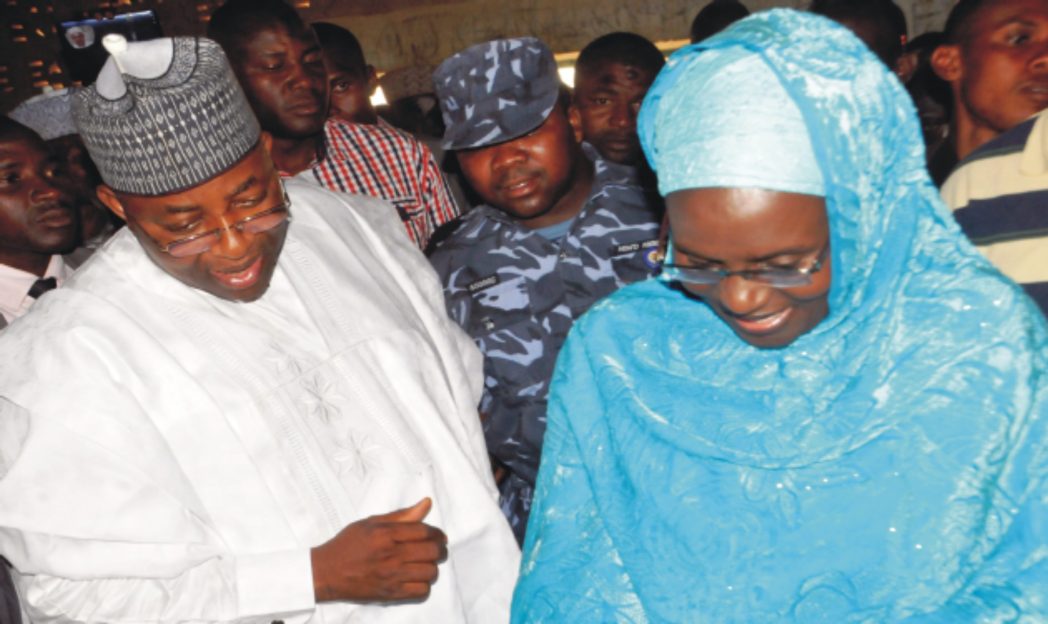
Bauchi State Governor-elect, Alhaji Mohammed Abubakar of Apc and his wife react after he was announced winner of the governorship election in Bauchi recently
Bauchi
A Local Church Council (LCC) of the Evangelical Church
Winning All (ECWA), has held special prayers to seek God’s intervention for a smooth handover on May 29.
Our correspondent learnt that the prayers were held during the LCC two-day revival service which ended on Saturday at ECWA II, Bauchi.
The Local Overseer, Rev. Shuaibu Byal, told newsmen shortly after the prayers that consistent prayers were needed for God’s intervention to deepen Nigerian democracy.
Byal said that with the handover day less than a week away, there was need for Christians and Muslims to pray for smooth transition.
According to him, it is only God that will ensure a smooth transition from President Goodluck Jonathan-led administration to the incoming Government.
Borno
The Borno State government, has commended the Federal
Government for setting up an Inter-ministerial Assessment Committee for rehabilitation of structures damaged by Boko Haram insurgents in the North East.
The state’s Deputy Governor, Alhaji Mustapha Zanna, gave the commendation when he received members of the committee who were on a visit to Maiduguri.
Zanna said that the constitution of the committee was timely as it would provide avenue for the commencement of work in affected communities.
He added that, “the setting up of the committee is timely because our people are due to start going back to their communities following the liberation of their communities by soldiers.
Earlier, the leader of the delegation, Air Commodore Charles Otegbade, the Director of Search and Rescue of the National Emergency Management Agency (NEMA), had told the deputy governor that the visit was to assess damages done by the insurgents in the state.”
FCT
The Director-General, Bureau of Public Procurement (BPP),
Mr Emeka Ezeh, has warned newly recruited procurement officers to follow due process in the award of contracts or risk going to jail.
Ezeh gave the warning in Abuja when he led the 130 procurements officers’ in-training on a tour of Kuje Medium Security Prisons.
Represented by Mr James Akanmu, Director, Research and Training, Ezeh said that being a procurement officer was a sensitive position.
He, therefore, urged the officers to refrain from corrupt practices and any act that could tarnish their reputation.
The BPP boss informed the officers of the provisions of sub-section 5 of Section 38 of the Public Procurement Act.
According to him, the act states that “any government official upon conviction of contravention of the Public Procurement Act will be sentenced to not less than five calendar years”.
Gombe
The National Association of Persons with Disabilities
(NAPW) last Monday, appealed to the Federal Government to organise a special skills acquisition training programme for its members across the country.
The Chairman of the Association in Gombe State, Alhaji Ali Goro, made the appeal in an interview with newsmen in Gombe State.
He said that such training would help its members and also assist the less-privileged amongst them, who relied on street-begging for their livelihood.
“We are appealing to the Federal and Gombe State Governments and some of the Non-Governmental Organisations (NGOs), to come out with special packages for our members.”
Jigawa
Electricity consumers in Hadejia, Jigawa State last Monday
decried the epileptic power supply in the area.
Our correspondent reports that Hadejia and its environs had been facing persistent outage in the last three weeks.
The poor power supply had affected businesses and made life unbearable, a situation a cross section of the residents who spoke to newsmen in Hadejia, described as worrisome.
A resident, Aminu Umar, said the persistent power outage has made life difficult due to the prevailing hot weather.
He said that the situation had forced many families to sleep outside, inspite of the ravaging mosquitoes and other pests.
Kano
The Federal Government has approved the establishment
of two specialised universities, President Goodluck Jonathan has said.
Speaking at the 31st convocation of the Bayero University, Kano, recently, Jonathan said the universities were the Marine University and the Federal University of Health Sciences.
Jonathan, who was represented by the Executive Secretary of the National Universities Commission (NUC), Prof. Julius Okoje, said the decision was borne out of the government’s desire to give more students with the requisite qualifications the opportunity to access quality education.
He said that in spite of the numerous challenges, the Federal Government would continue to support the education sector to empower the youth.
Kwara
The Senator -elect representing Kwara South Senatorial
District, Dr Rafiu Ibrahim, yesterday, assured victims of Owode market fire disaster in Offa of adequate succour.
He gave the assurance in Offa while speaking to newsmen after inspecting shops gutted by the inferno.
Ibrahim said he would contact relevant emergency management agencies to provide immediate assistance to the victims.
He pledged to seek the intervention of the Federal Government and the National Assembly, describing the fire incident as a monumental loss to the people and the state at large.
Niger
The Niger State Police Command has said that it deployed
7,000 personnel in Minna to ensure a hitch-free inauguration of the state Governor elect, Alhaji Sani Bello, on May 29.
This is contained in a statement in Minna by the Commissioner of Police Mr Olusola Amore .
“We have deployed no fewer than 7,000, personnel in strategic areas of the venue of the ceremony and Minna to ensure adequate security coverage of the event,’’ Amore said.
He enjoined the good people of the state to continue to be law abiding and to support the Police in protecting lives and property.
Amore commended the media for its balanced reportage before, during and after the 2015 general elections in the state.
Ondo
Pastor Richard Adesoji of Gospel Faith Mission International
in Okitipupa on Sunday, advised Nigerians to be fervent in prayers for a smooth and hitch-free transition to new government.
Adesoji gave the advice in an interview with newsmen shortly after he delivered a sermon on “The Journey to the Promised Land”.
He recalled that the biblical Israelites faced series of difficulties before getting to the Promised Land, but through prayers to God, they got to the Promised Land which God prepared for them.
Adesoji likened Nigerians to the biblical Israelites, saying that Nigerians would definitely get to the Promised Land “if they pray and seek God’s face“.
Sokoto
Youth Leader of Peoples Democratic Party (PDP) in Sokoto
State, Malam Musa Isa, has pleaded with the party leaders to entrench internal democracy in the party to ensure its success in future elections.
He made the call in Sokoto while speaking with newsmen.
Isa identified lack of internal democracy and disrespect for the founding members of PDP as the major factors responsible for the failure of the party in the last general elections.
“The new comers to the party have no regard for the founding members of the party.”
“New members who defected to the party from various political parties were given more regards than the founding members that stayed and promoted the lofty ideals of the party,’’ he said.
Taraba
Former Minister of Defence, Gen. Theophilous Danjuma,
last Saturday inaugurated two bridges worth N500 million along Takum-Katsina Ala Federal Highway in Taraba.
The project is meant to curb the frequent accidents on the road as a result of the collapse of the bridges.
“The project started when I noticed the deplorable state of the bridges and realised that they had become death traps and a major cause of serious disabilities in the society over the years.
“We worked closely with the ministry and other relevant bodies and today, the challenges are over and I am glad this is over,” Danjuma said during the inauguration ceremony.
He observed that the road had not been given any serious attention since the end of the Nigerian Civil War.
He called on the Minister of Works to award the contract for the construction of the road to a competent civil engineering company.
Yobe
The Jamaatul Izalatul Bidiah Wa Ikhamatis Sunnah (JIBWIS)
an Islamic sect in Yobe State has advised parents against exposing their wards to wrong religious teachings.
Its Deputy Chairman, Malam Babagana Kyari, gave the advice in Damaturu at the closing ceremony of a Quranic recitation event.
“Our experiences in Yobe and Borno states have taught us to be vigilant of friends and associates of our wards, their schools, teachers and behaviours.
“This Quranic recitation competition has promoted true teachings of the holy Quran and unity among the Muslim community across the state,” Kyari said.
He urged all parents to scrutinise the type of schools and religious knowledge being imparted to their wards to avoid the type of insurgency plaguing the North East of Nigeria today.
In his speech, the Chairman of the State Council of Clerics, Sheik Haruna Gashua, commended security operatives for improving the security situation in the state.



Rivers State University and the Otonti Nduka Foundation for Values Education jointly hosted a two-day National Conference on 8 and 9 May 2026 to examine the state of values in Nigeria.
The two days conference held at Rivers State University convocation arena brought together academics, policymakers, legal experts and education leaders under the theme _“Trends and Challenges in Upholding Values in Nigeria.”_
The gathering focused on policy gaps, curriculum reform, and the role of ethics in public service and education.
The event opened on Friday with remarks from Vice Chancellor Prof. Chief Isaac Zeb-Obipi, who stressed the need to address declining moral and civic values across Nigeria’s education and public sectors. A book of abstracts for the plenary sessions was also presented to participants.
Key speakers included former Attorney General Chief Dr Kanu Agabi, SAN; NERDC Executive Secretary Prof. Shehu Salisu; Prof. Hauwa Imam, FNAE, of the University of Abuja; former Rivers SUBEB Chairman Ven Dr Fyneface Akah, ; former NIMASA DG Dr Hon. Dakuku Adol-Peterside; and RSU Director of ICT Prof. Sunny Orike.
Discussions centered on integrating values education into schools, tertiary institutions and public institutions, alongside the impact of technology on moral development among young Nigerians. Panel and plenary sessions produced practical recommendations for curriculum and policy reform.
On Saturday, the foundation marked its centenary with the unveiling of the book _Otonti Nduka in History_, launched by Chief Engr. Grant Offor, FNSE. The Nigerian Academy of Education held a ceremonial procession led by its President Prof. Olu Jegede and the Ikwerre Professors Forum.
In a communiqué, participants called for stronger collaboration between government, civil society and academia to mainstream values education nationwide. They recommended reviewing teacher training curricula and expanding digital platforms to promote ethical civic engagement, with the foundation pledging to share the outcomes with education authorities for implementation.
Dignitaries present included Ogbakor Ikwerre Worldwide as Chief Host, Prof. Emeritus Chief T. Uzodimma Nwala, the Ikenga 1 of Mbaise and first philosophy student of Prof. Otonti Nduka, alongside scholars and community leaders.
Amadi Akujobi

The Shell Nigeria Gas Limited, in partnership with the Manufacturers Association of Nigeria, has reaffirmed support for efforts to expand gas distribution infrastructure in Rivers State as part of initiatives aimed at improving access to affordable, cleaner and more reliable energy for industries across the South-South region.
The commitment was highlighted during the SNG–MAN Business Forum held in Port Harcourt, where stakeholders from the industrial and public sectors examined the role of natural gas in driving industrialisation, boosting local production and strengthening energy security.
Speaking at the forum on behalf of the Managing Director of Shell Nigeria Gas Limited, the company’s Head of Gas Distribution, Mr. Chukwuka Amos Ejesi, described natural gas as a critical component of Nigeria’s energy mix and a key driver of sustainable industrial growth.
According to him, Nigeria’s gas development agenda has reached a stage where policy direction must be matched with practical implementation capable of addressing the energy challenges confronting manufacturers.
He noted that pipeline gas offers industries a cleaner, more dependable and cost-effective energy alternative capable of supporting uninterrupted operations, reducing emissions and improving production efficiency.
“Gas is the backbone of manufacturing, and we are encouraged by the growing recognition among stakeholders of the need for cleaner and more reliable energy solutions,” he said.
Ejesi stressed the need for sustained collaboration among energy providers, government institutions and industrial stakeholders to maximise the country’s gas resources for economic development.
He added that improved gas infrastructure would strengthen manufacturing value chains, enhance productivity and promote more competitive industrial operations across Rivers State and the wider South-South region.
Participants at the forum also emphasised the importance of expanding energy infrastructure as a pathway to unlocking industrial capacity, reducing operating costs and promoting sustainable industrial development.
Representing Governor Siminalayi Fubara, the Director-General of the Rivers State Investment Promotion Agency, Dr. Chamberlain Peterside, reaffirmed the state government’s commitment to partnering with private sector investors to revitalise industrial activities in the state.
He identified key projects targeted under the initiative to include the revival of the Ahoada Industrial Park, the New Port City project and the proposed Bonny Industrial Park, all aimed at stimulating economic growth and expanding industrial opportunities along the Bonny corridor.
According to the governor, the long-term vision is to position Rivers State as a leading manufacturing hub in Southern Nigeria through strategic public-private partnerships.
Governor Fubara also commended Shell Nigeria Gas and MAN for sustaining engagements geared towards improving industrial energy access, noting that gas infrastructure development remains central to the state’s economic recovery plans.
He further observed that the gas sector presents enormous opportunities for economic growth, especially as global energy systems continue to shift towards cleaner energy sources.
The governor called on stakeholders to work collectively towards developing a practical and sustainable gas framework capable of supporting the state’s industrial and energy development objectives.
Chairman of MAN, Rivers and Bayelsa Branch, Elder Vincent Okuku, described gas as indispensable to industrial operations, noting that many manufacturers continue to struggle with the high cost of alternative energy sources.
Similarly, President of the Port Harcourt Chamber of Commerce, Industry, Mines and Agriculture, Dr. Chinyere Ngozi Nwoga, said the transition to natural gas had become increasingly necessary for businesses seeking stable and cost-efficient operations.
“Pipeline natural gas provides a more cost-effective and reliable source of energy for industries,” she stated.
Also speaking, former Chairman of MAN in Rivers and Bayelsa States, Mrs. Emilia Akpan, stressed the need to align energy infrastructure development with investment in human capacity.
She maintained that rebuilding the state’s economy would require not only reliable energy supply but also the development of technical skills needed to support long-term industrial growth.
By Kevin Nengia

The City Boy Movement in Etche Local Government Area of Rivers state has commended Senator Allwell Onyesoh on his victory in the APC primary election for Rivers East Senatorial District.
Chairman of the group in Etche, Dr. Fortune Uchenna Obi, spoke to journalists in Okehi Ward after participating in Monday’s direct primary. He described Onyesoh’s emergence as the party’s candidate for the 2027 senatorial election as a reflection of the people’s will.
Dr. Obi said the senator has performed well during his first term and deserves re-election. He also thanked FCT Minister Nyesom Wike, leader of the Renewed Hope Agenda and Rainbow Coalition in Rivers State, for supporting Onyesoh’s candidacy. According to him, Wike’s backing was instrumental to the senator’s nomination, clearance, and victory at the primary.
He further praised voters in Etche and across Rivers East for turning out in large numbers at ward centers and urged them to sustain the support to ensure Onyesoh’s success in the January 2027 general election.
-

 Editorial1 day ago
Enough Of Xenophobic Attacks On Nigerians
-

 Nation1 day ago
RSU, Otonti Nduka Foundation Holds Centenary Conference, Unveil Book on Values in Nigeria
-

 Oil & Energy1 day ago
Rivers PETROAN Elects 12-Member Executive
-

 Environment1 day ago
MOSOP – Tinubu Not Sincere With Ogoni People For Oil Resumption
-
Politics1 day ago
APC Group Protests Ex–Presidential Aspirant’s Disqualification From Rivers Senatorial Race
-
Politics1 day ago
Reps Speaker Secures APC Return Ticket For Fifth Term
-

 News2 days ago
Fubara, Wife Hail Tinubu’s Renewed Hope Initiative …As Over 6,800 Families Benefit From Largesse In Rivers
-

 Sports1 day ago
Oparaodu Urges Rivers United To Win Katsina United