Connect with us

Environment

Odual Communities And Water Hyacinth

Published

on

Communities in the
Odual and Emago Kubo axis of Abua/Odual Local Government Area of Rivers State are on the brink of extinction following the invasion of the area by water hyacinth.
The Tide learnt that, the entire stretch of the Odual water ways running from Abua to Okolomade has been covered by the dreaded water weeds.
Sources within the area also informed The Tide that, the inhabitants of the area who are mostly farmers and fishermen can no longer access their farms and fishing sites.
According to the source, apart from making communication difficult, the situation has increased the presence of reptiles in the areaw, thereby making it difficult for people to go out for fishing or farming.
It will be recalled that water hyacinth was first reported in the old Rivers State in 1995.
However, since water hyacinth thrives in fresh water, the creation of Bayelsa State out of the present Rivers State has reduced the influence of water hyacinth in the state.
Presently, the weeds are confined to the Odual and Emago Kubo axis of the state since it is the only zone in Rivers State that lies within the fresh water zone.
The Tide also learnt that the river, which acts as a source of drinking water for inhabitants of the areas, is also heavily polluted with dangerous organisms from the weeds.
Moreover, the increased presence of reptiles on the river, The Tide learnt, is also scaring the people from fetching water from the river for domestic use.
Some inhabitants of the communities told The Tide in an interview that life is becoming difficult for them as both their sources of drinking water and livelihood have been threatened.
They noted that since last year when the incident occurred in the area, all efforts to get the attention of both the government and the multinational oil companies operating in the area have proved abortive.
They particularly said that several complaints have been lodged with the Abua/Odual Local Government Council to draw its attention to the plight of the people, but the council is yet to take any action.
Speaking to The Tide at Emelogo, the traditional headquarters of Odual Kingdom, Chief Wariboiko Victor, a community leader, told The Tide that, before now a journey from Okolomade to Emelogo by boat usually took five minutes, but now, it takes two hours.
Chief Victor said that apart from making communication difficult the source of livelihood of the people is also under threat.
According to him, snakes,  and other reptiles now parade the river scaring people from getting nearer to fetch drinking water, while even farmers are afraid to go to the farms.
“It has blocked the river making communication difficult, with it come all sort of reptiles” he said.
The community leader lamented that, if no urgent attention is paid to the problems, Odual communities will soon become extinct.
“As I’m talking to you now, no fishing is going on here. Even farmers are afraid to go to farm because of the large presence of reptiles”, he said.
He said that the people are now taking their destinies in their hands through communal efforts which, according to him, involves using youths of the various communities to clear the area of the weeds.
Also speaking to The Tide in the area, the President, Women’s Wing of Odual Peoples Assembly, Mrs Jessey Edeh, described the situation as unacceptable and stressed the need for the authorities to come to the aide of the communities.
Meanwhile, the Rivers State Ministry of Environment, says it is still sourcing for funds to tackle the problem of water hyacinth in the Odual river of Abua/Odual Local Government Area.
The Director, Flood and Erosion Control, Rivers State Ministry of Environment, Sir Lawrence Igwe, said this in an exclusive interview with The Tide in his office while reacting to the problem.
He said that since last year when the ministry got the report, efforts to secure the necessary funding to tackle it has proved abortive.
Sir Igwe said that both the state government and the various corporate organisations operating in the state had been written to on the issue, but none was willing to help.
The Director also criticised the move by the Niger Delta Development Commission (NDDC) to undertake the clearing alone, describing it as duplication of functions.
He described water hyacinth as dangerous weeds to the environment, adding that apart from navigation difficulties, reptiles and other rodents will always have a field day in water hyacinth-prone environment.
An official of Abua/Odual Local Government Council told The Tide at Abua Central that the council was aware of the problem and was taking steps to solve it.
The official, who spoke under condition of anonymity, however, gave no detail of steps taken so far by the council to clear the area of the weeds.
Similarly, at the headquarters of the Niger Delta Development Commission (NDDC) in Port Harcourt, The Tide learnt of contracts being awarded to youth groups to clear rivers of water hyacinth in parts of Niger Delta, but there is no independent confirmation of this claim.
The Tide will, however, continue in its effort to verify the authenticity of this claim.
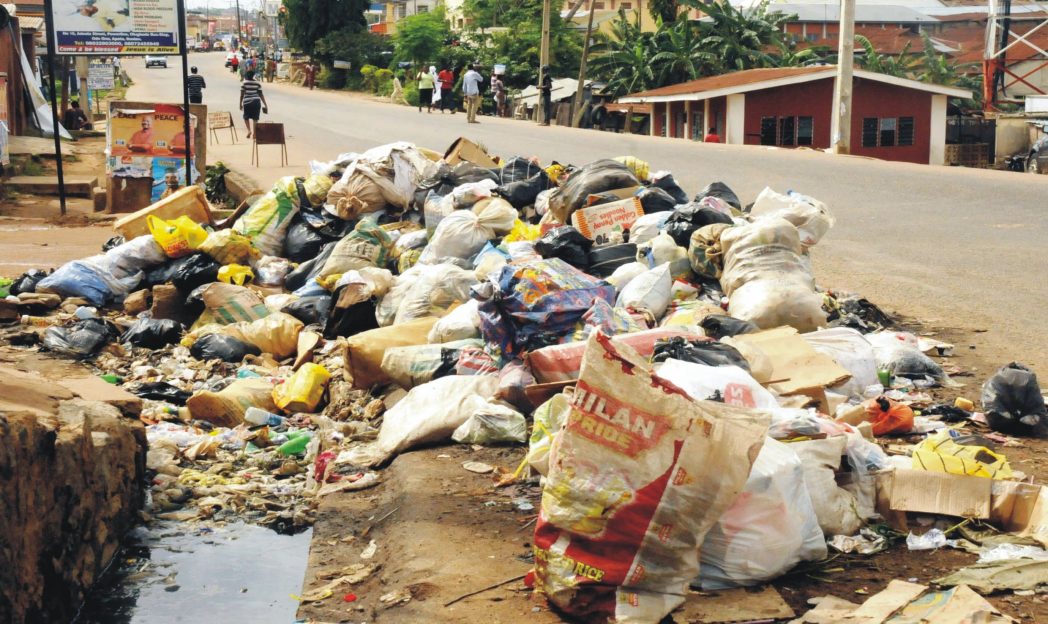
Heap of refused blocking a drainage

Heap of refused blocking a drainage

Continue Reading

Environment

Ministry of Environment Launched Ikosi Market Anaerobic Digester

Published

on

The Lagos State Ministry of Environment and Water Resources (MOE&WR) has officially launched the Ikosi Market Anaerobic Digester powered by C40 Cities Urban Climate Action Programme to turn waste-to-energy.
  The project is facilitated by C40 Cities Urban Climate Action Programme – Climate Action Implementation (UCAP CAI), financed by the UK government’s Foreign, Commonwealth and Development Office (FCDO).
It is also supported by the British High Commission in Nigeria.
This facility will systematically collect the market’s organic waste and feed it into an anaerobic digester.
The natural bacteria will break down the waste without oxygen to produce biogas.
Also,  in doing so, it will carry out a remarkable process of biological transformation that yields two invaluable products, biogas and bio-fertiliser.
Speaking at the event, Mr Tokunbo Wahab, Commissioner for the Environment and Water Resources, described the launch of the Biogas as a milestone achievement in addressing waste management issues in the state.
“Today is a proud moment for Ikosi, and indeed for Lagos State, as we mark another important milestone on our journey towards a cleaner, greener and more resilient city.
“We are not merely commissioning a facility; we are unveiling a vision on how Lagos can turn our everyday challenges into powerful opportunities.
“The Ikosi Fruit Market Biogas Plant represents a bold step in reimagining waste, not as a burden, but as a valuable resource that can drive sustainability, resilience and inclusive growth.
“This project transforms a long-standing problem into a practical solution. Instead of rotting in dumps, organic waste from this market will now be converted into clean, sustainable biogas for cooking and electricity.
“At the same time, it will produce nutrient-rich organic fertilizer that can be used on our farms. This is the circular economy in action—closing the loop, reducing emissions, creating value and improving livelihoods,” Wahab said.
He said the project reflects a much bigger ambition for Lagos State.
“The initiative is being implemented in partnership with C40 Cities and UK International Development under the Climate Action Implementation programme.
“Through this collaboration, Lagos continues to show leadership by translating international climate commitments into practical, community-level action.
“Today’s launch affirms a simple but powerful truth: the future of sustainable cities will be built not only in boardrooms and policy documents, but right here in our markets, our communities and our daily activities,” he said.
On his part, Dr Muyiwa Gbadegesin, the Managing Director of the Lagos State Waste Agency, said the project launch was a testament of the state’s drive to tackle waste.
“Lagos State Government takes very seriously the issue of environment, the issue of waste management, and in particular, the issue of circular economy, which you can only achieve by converting our waste to wealth.
“It’s beginning of many more projects, because we in Lagos State have recognised that waste is a resource.
“By managing our waste in this manner, we are strengthening public health and sanitation in our markets, and we are advancing our shift to climate smart and accountable Waste Management System.
“This project takes organic market waste that would otherwise end up in the drains or illegal dumps or on culverts.
“We want this place to work so that we can get more C40 cities to see what we’re doing and maybe the next market may be the Mile 12 market,” Gbadegesin said.
Also, Mr Gaji Tajudeen, the Permanent Secretary MOE &WR, lauded the partners and all the stakeholders that made the launch a reality.
“I welcome you all to the launch of the Ikosi Fruit Market Biogas Plant. This achievement represents a major step forward in our collective pursuit of environmental sustainability, renewable energy and the conversion of waste into wealth.
“Today is a powerful testament to your commitment to innovation, sustainable development and the importance of collaborative efforts in addressing the environmental challenges facing our state.
“This project represents the power of innovation, collaboration and technology. For a long time, we have grappled with the challenge of waste management.
“The Ikosi Fruit Market Biogas Plant provides an ingenious solution, transforming what we once considered “waste” into valuable resources.
“It will convert organic waste into clean cooking gas and electricity for our homes, and organic fertilizer for our farms.
“We owe our sincere appreciation to C40 Cities and UK International Development under the Climate Action Implementation programme for their continued support,” Tajudeen said.
The C40 Cities Regional Director -Africa, Mr Anthony Okoth, said the “C40 is a global entity that actually focuses on bringing together 100 mega cities across the globe.
“It basically controls a population of about 925 million people in terms of cities, and basically takes care of about 20% of the global economy.
“And basically our main mandate is actually to look to ensure that as we engage the cities, we actually are able to drive the Paris Declaration of ensuring that we don’t go beyond the 1.5 degrees centigrade in terms of heat increase.
“As we stand here today, I’m very proud, because it’s truly simple by saying that we can actually turn waste into wealth.
“And for us, that’s our mantra, working with African grown solutions to actually transform and address the African agenda.
“It is not us who have done it alone, but under the leadership of the state government.
“And so we truly appreciate the leadership and the direction that we have gotten and received for us, this project actually is a symbol of local, grown solutions, where we are actually excited,” Okoth said.
Also, Mrs Temitope Okunnu, the Chief Executive Officer of FABE Foundation and implementer of the project, said the launch “is a reality come true”.
“We have had different engagements in this market since a year plus, it has been an amazing. It has been a beautiful work done here.
“Imagine food waste from the regular Ikosi Market that you and I come on a regular basis, now converting their own food waste that was meant to be at the dump site into electricity, gas, cooking gas.
“And the most important of all, is that we can secure our food in Lagos with the digester, which we call the Eco-fertiliser.
“So, let us appreciate the Lagos State Government through the Ministry of Environment for championing this beautiful cause and C40 Cities for supporting this project in Lagos, Nigeria.
“The replication has started already across the other 35 markets, we are ensuring that we would start something and make it work,” Okunnu said.
NAN reports that the Ministry of Agriculture and Food Systems as partners of the project will be distributing the biodigester to the farmers the project was implemented by FABE Foundation and MEYANA.
Continue Reading

Environment

NiMet predicts longer-than-normal rainy season in 13 states

Published

on

The Nigerian Meteorological Agency (NiMet) has predicted a longer-than-normal length of rainy season in Lagos, Benue, Enugu, Ebonyi, Ogun, Oyo, Nasarawa, Anambra, Kwara, Kebbi, Kaduna, Gombe and Taraba States in 2026.
The Minister of Aviation and Aerospace Development, Mr Festus Keyamo, disclosed this during the Public Presentation of the 2026 Seasonal Climate Prediction (SCP) in Abuja on Tuesday.
Keyamo said NiMet revealed that early onset was expected in Bayelsa, Rivers, Akwa Ibom, Cross River, Benue, Kogi, Nasarawa, Oyo, and parts of Kebbi, Niger, Jigawa, Katsina, Kano, Adamawa, and Taraba.
“While a late onset is expected over Borno State. Rainfall cessation is anticipated to be earlier than normal in parts of Ogun, Osun, Ondo, Imo, Rivers, Akwa Ibom, Kogi and Niger States.
“However, a delayed end of season is expected in Lagos, Ogun, Anambra, Enugu, Cross River, Benue, Nasarawa and Kaduna States.
“Whereas, parts of Borno, Yobe and Niger States are expected to have a shorter-than-normal length of rainy season. A normal annual rainfall amount is anticipated in most parts of Nigeria compared to long-term average,” the agency said.
It forecast above-normal rainfall in Borno, Sokoto, Kebbi, Kaduna, Enugu, Cross River, Abia, Ebonyi, Akwa Ibom States, and the Federal Capital Territory; while in parts of Katsina, Zamfara, Kwara, Oyo, and Ogun States, below-normal rainfall would be expected.
The agency anticipated severe dry spells exceeding 15 days in parts of Oyo and Ogun States during the season of March to May.
NiMet also predicted moderate dry spells over Ekiti, Kogi, Osun, Ondo, Ogun, Edo, Ebonyi, Abia, Cross River, and Delta states, parts of Kogi and Kwara States.
‘’Furthermore, during the June-July-August season, a severe dry spell that may last up to 21 days is predicted for parts of Bauchi, Borno, Gombe, Jigawa, Katsina, Kano, Kebbi, Kwara, Nasarawa, Niger, Oyo, Plateau, Sokoto, Yobe, and Zamfara States.
‘’ The Little Dry Season (LDS), also known as ‘August Break,’ is predicted to begin by late July and will be severe and prolonged over Lagos, Ogun, Ekiti and parts of Oyo States.
‘’The number of days with little or no rainfall will range between 28 and 40 days. A moderate LDS effect is expected over Ondo, parts of Kwara and Edo States,’’ it noted.
According to the agency, both daytime and nighttime temperatures are predicted to be warmer than the long-term average over most parts of the country in January, February, March, and May.
“Some significant rains across the southern parts of the country this year should not be taken to mean that the rainy season has started in these places.
‘’Those engaged in rained agriculture and other rainfall-dependent activities in Nigeria are therefore advised to refer to the predicted onset dates in the publication or consult NiMet for proper guidance, ‘’
Continue Reading

Environment

Oxfam, partners celebrate 5 years of climate governance programmes in Nigeria

Published

on

Oxfam in Nigeria has marked the close-out of its five-year Power of Voices, Fair for All (F4A) and African Activists for Climate Justice (AACJ) programmes in Nigeria.
Oxfam Country Director, John Makina, at the occasion on Thursday in Abuja, described the programmes as “a journey of courage, partnership and transformation.”
Makina said that the initiatives demonstrated the power of communities, when equipped, to “speak, act and lead” in governance, climate justice and economic accountability.
He said that the journey had been more than a development intervention.
“It has been a collective effort to shift power, amplify voices and place citizens where they rightfully belong—at the centre of governance, climate justice and economic accountability in Nigeria,” he said.
Makina highlighted key achievements of the programmes to include: cultivation of 15,500 seedlings through community nurseries and distribution of 3,500 clean cooking stoves in Bauchi State to reduce emissions and improve health.
He stated that 256 community volunteers, including persons with disabilities (PWDs) were also trained in briquette production and other nature-based solutions.
“Oxfam also supported the development of new climate laws, unlocked ?15.5 billion in local climate financing and expanded climate-smart livelihoods, such as beekeeping, briquette production and tree planting.
“Women beneficiaries reportedly earned between ?150,000 and ?300,000 through climate-friendly enterprises.
“The programmes reached more than 10 million Nigerians through the “Follow the Money” media platforms, while civic participation was strengthened through Freedom of Information coalitions, youth civic clubs and improved security commitments from the police,” he said.
Makina added that the initiative also trained 500 journalists in climate reporting, mobilised 664 citizens through the Africa Climate Caravan and empowered PWDs to participate independently in agriculture and community governance.
He expressed appreciation to some implementing partners, such as Civil Society Legislative Advocacy Centre (CISLAC), Connected Development (CODE) and BudgIT Foundation, among others, saying that their support and dedication contributed to the success of the initiatives.
The country director also commended the Government of The Netherlands for funding the project.
Speaking on behalf of the partners, CISLAC’s Executive Director, Auwal Rafsanjani, said the programmes delivered ‘transformative reforms, bold advocacy and unprecedented community-led impact’ across Nigeria.
Rafsanjani noted that the projects strengthened tax justice campaigns, boosted transparency in the extractive sector, improved compliance with beneficial ownership rules and expanded state-level advocacy platforms.
He said that sustained civil advocacy also helped in shaping the passage of four new tax laws and contributing to government’s approval of over 1 billion dollar for the upgrade of major ports.
Rafsanjani stressed that although donor funding had ended, the responsibility to sustain the gains now rests with Nigerians.
“The work must continue because inequalities, corruption and climate challenges remain,” he said.
While giving an overview of the project, the Programme Manager of Oxfam, Henry Ushie, said it built regulatory frameworks that mobilised communities to be proactive in demanding for the three per cent meant for them by companies.
“They were also empowered to access the money and demand for accountability and transparency on how the money was deployed, ensuring that it was ploughed back into the communities,” Ushie said.
Continue Reading

Trending