Connect with us

Business

2014: Ministry Supervises 1,690 Remediation Oil Spill Sites -Report

Published

on

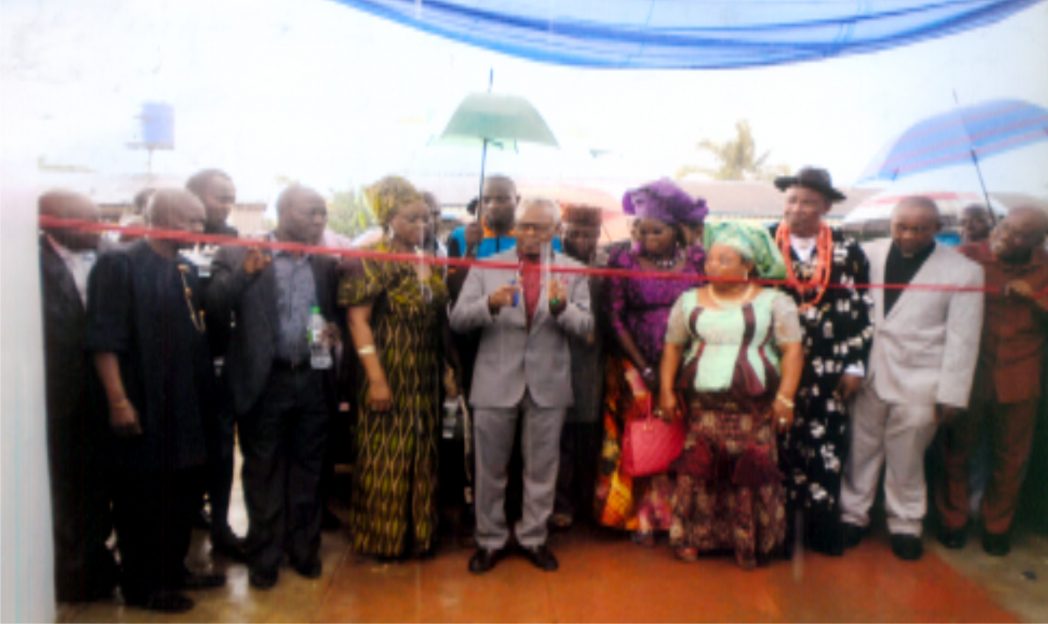
Assstant Regional Eck Spiritual Aide, Nigeria, Odololiyi Lolomari (middle) flanked by Director, Business Development, RSNC, Vincent Ochonma and others cut  the tape to commission Chanhassen lodge, a two-star hotel in Port Harcourt, recently

Assstant Regional Eck Spiritual Aide, Nigeria, Odololiyi Lolomari (middle) flanked by Director, Business Development, RSNC, Vincent Ochonma and others cut the tape to commission Chanhassen lodge, a two-star hotel in Port Harcourt, recently

The Federal Ministry of
Environment has said it supervised the remediation of over 1,690 oil spills sites nationwide in 2014.
The ministry stated this in a report on the “Transformation Agenda of President Goodluck Jonathan in the Environment Sector in 2014’’ obtained by The Tide Source on Friday in Abuja.
According to the report, the ministry has remediated over 430 lead poisoned compounds in Zamfara and four hectares of lead poisoned industrial sites in Bagega village in the state.
“The ministry’s activities on remediation in response to the persistent environmental degradation and devastation of the coastal ecosystem have doubled, especially in oil-producing areas of the Niger-Delta region.
“It has also re-doubled its effort towards reducing incidents of oil spill and remediating the impacted sites,’’ the report stated.
The report said that the ministry bid and won the right to host the UN Environment Programme’s African Regional Coordinating Centre for Marine Pollution.
“This is in recognition of Nigeria’s leadership role in response to marine pollution control in West Africa Sub-region.
“When fully established, it will enhance the nation’s capacity to tackle the challenges of marine pollution in all its ramifications,’’ the report stated.
“ To facilitate regular interaction with public, the ministry applied for and obtained a toll-free line for reporting oil spill incidents across the country; this facility will be fully activated in December 2014.
“The ministry procured equipment for the Geographic information System (GIS) and Remote Sensing laboratories at the headquarters in Abuja and five zonal offices.
“The ministry collaborated with other stakeholders to create the oil spill monitor, a robust GIS-based web platform that has raised the level of awareness and transparency in oil spill management,’’ it said.
On ozone friendly programmes, the report said the ministry had distributed a first set of 30 low pressure foaming machines to small-scale ice machine makers.
It said the ministry distributed the machines to ice-makers under its ozone depleting phase out programme to ensure conversion from the use of ozone depleting chemicals to ozone friendly ones in their production process.
It also said that the ministry had contributed to achieving a clean and healthy environment by training over 50 health officers on construction of domestic bio-digester nationwide.
According to the report, 7, 983 environmental health officers have been registered and certified nationwide, while additional 4, 324 environmental health professionals have been registered to sit for certification examination this month.
“The ministry has collaborated with SURE-P in engaging 10,000 environmental health officers as a stop gap to the yearning of Nigerians for the re-introduction of sanitary inspectors in phases.’’
It said 120 health officers were qualified in Abuja for house -to -house inspection.

Continue Reading

Business

Ban On Satchet Alcoholic Drinks: FG To Loss  N2trillion, says FOBTOB

Published

on

Ahead the December 31 effective date for enforcement of the ban on alcoholic drinks and beverages in PET or glass bottles below 200ml, the Food, Beverage, and Tobacco Senior Staff Association (FOBTOB) has warned that Nigeria risks losing more than N2 trillion in investments.
The union urged the federal government to reverse the planned ban, cautioning that the Senate’s directive to the National Agency for Food and Drug Administration and Control (NAFDAC) would trigger severe socioeconomic consequences across the industry.
Speaking at a Press Conference, in Lagos, the President of FOBTOB, Jimoh Oyibo, said repealing the directive would prevent massive job losses and protect the country from economic disruption.
“Repealing the order would avert the grave repercussions that would most definitely follow the ban, especially by saving approximately 5.5 million jobs, both direct and indirect,” he said.
Oyibo appealed to the Senate to invite stakeholders to a public hearing, insisting that all parties must be allowed to present their positions before any decision is made.
“For a fair hearing and to demonstrate good faith, the Senate should invite relevant stakeholders to a Public Hearing to ‘hear the other side’ and be adequately informed to make an informed decision,” he said.
The union leader urged the Senate to carefully review and endorse the validated National Alcohol Policy, describing it as a multi-sectoral framework developed after last year’s public hearing, when the initial call for the ban was raised.
He urged the lawmakers to consider the entire value chain in the alcoholic beverage industry, including formal and informal workers and legitimate local manufacturers, before approving any enforcement.
Highlighting the economic implications, Oyibo said close to N2 trillion invested in machinery and raw materials could be wasted, while over 500,000 direct workers and an estimated five million indirect workers, including suppliers, distributors, marketers, and logistics operators, could lose their livelihoods.
He said “Nearly N2 trillion worth of investments in machinery and raw materials could be lost. Indigenous Nigerian manufacturers risk total collapse, discouraging future investments.
“Smuggling and the circulation of unregulated alcoholic products may skyrocket, worsening public health dangers. Government tax revenue could decline sharply as factories shut down or scale back operations.
“With rising unemployment and no safety nets, this ban will plunge families into poverty. The very children the policy claims to protect may be forced out of school if their parents lose their jobs”.
Continue Reading

Business

Estate Developer Harps On Real Estate investment 

Published

on

A  Canadian based Nigerian Estate  Developer, Andrew Enofie, has said that diversification of investment into the real  estate sector remains the key to business sustainability.
Enofie said this during the launch of The Golden Gate investments, in Port Harcourt, recently.
He said  real estate sector has always remain stable during period of  inflations, adding that diversification into the sector would ensure that businesses never loose out during such periods.
He also called on Nigerian businessmen to put their money into the Canadian estate industry with the view to reaping maximum benefit.
According to him, Canada  has one of the lowest inflation rate in the world and Nigerian businessmen can reap benefits by putting their monies into the Canadian estate sector.
Enofie said his company, with many years of experience in the real estate sector, can assist Nigerian businessmen with the quest  to acquire property in Canada.
According to him, investors have more opportunities to diversify their funds, saying “it also open doors for investors to invest in the Canadian real estate market.
“With the launch of this fund, we are strategically positioned to navigate current market dynamics,r3 rising demand, shifting rates and evolving economic trends, while focusing on sustainable growth”, he said.
Also speaking, an investor, Mike Ifeanyi, also called on investors to invest in real estate.
He commended the company for its pledged to assist Nigerian businessmen willing to invest in Canada, but added that the whole thing must be transparently done inorder to avoid fraud.
Also speaking, Chukwudi Kelvin, yet another investor, described the event as an eye opener, stressing that time has come for Nigerian investors to go into the Canadian estate sector.
By: John Bibor,/Isaiah Blessing/Umunakwe Ebere/Afini Awajiokikpom
Continue Reading

Business

FG Reaffirms Nigeria-First Policy To Boost Local Industry, Expand Non-oil Exports

Published

on

The Federal Government has reaffirmed its continued commitment to driving Nigeria-First policy aimed at encouraging local manufacturers and improving the economy through the non-export sector.
This is as the National Assembly has revealed that a bill for establishing a Weights and Measures Centre is advancing.
Delivering the keynote address at the Opening Ceremony of the 2025 Nigerian International Trade Fair, in  Lagos, Minister of Industry, Trade and Investment, (FMITI), Dr. Jumoke Oduwole, said that government would continue to promote locally made goods.
Oduwole stated that the fair was not only an opportunity to showcase the best of Nigerian products but ensuring that the country continues to accelerate its non-oil exports under the Renewed Hope Agenda.
The minister noted that the government’s reforms are working and demands a lot of support from all stakeholders.
In her words, “Already, our non-oil exports have grown by 14 per cent. Our exports to the rest of Africa was the fastest growing at 24 per cent last year Q1, year-on-year, CBN released the results at the end of Q1.
“Now, this shows us that our goods are in demand across Africa. Earlier this year, the Federal Ministry of Industry, Trade and Investment opened an air cargo corridor in partnership with Uganda Air, and we mapped 13 Southern and Eastern African countries who want Nigerian products. We understood that they want our fashion, they want our light manufacturing, our food, our snacks, plantain chips, chin chin.
“They also want our zobo, our shea butter, beauty products. The things we take for granted here, our slippers, our hair wigs, are things that are in demand across the continent. And so we’re here to support our Nigerian exhibitors and to welcome our friends across Africa and across the world.
“Exhibitors, buyers who are interested in purchasing, we’re interested in growing these businesses. So a business that is a small business this year should be a medium-sized business in the next five years. Each trade fair has its uses, each trade fair has its conveners, and really, to be honest, there cannot be too many.
“This trade fair, traditionally, has been the largest in the country, and we want to bring it back to its former glory. There’s nothing like a competition.
On her part, the Executive Director, Lagos International Trade Fair Complex Management Board, Vera Safiya Ndanusa, said the board would, in the coming months, champion structured and modernised regulatory frameworks for trade fairs and exhibitions.
She stressed that reviving the Tafawa Balewa Complex was part of a broader mission to strengthen confidence in the nation’s trade infrastructure, while stimulating industrial activity and showcasing the enormous potential of the nation’s citizens.
“Most importantly, we remain the only agency in Nigeria expressly mandated by law to organise trade fairs, and we intend to restore that statutory responsibility to the prominence it deserves ensuring coherence, quality, and national alignment in trade events across the country.
“We will be deepening our engagement with NACCIMA, whose partnership has historically anchored the success of organised trade in Nigeria, while also strengthening ties with ECOWAS, continental business groups, and international partners who share our vision for a more integrated African marketplace.
“In the coming months, we will champion a more structured and modernised regulatory framework for trade fairs and exhibitions, one that protects stakeholders, ensures standards, and positions Nigeria as a credible and well organised destination for regional and continental commerce”, she stated.
She noted that as Africa embraces the promise of the African Continental Free Trade Area, a new momentum was building across the continent.
“For Nigeria, AfCFTA is not just an economic framework; it is a pathway to industrialisation, job creation, and intra-African collaboration.
“This complex must play a central role in that journey. We intend to make this fairground a primary entry point for African trade, a marketplace where producers and buyers from across the continent meet, a logistics hub connected to regional value chains, a centre for cross-border SME activity, and a launchpad for Nigerian businesses looking to expand beyond our borders.
“To achieve this, we are intentionally expanding access to markets physically, economically, and digitally. We are working to make participation more affordable for SMEs, women-led enterprises, and young entrepreneurs. We are improving mobility within and around the complex. A truly vibrant trade ecosystem must be inclusive, and inclusivity begins with access,” she stated.
Chairman, House Committee on Commerce, Ahmed Munir, commended Ministry of Industry Trade and Investment, ED LITF and her team, for promoting the platform as a veritable marketplace of ideas, innovation, and partnership.
He said the event was a clear reflection of the economic agenda of the current administration, supported by Speaker Rt. Hon.Abbas Tajudeen.
According to him, “The House of Representatives recognises that the engine of our economy is the private sector, particularly our Micro, Small, and Medium Enterprises (MSMEs), which contribute nearly 50 per cent to our GDP and employ the vast majority of our citizens.
“To create the competitive environment they need, the National Assembly has been working assiduously to pass and amend vital legislation to enhance the Ease of Doing Business by Streamlining regulatory bottlenecks and reinforcing essential infrastructure to make business operations simpler and more predictable.”
He stressed that as policy makers they would continue to promote the “Nigeria First” Policy through robust legislative support, ensuring that government ministries and agencies prioritise locally manufactured goods in all public procurement processes. “This is our clear statement: We must buy Nigerian to build Nigeria.
“Also to ensure quality and standards, the bill for establishing a Weights and Measures Centre is advancing. Quality is not optional; rather, it is the key to consumer trust and international competitiveness,” he said.
Continue Reading

Trending