
Ict/Telecom
Customs Builds ICT Centre

The Comptroller General
of Customs, Dr. Abdullahi Dikko through the Apapa Area 1 Command of Nigeria Customs Service, have put in place an ultra modern Information Communication Technology (ICT) Centre and Communication Tower(mast) of 160 metres height to serve Zone A of the service, which comprises all customs areas and formations in the South West geo political zone of the country
The new installations, according to Charles Edike, Customs Area Comptroller (CAC) of Apapa customs, will not only boost customs revenue collection, but would also facilitate legitimate trade without compromising national security and improve on the existing customs community relations.
The installed facilities will also enhance the operational interface between the customs other government organisation and organised private sector stakeholders. Govern-ment agencies like the office of the Nigeria Shippers Council are connected to the system.
It also connects private sector stakeholders involved in customs clearance procedure like the commercial banks and Direct Trader Input (DTI) café operators involved in customs duty collection and documentation processing respectively .
‘’Our ICT centre is going to complement the functions of the Customs Ruling Centre based in our Abuja Headquarters, and will serve as a base for training and retraining of officers and stakeholders.
It will also replicate at the area command level some of the modern techniques in customs operations officers have learnt at the Customs Command and Staff College, Gwagawlada, he said.
The Apapa Customs chief added that ‘’As a way of passing the message through the media to the public, we are training over 50 maritime journalists at the ICT Centre as pioneer trainees to give them first hand knowledge about the information they are to disseminate and get them to experience some basic theoretical and case study training about customs clearance procedures under interna-tionally certified trainers. This will also keep them abreast of the fast evolving trend in customs modernization.
‘’Let me refresh our memories on the six point agenda of my CGC which includes maximising the potentials of the service through capacity building; Moral rebirth for discipline and integrity in the service, in tandem with the national current rebranding; Ensuring enhanced welfare package for officers and men of the Service and consolidating on the current e-customs through ASYCUDA for international best practices.
Others are continued collaboration and partnering with stakeholders and international organisations; and Fostering mutual understanding between the Service and the general public through coordinated public relations activities’’.
The installed ICT facilities will further boost the output of the command that has since surpassed all the teething challenges associated with the implementation of the Pre Arrival Assessment Report (PAAR) as agents and importers upon lodging sincere declarations are issued the PAAR in a matter of hours.
The facility was commissioned by Assistant Comptroller General and Zonal Coordinator in charge of Zone A, Victor Osita Gbemudu,who urged all stakeholders to take advantage and make maximum use of the training facility.
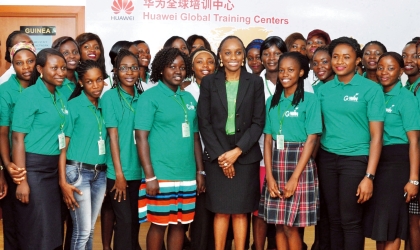
Minister of Communication Technology, Mrs Omobola Johnson (middle), with some girls undergoing Ict training at the 1000 Girls Ict Training Programme of the Ministry in Abuja last Tuesday. Photo: NAN


The Nigerian Communications Commission (NCC) has assured Nigerians of accessible, resilient and safe digital space in the nation’s digital economy.
The Executive Commissioner, Stakeholders Management, NCC, Rimini Makama, gave the assurance at the NCC’s Digital Economy Sensitisation Forum, with the theme, “Leaving No One Behind: Digital Access, Equity and Empowerment” in Abuja.
Makama said that the commission remained committed to ensuring that Nigeria’s national telecommunications infrastructure remained resilient, accessible and secure.
“Digital empoScientists Advocate Shared Responsibility To Boost Food Securitywerment must be inclusive. Without inclusion and equity, the benefits of the digital economy will remain unevenly distributed.
“The commission, through its Universal Service Provision Fund (USPF) and other initiatives, is actively extending digital opportunities to the unserved, underserved, physically challenged and vulnerable groups through several impactful programmes,” he said.
The Publicity Expert for the Association of Telecommunications Companies of Nigeria (ATCON), Dr Nihinlola Fefa, said that the association had been an advocate of cyber security awareness and sensitisation over the years.
“ATCON has been a very key stakeholder in the ICT and telecom industry. We have always advocated for cybersecurity awareness and sensitisation.
“We have been giving our own input over the years. We interface with all the telecom companies. We do a lot of studies, and we also give our contributions in so many ways,” she said.
She commended the Minister of Communications, Innovation and Digital Economy, Bosun Tijani, for deploying technology into rural communities.
According to her, though Nigeria is doing well in the area of cybersecurity, there is room for improvement.
“We are in a good position right now and we can do better from the government side,” she said.
Also speaking, the Head, IT and Cybersecurity, National Data Protection Commission (NDPC), Olorunisomo Isola, said that the commission had rolled out the necessary framework.
An economist, Dr Chinedu Amadi, has urged Nigerians to leverage the opportunities inherent in Artificial Intelligence (AI) to become competitive in the global business and social spaces.
Amadi, who is also the President, Organisation of Youth in International Trade and Commerce (OY-ITC), gave the urge during an interview with newsmen , in Abuja, Monday.
Amadi noted that humanity has always advanced by expanding its intelligence and capabilities through technology across different eras pointing out that AI now drives economic systems, social interactions and competitive advantage among nations globally.
“The world is entering a phase where humans and intelligent machines will share cognitive functions, so Nigeria should innovate or risk being sidelined in the emerging global digital order.
“The next frontier extends beyond AI tools to a deeper relationship between human consciousness and machine intelligence. This phase has the dawn of shared human machine cognition shaping future innovation and development worldwide,” he said.
Amadi noted that countries like the U.S., Japan and China already integrated AI into national planning, logistics and defence operations.
He warned that a deeper wave of collaboration between humans and intelligent systems is rapidly emerging
urging Nigeria and other African nations not to remain passive observers in this technological transition.
“Nigeria must innovate urgently or risk missing another major industrial revolution. Future global leadership will favour nations that create, regulate and ethically manage advanced technologies,” he added.
He said that the youthful population is viewed as a potential cognitive economy capable of driving digital creativity.
He advised policymakers and institutions to develop indigenous technologies, reflecting national priorities and moral values.
The president, however, noted that energy and agricultural sector can gain efficiency through predictive AI and advanced computation, adding that governance can also benefit from digital systems that strengthen transparency and curb corruption.
While noting that neural interfaces and quantum processing would soon merge human thought with computationAmadi said that the evolution demands ethical guidance, empathy and deeper human conscience in education system.
According to him, nations worldwide are racing to regulate AI and Nigeria also needs to define its strategic position.
“The future beyond AI will favour societies that balance innovation with wisdom and uphold human dignity,” he said.
The Nigerian Communications Satellite (NIGCOMSAT) Limited says the country’s digital broadcast subsector has expanded by 35 per cent to 75 per cent utilisation in two years.
This, it said, represented a milestone in the country’s digital transformation drive.
The Managing Director, NIGCOMSAT, Mrs Jane Egerton-Idehen, made the remark at a retreat with the theme: ‘Aligning for the Future: Innovation, Collaboration, and Sustainable Growth”, in Abuja, Monday.
According to her the theme reflects NIGCOMSAT’s commitment to driving Nigeria’s digital transformation and positioning itself as a global satellite industry leader.
She said one of the notable achievements in its broadcast segment was the Digital Switch Over (DSO) project, describing it as not just a technical milestone but also a national service.
“This growth is a testament to the organization’s improved service delivery and stronger engagement with partners and clients.
“The DSO project, a collaborative effort with the National Broadcasting Commission (NBC), is a key milestone in Nigeria’s digital transformation.
“NIGCOMSAT’s contribution to the project is enabling digital broadcasting penetration across the federation, cementing the organisation’s position at the centre of Nigeria’s digital transformation,” she said.
Egerton-Idehen said the achievements were expected to drive revenue growth, with target of three billion naira in annual revenue and eight billion naira in revenue within three years adding that the organisation’s expansion of broadband services and private sector partnership was key to achieving the goals.
“We cannot move boldly into the future without addressing the weight of the past. Our debt profile — both financial and operational — is a reality we must confront with strategy, discipline, and creativity.
“These are our headwinds. We acknowledge them openly because honesty is the first step toward transformation.,” Egerton-Idehen said.
She said in spite of challenges such as economic barriers and competition, the organisation remained optimistic about the future.
“We must out-innovate the market, deepen partnerships, and build a culture of solution-focused, profit-driven, and people-centered excellence.”
“The key initiatives include transitioning to software-defined satellites, expanding broadband services, and the NIGCOMSAT Accelerator for the Space Ecosystem.
“The organisation is prioritising public-private partnerships, branding, and communication, as well as investing in its people,” she said.
The Chief Executive Officer, Data Science Nigeria, Olubayo Adekanbi, said satellite-based economy could revolutionise key sectors such as agriculture, health, and education, creating new job opportunities and increasing productivity.
“By providing internet access to remote areas, satellite technology can bridge the digital divide and ensure no one is left behind.