
Connect with us

Agriculture

Agric Credit: Songhai Farms Boss Makes Case For Farmers

Published

on

The Farm Operations Co-
ordinator of Songhai Rivers Farms Initiative, (SRI), Mr Tammy Jaja, has said that inability of farmers to access government agricultural funds was capable of making farmers produce below expectation for the nation’s food needs.
Jaja stated this while speaking recently in a lecture presented at the University of Port Harcourt, during the 2nd Niger Delta Conference and the 1st induction ceremony of 21 members into the Institute of Natural Resources, Environment and Sustainable Development, (INRES).
He explained that without access to such agricultural funds, farmers, especially the subsistence ones that dwell in the Niger Delta region would not be able to produce large quantities of food stuff.
The three-day event with the theme: “Optimizing the Utilisation of Natural Resources of the Niger Delta and Managing Flood-induced Pollution, Jaja said that it was time for the government to become more sensitive to the plight of poor subsistence farmers in the Niger Delta.
According to him, the essence of setting up agricultural funds would be defeated if rural farmers find it difficult to access such funds for the development of their farms.
“There is no point setting up agricultural funds without allowing poor rural farmers in the Niger Delta to have access to them.
“No Single farm can feed the entire nation, and so our rural farmers must gain access to agriculture funds which give financial support to their farming activities,” he said.
While lamenting the bureaucratic procedures that characterize farmers’ access to funds, he advocated for the elimination of such a process, noting that they have become some of the reasons why many people do not want to go into farming.
Pointing out other challenges faced by subsistence farmers in the Niger Delta, he said non-engagement of key stakeholders in decision-making, limited research, top-bottom approach to policy making, environmental issues, improved seedlings, land tenure system and lack of training for farmers among others were the major challenges faced by the farmers.
The SRI Farm Operations Coordinator further explained that despite the fact that farmers were the key stakeholders in agriculture, they do not receive agric training and do not even know how to source for agricultural funds.
“The agricultural sector has other challenges which include absence of research and development, environmental constraints, the frustrating land tenure system of 1978, gender issues in agriculture, non-implementation of research findings, poor farmers’ linkage with the market as well as other numerous challenges” he said.
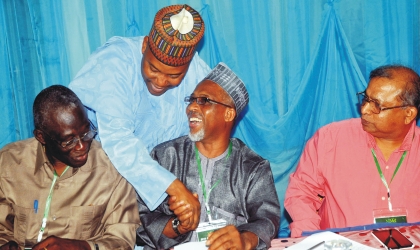
Commissioner, Katsina State Ministry of Environment, Mr Jamilu Danmusa (2nd left) in a handshake with representative of Food and Agriculture Organisation, Mr Rabe Mani (2nd right), at the opening of 2014 seasonal rainfall prediction follow-up workshop in Abuja. With them is consultant and team leader, extension, Federal Ministry of Agriculture and Rural Development,  Prof. Tunji Arokoyo (left) and President, Global Climate Technology, Dr Shrikant Jagtap. Photo: NAN

Commissioner, Katsina State Ministry of Environment, Mr Jamilu Danmusa (2nd left) in a handshake with representative of Food and Agriculture Organisation, Mr Rabe Mani (2nd right), at the opening of 2014 seasonal rainfall prediction follow-up workshop in Abuja. With them is consultant and team leader, extension, Federal Ministry of Agriculture and Rural Development, Prof. Tunji Arokoyo (left) and President, Global Climate Technology, Dr Shrikant Jagtap. Photo: NAN

Continue Reading

Agriculture

KWASANGLaunches Cassava Processing Factory To Boost Value Chain In Kwara

Published

on

The Kwara State Government has inaugurated the Kwara State Association of Nigerians in UK (KWASANG) APEX CO-OP Cassava Value-Addition Factory in Osin Pakate, Ilorin East Local Government Area, to boost cassava value addition and agro-processing in the State.
Speaking at the event, Alabi, Commissioner for Agriculture and Rural Development, Afees Abolore Alabi, described the initiative as a cooperative-led programme that aligns with the State’s agricultural development priorities.
He noted with satisfaction that the project demonstrates how farmer organisations, supported by the right policies and partnerships, can drive sustainable agribusiness growth.
Alabi explained that cassava value addition plays a critical role in reducing post-harvest losses, improving product quality, and increasing farmers’ incomes, while also creating employment opportunities for youths and women.
He added that initiatives such as the KWASANG factory contribute to food security, supply of industrial raw materials, and rural economic development.
Alabi acknowledged the partnership of the leadership of KWASANG with diaspora partners, describing their collective investment as a strong signal of confidence in cassava production and processing opportunities within the state.
The Commissioner further noted that cooperative organisation remains a key pillar in the Government’s approach to inclusive agricultural development.
Alabi stated that the role of the Kwara State Government is to provide an enabling environment through supportive policies, infrastructure development, capacity building, and strategic collaboration with cooperatives and the private sector.
He added that the progress being recorded across the cassava value chain reflects the development direction of Governor Abdulrahman Abdulrazaq, whose administration continues to prioritise agricultural transformation through strategic partnerships and investor-friendly policies.
The factory, according to the Commissioner, is expected to process cassava into products such as Gari, high-quality cassava flour, starch, and other value-added derivatives for household consumption and industrial use.
Alabi stated “The initiative also complements ongoing efforts to strengthen the cassava value chain through improved access to inputs, extension support, and market linkages aimed at increasing productivity and profitability for farmers across the State”.
Earlier, the Chairman of KWASANG Farmers, Mustapha Tunde Salawu, appreciated the Kwara State Government for creating a supportive environment that made the project possible.
He encouraged Nigerians in the diaspora, particularly Kwarans, to look back home and invest as a way of contributing to the development of their communities, Kwara State, and the country at large.
Salawu noted that Kwara State’s vast arable farmland and its strategic location as a gateway between the northern and southern parts of the country made it a highly attractive destination for agricultural and agribusiness investment.
“The KWASANG APEX CO-OP Cassava Value-Adding Factory, is expected to reduce post-harvest losses, improve market access for cassava farmers, and stimulate economic activities within Osin Pakate and surrounding communities”, he said.
Continue Reading

Agriculture

Livestock Ministry Empowers Women, Youths For Sustainable Growth

Published

on

The Federal Ministry of Livestock Development has reaffirmed its commitment to empowering women and youths as key drivers of a sustainable, innovative, and competitive livestock sector in Nigeria.
The Director, Technical, Office of the Permanent Secretary, Dr. Peter Alike, stated this at a Capacity Building Workshop for Women and Youths in the Livestock Value Chain, held in Abuja from Monday, 29th – Tuesday 30th December, 2025.
Alike emphasised that integrating sustainability and innovation across the entire livestock value chain, from feed production and animal husbandry to processing and marketing, is critical to transforming the sector and unlocking its economic potential.
He noted that building the capacity of women and youths remains central to the Ministry’s mandate to reposition livestock as a viable contributor to food security, employment, and national growth.
According to him, the capacity-building initiative is designed as a continuous and transformative programme, equipping participants with practical, hands-on skills that can be directly applied to their farms and enterprises.
He stressed that the training goes beyond theory, focusing on actionable knowledge, mindset change, and long-term competency development to promote sustainable livestock practices.
Alike further explained that the strategic importance of women and youths informed their inclusion as a priority group within the ten pillars of the National Livestock Growth Acceleration Strategy (NL-GAS), the Ministry’s flagship framework for sectoral reform.
In his presentation, an Animal Scientist, Ifeanyi Harry Njoagwuani, described sustainability as a continuous journey driven by science and effective management highlighting the adoption of climate-resilient breeds, improved genetics, precision nutrition through optimized feed formulations, and climate-smart housing systems as critical pathways to sustainable livestock production.
Speaking during a session on biogas production for sustainable livestock development, Ayoade Akande, underscored the need to strengthen extension services and promote private sector investment in modern feed technologies.
He advocated for expanded forage seed distribution networks, support for research and innovation hubs, and enabling policies that promote sustainable ruminant nutrition.
In his closing remarks, the Director of Livestock Extension and Business Development, Joseph Ako Eleojo, urged participants to form cooperative alliances and serve as advocates for change within their communities.
He noted that women and youths were deliberately targeted for the programme due to their strategic role in driving innovation, productivity, and sustainability in the livestock sector.
A major highlight of the two-day workshop was a study visit to De-Dre Solution Poultry Farm, located at Pasali 2, Kuje Area Council of the FCT. The farm, with a capacity of 24,800 birds, produces approximately 650 crates of eggs daily, providing participants with practical insights into efficient and sustainable poultry operations.
Participants at the workshop were drawn from poultry and ruminant farming enterprises across several states of the Federation.
Continue Reading

Agriculture

FG, Ogun Distribute Inputs To 2,400 Farmers

Published

on

Federal Government and the Ogun State Government, on Wednesday, distributed farm inputs to farmers as part of effort to address food security challenge.
The State Director, Federal Ministry of Agriculture and Food Security, Dr. Toyin Ayo-Ajayi, during the flag-off ceremony of Inputs Redemption Under The National Agricultural Growth Scheme-Agro Pocket (NAGS-AP), in Ogun State, disclosed that beneficiaries of the gesture were primarily rice, maize and cassava farmers across the State.
Ayo-Ajayi commended the Ogun State Government for partnering with the government at the centre for the effort in supporting farmers with inputs that would bring about yieldings for local consumption and likely exportation.
She noted that government is supporting rice, cassava and maize farmers with inputs worth N212,000; N189,000 and N186,000 respectively.
The Permanent Secretary in the State Ministry of Agriculture, Mrs Kehinde Jokotoye, who represented the  Commissioner in the Ministry, Bolu Owotomo, stated that traditional farmers are critical in food production, hence the need to encourage and support them with inputs that would bring about desired results during harvesting.
Owotomo said: “Let us make good use of this opportunity, so that the success of this phase will make farmers benefit more from the state and federal governments of Nigeria.”
Earlier, State Coordinator, Federal Ministry of Agriculture and Food Security, Dr. Oluwatoyin Ayo-Ajayi, appreciated the present administration for partnering with the federal government for the initiative, adding that the programme is designed to support farmers at the grassroots level in cassava, rice and maize with inputs such as, seeds, pesticides, herbicides and fertilizers, to boost their production and enhance their livelihood.

Continue Reading

Trending