
Nation
THE STATES

Adamawa
Governor Murtala Nyako of Adamawa State, says the
state has diamond in commercial quantity awaiting exploitation.
Nyako made the disclosure in Yola while fielding questions from newsmen on resource control.
He said the state also has coal and other natural resources, quoting a recent survey conducted by foreign experts which confirmed the availability of the mineral resources.
The governor added that “in fact, the recent survey by Russians in Adamawa showed we have commercial quantity of diamond. We also have lots of coal and you know that where there is coal, there is gas.’’
He noted that the gas could be used to produce sufficient fertiliser not only for farmers in the country, but also for export.
Bauchi
The Emir of Bauchi, Alhaji Rulwanu Suleiman, on
Saturday called on the state government to enact a law on polio immunisation to curb its spread.
Suleiman made the call in Bauchi at a roundtable on ways to curb polio organised by the Voice of America (VOA) and the Centre for Disease Control.
Represented by the Dam Amar Bauchi, Alhaji Hassan Bayero, the monarch said such a law would take care of parents who refused to bring out their children and wards for immunisation.
In his contribution, a cleric with the Bauchi State Shari’ah Commission, Uztaz Hadi Abubakar, disabused the minds of the people that the administration of polio vaccine was un-Islamic.
Abubakar explained that it was wrong for parents and guardians to prevent their children and wards from being immunised.
Benue
The Coordinator, First Step Action for Children, Mrs Rose
mary Hua, said the NGO was sponsoring 4,600 children who were victims of HIV/AIDS in various schools in Benue and Nasarawa states.
Hua told newsmen in Makurdi that some of the children were orphans living with the virus.
She said: “we started this assistance in 2011 and the numbers of beneficiaries kept on increasing every year.
“We have also enrolled vulnerable children in various schools and offered preventive healthcare services, psychological, and financial support to their parents where necessary.
“Our primary aim is to bridge the gap between urban and rural communities through the establishment of Early Child Care Centres in areas where schools are not handily accessible for children.
Borno
The Borno State Government has denied allegation by
the National Emergency Management Agency (NEMA) that healthcare services have collapsed in the North-East, due to the activities of insurgents.
The state’s Commissioner for Health, Dr Salma Kolo, told newsmen in Maiduguri, that the allegation was untrue.
Kolo said that no health facility had been closed down in the state due to the Boko Haram insurgency.
“I wish to state categorically that no healthcare facility had been closed down in the state, in spite of the insurgency.
“All the four general hospitals at the state capital are working effectively, so also are the public health facilities in the 27 Local Government Areas of the state.’’
FCT
Governor Lyel Imoke of Cross River State has urged
the Federal Government to introduce appropriate policy that would enhance the development and utilisation of the potential of tourism industry.
Imoke made this call at the Abuja Bantaba, an annual travel event organised by Akwaaba Travel Market in Abuja to celebrate Nigerian centenary.
“Federal Government should make policy that will make Calabar in Cross River and other places in the country to compete with other tourist cities of the world,” he said.
He said that there was need for the Federal Government to give the travel and tourism sector necessary support that would make the nation exploit the full potential embedded in the sector.
Jigawa
The Jigawa State Urban Development Board said it had
concluded arrangements to remove all illegal structures in Hadejia town.
The board’s Chairman, Alhaji Adamu Tahir, made the disclosure when members of the board paid a courtesy visit to the Emir of Hadejia, Alhaji Adamu Abubakar, in Hadejia.
Tahir said the board would remove all illegal structures on roads and other strategic locations in Hadejia and other major towns in the state.
He added that the exercise was designed to ensure compliance with the principles of urban settlement in creating befitting residences for the people.
Kano
The Kano State Universal Basic Education Board
(SUBEB) has commenced massive enlightenment campaign on girl-child education through the use of film shows.
Hajiya Amina Umar, the board’s Deputy Director in charge of Communication unit, made the disclosure in an interview with newsmen in Kano.
She said that the campaign, which started last Friday, was being carried out by the board in collaboration with the Education Sector Support Programme in Nigeria (ESSPIN), a UK funded programme.
She added that the campaign was aimed at sensitising the public, particularly parents, on the importance of girl-child education and the need for them to enroll their daughters in primary schools.
Kebbi
The Zuru Emirate Council in Kebbi State has
mobilised indigenes for the annual Uhola Agriculture Show and Cultural Festival.
The Chairman of the 2014 Uhola Festival Central Organising Committee, Alhaji Isah Sani, told newsmen in Zuru that the two-day festival was an avenue for indigenes to meet and celebrate their traditions.
Sani, who is also the Head of the Dabai Chiefdom, said events lined up for the festival include traditional wrestling, bicycle race, archery, cultural dances, livestock display and the famous Golmo.
Mr Benjamin Dikki, the Chairman of the festival sub-committee, said the committee had mobilised communities to display their farm and livestock products.
Lagos
The Nigerian Navy has pledged to investigate and
prosecute any of its personnel involved in acts capable of tarnishing the image and reputation of the service.
This is contained in a statement signed by Lt. Way Olabisi, Spokesman, Western Naval Command, Lagos.
The statement promised to punish the naval personnel alleged to have shot at a tanker driver at Ibafo/Trinity area of Apapa in the early hours of Friday, if found guilty.
“Nigerian Navy has a reputation of not covering offenders and this case will not be an exception, especially if the suspect is found to be Nigerian Navy personnel.
Ondo
Ondo State Government said it would soon reno
vate all public schools in Owo Local Government Area.
Mr Jide Adejuyigbe, the state Commissioner for Education, made this known while monitoring the conduct of on-going WAEC examinations in the area.
He said this would be in line with policy of the current administration to make the school environment conducive for teaching and learning.
Adejuyigbe, who inspected facilities in some schools, said that the efforts of the state government in monitoring examination had started yielding positive results as cases of examination malpractices had drastically reduced in the state.
Oyo
Rev. Ademola Ishola, the immediate past president,
Nigeria Baptist Convention (NBC), has admonished Nigerian Youths to shun immoral activities and embrace God.
Ishola made the call while delivering a sermon at the solemnisation of Hadiza Okoya and Olamijuwonlo Alao-Akala held at the Molete Baptist Church, Ibadan.
Our correspondent reports that Hadiza is the daughter of the Lagos businessman, Alhaji Rasak Okoya while Olamijuwonlo is the son of a former Governor of Oyo State, Adebayo Alao-Akala.
Ishola, in his sermon entitled “Commitment to Enduring Marriage,” said immoral activities such as homosexuality and others should be condemned in their entirety.
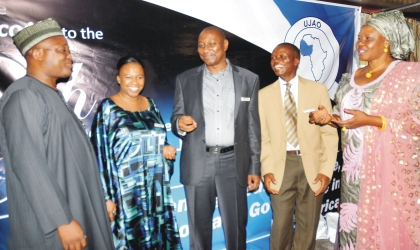
L-R: NUJ National Secretary, Mr Shuaibu Usman-Leman, Coordinator, WAJA Capacity Building Project, Mrs Ndey Tapha-Sussen, out-going President, West African Journalists Association (WAJA)/NUJ National President, Alhaji Mohammed Garba; out-going Treasurer of Waja, Mr Peter Quaqua and National President of NAWOJ, Mrs Asabe Baba-nahaya, at the 8th Ordinary Congress of West African Journalists Association (WAJA) in Abuja, recently.



Rivers State University and the Otonti Nduka Foundation for Values Education jointly hosted a two-day National Conference on 8 and 9 May 2026 to examine the state of values in Nigeria.
The two days conference held at Rivers State University convocation arena brought together academics, policymakers, legal experts and education leaders under the theme _“Trends and Challenges in Upholding Values in Nigeria.”_
The gathering focused on policy gaps, curriculum reform, and the role of ethics in public service and education.
The event opened on Friday with remarks from Vice Chancellor Prof. Chief Isaac Zeb-Obipi, who stressed the need to address declining moral and civic values across Nigeria’s education and public sectors. A book of abstracts for the plenary sessions was also presented to participants.
Key speakers included former Attorney General Chief Dr Kanu Agabi, SAN; NERDC Executive Secretary Prof. Shehu Salisu; Prof. Hauwa Imam, FNAE, of the University of Abuja; former Rivers SUBEB Chairman Ven Dr Fyneface Akah, ; former NIMASA DG Dr Hon. Dakuku Adol-Peterside; and RSU Director of ICT Prof. Sunny Orike.
Discussions centered on integrating values education into schools, tertiary institutions and public institutions, alongside the impact of technology on moral development among young Nigerians. Panel and plenary sessions produced practical recommendations for curriculum and policy reform.
On Saturday, the foundation marked its centenary with the unveiling of the book _Otonti Nduka in History_, launched by Chief Engr. Grant Offor, FNSE. The Nigerian Academy of Education held a ceremonial procession led by its President Prof. Olu Jegede and the Ikwerre Professors Forum.
In a communiqué, participants called for stronger collaboration between government, civil society and academia to mainstream values education nationwide. They recommended reviewing teacher training curricula and expanding digital platforms to promote ethical civic engagement, with the foundation pledging to share the outcomes with education authorities for implementation.
Dignitaries present included Ogbakor Ikwerre Worldwide as Chief Host, Prof. Emeritus Chief T. Uzodimma Nwala, the Ikenga 1 of Mbaise and first philosophy student of Prof. Otonti Nduka, alongside scholars and community leaders.
Amadi Akujobi

The Shell Nigeria Gas Limited, in partnership with the Manufacturers Association of Nigeria, has reaffirmed support for efforts to expand gas distribution infrastructure in Rivers State as part of initiatives aimed at improving access to affordable, cleaner and more reliable energy for industries across the South-South region.
The commitment was highlighted during the SNG–MAN Business Forum held in Port Harcourt, where stakeholders from the industrial and public sectors examined the role of natural gas in driving industrialisation, boosting local production and strengthening energy security.
Speaking at the forum on behalf of the Managing Director of Shell Nigeria Gas Limited, the company’s Head of Gas Distribution, Mr. Chukwuka Amos Ejesi, described natural gas as a critical component of Nigeria’s energy mix and a key driver of sustainable industrial growth.
According to him, Nigeria’s gas development agenda has reached a stage where policy direction must be matched with practical implementation capable of addressing the energy challenges confronting manufacturers.
He noted that pipeline gas offers industries a cleaner, more dependable and cost-effective energy alternative capable of supporting uninterrupted operations, reducing emissions and improving production efficiency.
“Gas is the backbone of manufacturing, and we are encouraged by the growing recognition among stakeholders of the need for cleaner and more reliable energy solutions,” he said.
Ejesi stressed the need for sustained collaboration among energy providers, government institutions and industrial stakeholders to maximise the country’s gas resources for economic development.
He added that improved gas infrastructure would strengthen manufacturing value chains, enhance productivity and promote more competitive industrial operations across Rivers State and the wider South-South region.
Participants at the forum also emphasised the importance of expanding energy infrastructure as a pathway to unlocking industrial capacity, reducing operating costs and promoting sustainable industrial development.
Representing Governor Siminalayi Fubara, the Director-General of the Rivers State Investment Promotion Agency, Dr. Chamberlain Peterside, reaffirmed the state government’s commitment to partnering with private sector investors to revitalise industrial activities in the state.
He identified key projects targeted under the initiative to include the revival of the Ahoada Industrial Park, the New Port City project and the proposed Bonny Industrial Park, all aimed at stimulating economic growth and expanding industrial opportunities along the Bonny corridor.
According to the governor, the long-term vision is to position Rivers State as a leading manufacturing hub in Southern Nigeria through strategic public-private partnerships.
Governor Fubara also commended Shell Nigeria Gas and MAN for sustaining engagements geared towards improving industrial energy access, noting that gas infrastructure development remains central to the state’s economic recovery plans.
He further observed that the gas sector presents enormous opportunities for economic growth, especially as global energy systems continue to shift towards cleaner energy sources.
The governor called on stakeholders to work collectively towards developing a practical and sustainable gas framework capable of supporting the state’s industrial and energy development objectives.
Chairman of MAN, Rivers and Bayelsa Branch, Elder Vincent Okuku, described gas as indispensable to industrial operations, noting that many manufacturers continue to struggle with the high cost of alternative energy sources.
Similarly, President of the Port Harcourt Chamber of Commerce, Industry, Mines and Agriculture, Dr. Chinyere Ngozi Nwoga, said the transition to natural gas had become increasingly necessary for businesses seeking stable and cost-efficient operations.
“Pipeline natural gas provides a more cost-effective and reliable source of energy for industries,” she stated.
Also speaking, former Chairman of MAN in Rivers and Bayelsa States, Mrs. Emilia Akpan, stressed the need to align energy infrastructure development with investment in human capacity.
She maintained that rebuilding the state’s economy would require not only reliable energy supply but also the development of technical skills needed to support long-term industrial growth.
By Kevin Nengia

The City Boy Movement in Etche Local Government Area of Rivers state has commended Senator Allwell Onyesoh on his victory in the APC primary election for Rivers East Senatorial District.
Chairman of the group in Etche, Dr. Fortune Uchenna Obi, spoke to journalists in Okehi Ward after participating in Monday’s direct primary. He described Onyesoh’s emergence as the party’s candidate for the 2027 senatorial election as a reflection of the people’s will.
Dr. Obi said the senator has performed well during his first term and deserves re-election. He also thanked FCT Minister Nyesom Wike, leader of the Renewed Hope Agenda and Rainbow Coalition in Rivers State, for supporting Onyesoh’s candidacy. According to him, Wike’s backing was instrumental to the senator’s nomination, clearance, and victory at the primary.
He further praised voters in Etche and across Rivers East for turning out in large numbers at ward centers and urged them to sustain the support to ensure Onyesoh’s success in the January 2027 general election.
-

 Editorial5 days ago
Enough Of Xenophobic Attacks On Nigerians
-

 Sports5 days ago
Oparaodu Urges Rivers United To Win Katsina United
-

 Education5 days ago
UNIPort Senate Grants Two-Year Amnesty to U2010–U2018 Students
-

 Nation5 days ago
RSU, Otonti Nduka Foundation Holds Centenary Conference, Unveil Book on Values in Nigeria
-

 Oil & Energy5 days ago
Rivers PETROAN Elects 12-Member Executive
-
Politics5 days ago
APC Group Protests Ex–Presidential Aspirant’s Disqualification From Rivers Senatorial Race
-

 Sports5 days ago
” Nigeria’s best domestic players are not in NPFL”
-
Politics5 days ago
Reps Speaker Secures APC Return Ticket For Fifth Term