
Nation
THE STATES

FCT
The Chairman, Senate Committee on Rules and Business, Senator Ita Enang, said all critical bills pending before the Senate would be given urgent consideration before the end of the current legislative year.
Enang told newsmen in Abuja that the critical bills to be given priority attention included the Petroleum Industry Bill, the Constitution Amendment and the Electoral Act.
He said that the leadership of the senate had concluded arrangements to ensure that the bills were considered within the limited time available and assured that the committee working on the PIB would submit its report on resumption on Tuesday.
Enang said following the release of the election timetable by the Independent National Electoral Commission (INEC), the senate would give quick consideration to all aspects of the Electoral Act at least six months before the polls.
Gombe
The Gombe State Government said it spent over N70 billion on
road construction and other infrastructure across the state in the last three years.
The Commissioner for Works and Infrastructure, Alhaji Shehu Hadi-Ahmed, who made the disclosure in an interview in Gombe State said it spent N40 billion on completed projects, while N30 billion was earmarked for ongoing projects in 11 local government areas.
He said that the ministry under Governor Ibrahim Dankwambo-led administration, embarked on massive provision of roads in the last three years.
The commissioner said that 51 roads within Gombe metropolis, inter-local government roads and roads inside local government headquarters out of 55 ongoing roads had been completed.
Jigawa
Birnirwa Local Government Council of Jigawa State has said
that said it would raise 30,000 tree seedlings to enhance desertification campaign in the area.
The council’s Chairman, Malam Mahmud Bundai, disclosed this to newsmen in Birniwa, Jigawa.
Bundai said the council had approved N400,000 for the implementation of the project at its plant nursery.
He said that various tree species, including economic and drought-resistant seedlings, would be raised under the programme adding that the seedlings would be distributed free to the people during this year’s upcoming tree planting campaign.
The chiarman urged the communities to plant trees and desist from indiscriminate feeling of trees and bush burning.
The council, in collaboration with the state government, had established woodlots and planted trees on major roads and other strategic locations to control desert encroachment in the area.
Kaduna
The Katsina State House of Assembly has urged the state
government and the National Emergency Management Agency (NEMA) to provide relief materials for the 350 people affected by windstorm last week in two local government areas.
This is contained in a report of the Committee on Environment and Emergency Relief, directed by the house to assess the damage caused by the storm in Bakori and Musawa local government areas.
Presenting the report last Monday before the House, the Chairman of the committee, Alhaji Babangida Muhammad, said the disaster rendered 196 people homeless in Bakori council and 154 others in Musawa.
Kano
Red cap hawkers in Kano made brisk business during
the state congress of the All Progressives Congress (APC).
Red cap in Kano State is the symbol of Governor Rabiu Kwankwaso’s movement, known as “Kwankwasiyya movement’’ which refers to accountability and good governance.
Most of the hawkers, who trooped to the Sani Abacha Stadium at Kofar Mata in Kano metropolis, venue of the event, were able to make huge sales due to high demand of the commodity from the delegates.
One of the hawkers, Malam Musa Bala, said that he made more that N45, 000 from the sales of the caps during the event.
Another hawker, Alhasan Lawan, who claimed to have come to the venue around 2:30 p.m, said he sold no fewer than 50 caps, and at exorbitant prices.
“At normal price, each cap costs between N300 and N500 depending on the quality but here, I sold them at between N400 and N600 each,’’ he said.
Kebbi
The Chief Judge of Kebbi State, Justice Bala Mairiga, has
ordered the unconditional released of three awaiting trial inmates and 16 convicts.
Mairiga, who was on a visit to the Birnin Kebbi old and medium prison, also ordered that four awaiting trial inmates be admitted at the Psychiatric Hospital for treatment.
He said the release of the inmates was in line with Section 1 (1) of the Criminal Justice Release Laws of Federal Republic of Nigeria 2007.
The 16 released convicts were under-aged and were convicted for theft and miscellaneous offences.
Mairiga ordered the transfer of some criminal cases from Birnin Kebbi to Zuru and Yauri Divisions for quick dispensation of justice.
Kogi
Timber contractors and saw millers in Kogi State last Tuesday
said they had embarked on regeneration programme for massive tree planting as part of measures to address forest decline.
Kogi East Zonal Chairman of the Timber Contractors Association, Ali Ebiloma, disclosed in Idah, that the resolution was to fulfill part of the conditions given by the state government to lift the ban on logging in the state.
Ebiloma said that Governor Idris Wada had directed that for each tree felled, 10 new plant seedlings must be planted as replacements in line with the state afforestation programme.
He said that the seedlings would be purchased with resources from the Forestry Trust Fund as the annual contributions by the contractors and lodged with the state Board of Internal Revenue Account.
Lagos
The British Council in Nigeria said that plans had been con
cluded to train Nigerians in fashion business to make them compete on the world stage.
A statement issued by the council’s Communication Manager, Mr Desmond Omovie, in Lagos indicates that the programme is designed to expand skills in styling in the business of fashion among interested Nigerian designers.
It said that interested Nigerians must ensure that they meet up with laid down requirements not later than May 2.
The statement also said that the IstitutoMarangoni in London would be collaborating with British Council Nigeria and Style House Files, producers of Lagos Fashion and Design Week to organise the training for the designers.
Ogun
An Ake Customary Court in Abeokuta recently dissolved
the 15-year-old marriage between Mr Akeem Taiwo and the wife, Adijatu, over maltreatment.
The dissolution followed a suit filed by Adijatu against Akeem, alleging maltreatment, lack of care, frequent fighting and threat to life.
She told the court that she could no longer move on with the marriage which produced two children, aged 12 and 10 years.
Akeem, without mentioning a word, agreed that the marriage be dissolved.
The president of the court, Mr Olalekan Akande, dissolved the marriage, saying all efforts made by the court to reconcile the couple failed.
Oyo
The Chief Judge of Oyo State, Mrs Badejoko Adeniji, released
11 inmates of Agodi Prison in Ibadan. The released inmates comprised six male and five female.
She told newsmen that prison decongestion was a major duty of the judiciary which could not be ignored.
“Although the number released may look small when compared with the total number of inmates listed for consideration, yet we have done our best. We hope to be back in about three weeks time to continue where we stopped today,” she said.
She had earlier warned those released to desist from acts capable of bringing them back to prison. “You have learnt your lessons and if you should return here for any reason, there would be no pardon,” she said.
One of the freed inmates, Sulaimon Akintayo, said he was grateful to the Chief Judge and her team.
“I was wrongly accused of stealing and sincerely, I will never wish my enemy to visit the prison,” he said.
Plateau
Governor Jonah Jang of Plateau State said all members of the
State Executive Council were expected to be computer literate to speed up governance by minimising delays.
Jang, represented by his Chief of Staff, Mr Francis Bot, stated this at the beginning of Comprehensive Computer Literacy training for members of the state executive council in Jos.
Commissioner for Science and Technology, Prof. Comfort Piwuna, whose ministry is coordinating the training, commended Jang for investing heavily on ICT and e-governance.
Piwuna noted that e-governance was a global phenomenon as many countries had embraced it for its numerous and obvious advantages.
Sokoto
The National Human Rights Commission (NHRC) last Mon
day in Sokoto started the 2014 nationwide audit of prisons and other detention facilities.
The Executive Secretary of the Commission, Prof. Bem Angwe, started the exercise at the Sokoto prison.
According to Angwe, the commission has since 1999, carried out periodic audits of prisons and other detention facilities across the country and made recommendations.
The Sokoto State Controller of Prison, Hajiya Hauwa Shettima, commended the commission for embarking on the exercise.
Taraba
The Taraba State Acting Governor, Alhaji Garba Umar, has
enjoined the people of Wukari Local Government Area to eschew violence and embrace peace to foster development in the state.
At the presentation of relief materials to victims of the recent crisis in Wukari, Taraba, the acting governor called on the internally displaced persons across the troubled areas of the state to tolerate one another for a peaceful society.
Umar, who was represented by Mr Douglas Dogara, Head of Administration, Taraba State Emergency Management Agency (SEMA), said the eight trucks of food items presented were donated to the state by the National Emergency Management Agency (NEMA).
The Desk Officer of Wukari Local Government, Mr Gideon Utika, received the items for onward distribution to the victims.
The gesture was also extended to other victims of the crisis in Ibbi, Kente, Danacha and Sabon Gari areas of the state.
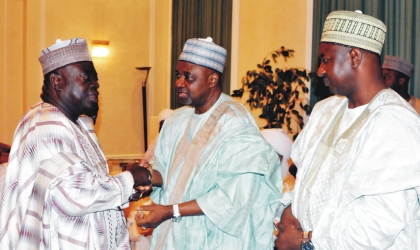
Governor Babangida Aliyu of Niger State (left), condoling with Vice President Namadi Sambo (middle) over the death of his brother, Capt. Yusuf Sambo, in Abuja, recently. With them is Governor Ramalan Yero of Kaduna State.



The Hydrocarbon Pollution Remediation Project (HYPREP) has commemorated the 15th anniversary of the release of the United Nations Environment Programme (UNEP) Environmental Assessment Report on Ogoniland, reaffirming its commitment to restoring the environment and improving the livelihoods of affected communities.
In a statement signed by the Project Coordinator, Prof Nenibarini Zabbey, to commemorate the anniversary, HYPREP described the anniversary as a significant milestone in Nigeria’s environmental restoration efforts, noting that the project has made remarkable progress in implementing the recommendations of the landmark UNEP report released on August 4, 2011.
The UNEP report had revealed extensive oil pollution across Ogoniland, severe environmental degradation, and serious public health risks resulting from decades of petroleum operations. It also recommended an initial $1 billion fund to commence the cleanup of the affected communities.
According to HYPREP, the Federal Government formally launched the Ogoni clean-up in 2016, while the Project Coordination Office was established in 2017 to drive the implementation of UNEP’s recommendations.
Zabbey said the current administration has continued to prioritise the project under the Renewed Hope Agenda.
Providing an update on the cleanup, the Project Coordinator disclosed that 30 of the 65 contaminated sites identified by UNEP have been fully remediated, while work is ongoing at several medium- and high-risk locations. It also stated that more than 1.5 million mangrove seedlings have been planted as part of what it described as the world’s largest restoration of oil-degraded mangroves, with over 1,000 hectares of shoreline already rehabilitated.
Zabbey further revealed that 49 Ogoni communities have been connected to potable water schemes through multiple water projects and booster stations aimed at providing safe drinking water across the region.
In the health sector, he said the 100-bed Ogoni Specialist Hospital in Kpite and the 43-bed Cottage Hospital in Buan are nearing completion, adding that several existing health facilities have been upgraded with modern medical equipment, while five ambulances have been donated to improve emergency healthcare services. The Project Coordinator also disclosed that a three-year human health biomonitoring study is being conducted in collaboration with the World Health Organization’s International Agency for Research on Cancer (IARC).
On economic empowerment, Zabbey stated that the Project has created more than 8,000 direct jobs and trained thousands of Ogoni youths and women in various vocational and technical skills, including software development, cybersecurity, aviation, commercial diving, seafaring, mechatronics, and creative arts. The project also reported awarding scholarships to more than 1,000 students, providing grants to small businesses, and supporting persons living with special needs through skills acquisition programmes.
The statement further highlighted ongoing legacy projects, including the Ogoni Power Project and the Centre of Excellence for Environmental Restoration, which it said is about 96 per cent complete. HYPREP also welcomed the recent designation of the Ogoni Wetland as a Ramsar Site of International Importance and pledged to continue promoting biodiversity conservation and sustainable management of the ecosystem.
Marking the anniversary, Zabbey said the progress achieved over the past 15 years demonstrates the collective commitment of government, development partners, stakeholders, and local communities to restoring Ogoniland. He called for renewed collaboration to sustain the cleanup effort, promote environmental sustainability, and support the long-term development of the region. 3
-

 News2 days ago
RSG Targets Nine Million Residents in Mosquito Net Distribution Campaign
-

 Oil & Energy2 days ago
Aiyedatiwa Signs New Electricity Bill
-

 Oil & Energy2 days ago
NLNG Commissions Research And Innovation Centre In RSU
-

 Maritime2 days ago
Marine Minister Commends President Tinubu On NPERA Bill Assent
-

 News2 days ago
KenPoly Holds Eight Convocations, August 29
-

 News2 days ago
RSG Begins Another Phase of Projects Commissioning Today
-

 News2 days ago
RMAFC Completes Revenue Sharing Review, Proposes New Pay
-

 Maritime2 days ago
NAGAFF Petitions IGP Over Alleged Maritime Police Harassment