
Oil & Energy
Electricity: Nigerians’ Expectations From Private Owners

The Federal Government
on October 30,2013 in Abuja handed over share certificates and licences to new core owners of 15 of the 18 Power Holding Company of Nigeria (PHCN) succesor companies. President Goodluck Jonathan who presided over the ceremony at the Banquet Hall of the Presidential Villa assured Nigerians of better days in electricity supply with improved economy and employment generations.
In his words: “To the Nigerian people who have demonstrated such great patience and confidence, putting up often with darkness, noisy power generating sets, the related pollution and daily disruptions in their lives, I say better days are coming. We do not expect the sector to be revitalised over night, but we can all look forward to a better time very soon as we have seen in the telecommunication and banking sectors”, adding “I am confident that the power sector will promise no less, knowing the caliber of those who are taking over. Today, we embark on a journey that will usher us to a destination of enduring gain and fulfillment”.
In separate messages to the handing over ceremonies across the country, Vice President Namadi Sambo, said sanction awaits any of the successor companies that fails to deliver or violates the rules enshrined in the Power Sector Reforms 2005. Sambo said the companies had been tasked to ensure consistent supply of electricity to improve socio-economic development and charged the companies to transform into world class entities in terms of quality of service delivery, social corporate responsibility, customers satisfaction and profitability.
The successor companies are Amperion Power Company Limited (Geregu), Transcorp/Woodrock (Ugheli), Integrated Energy Company (Ibadan), NEDC/KEPCO (Ikeja), Vigo Power Limited (Benin), Aura Energy Limited (Jos), Integrated Energy Company (Yola), Mainstream Energy Limited (Kainji), West Power and Gas (Eko), Kann Consortium (Abuja), 4 Power Consortium (Port Harcourt) and Sahelian Power SPV Limited.
Handing over the physical assets of the Power Holding Company of Nigeria (PHCN) to the 14 successor companies in Abuja, Power Minister, Chinedu Nebo told reporters that the PHCN had ceased to exist but the debt which government incurred and their assets have been transferred to the Nigeria Electricity Liability Management Company (NELMCO).
For many years, Nigerians have passed through untold hardship resulting from uncontrollable epileptic power supply. One will now think that the handover of the power sector to private managers automatically raises the hopes of electricity consumers across the country to begin enjoying constant and steady electricity supply. Nigerians have been patient with the federal government and its agencies that lacked investment potentials hence the engagement of the private sector.
The expectations of Nigerians are that the successor companies will turn around the power sector to meet international standard. Although this may not be done overnight, it is expected that a change is effected considering the fact that electricity consumers in this country had been subjected to many years of suffering. Past administrations in the country had made proposals and efforts at privatising the power sector to no avail while pessimists believed that the feat could not be accomplished. But the President Goodluck Jonathan-led administration has laid an unprecedented foundation for the country by this feat. Kudos to him.
It is hoped that the electricity market would be regulated in a manner that would promote growth and competitiveness while consumers interests would be protected from over-pricing and poor service. It is also expected that with the inauguration of the successor companies, power supply in the country would improve significantly, stabilise and improve to provide the necessary platform for transformation of the economy as transformation cannot take place without power supply.
With the inauguration of 434 megawatts Geregu II NIPP Power Station in Ajaokuta 2000 megawatts had been added to the grid which would translate to an improvement in power supply in the country. While congratulating President Jonathan’s administration for the sustained efforts in the power sector, Nigerians, we could say, are beginning to see the fruits of their labour.
Nigerians should be made to get the value of their money by providing quality service and regular light. The private managers of the country’s power sector must deliver to impact positively on the Nigerian people.
As Nigerians continue in their endless patience, efforts must be geared and quickly too, to improve the power supply in the country. It will be unfair and unpatriotic for any Nigerian to frustrate the privatisation efforts. All should cooperate with the government and the private investors to ensure the success of our dream.
Nigerians and governments at all levels should join hands to make the revolution in the power sector total. The Federal Government on its part should endeavour to resolve all the labour-related matters affecting the former workers of the PHCN by paying their severance benefits and all that is due to them.
It would be recalled that the final approval of the preferred bidders by the National Council on Privatisation (NCP) and its announcement for the successor companies was done on October 23,2013. By this development, the Nigerian Electricity Industry has been unbundled into generation and distribution companies and a single transmission company with a view to encouraging private sector participation and attracting foreign and local investors into the power sector to ensure economic and reliable electricity supply.
It, therefore, means that the management of the new successor companies and distribution companies must leave no stone unturned to ensure uninterrupted power supply to the entire country. The federal and various state governments are making efforts in providing injection substations while other stakeholders responsible for the construction of the NIPPs are keying into the transformation agenda for the present administration to boost electricity supply and ensure optimum service delivery.
The distribution companies should brace up to the challenge and ensure the use of both old and new facilities to improve the quality and quantum of electricity available to consumers in the country. The completion and inauguration of the National Integrated Power Projects (NIPPs) scattered across the country are a sign of government’s commitment to ensure uninterrupted power supply to Nigerians. Those projects are meant to strengthen the distribution end in the electricity value chain and ultimately enhance access to stable power supply, which will ensure that Nigerians get power in their individual homes and businesses.
According to the Permanent Secretary, Ministry of Power, Ambassador Godknows Igali, government would continue to carryout reforms in the power sector in order to reposition the sector for efficient service delivery hence the commissioning of new power facilities in parts of the country. For government’s plans to achieve the desired success, the problem of shortage in gas supply must be tackled as well as billing system and load allocation just as the electricity tariff should not be increased as Nigerians are still suffering unsteady supply.
While the federal Government should remain forthright and resolute to enable Nigerians benefit from the handover of the power sector to private owners, the successor companies should not subject Nigerians to constant interruption and too much payment without any significant services. Nigerians deserve the best practice as it relates to power business and any sharp practices that would not allow Nigerians benefit maximally from the handover initiatives must be avoided. All hands must be on deck for the smooth operation of the power sector at all levels.
It is also expected that the rural communities would not be left out in the Federal Government’s Transformation Agenda as it concerns power supply. This is why the sum of N16 billion was approved for rural electrification projects for the electrification of rural communities across the country. The new power owners must be reminded that Nigerians are looking forward to enjoying steady supply of electricity and not the epileptic type that bedeviled the unbundled PHCN, which triggered the handover to private owners.
Improvement in power supply will bolster confident that the Nigeria economy is growing and raise hope for an increase in gross domestic product (GDP) as well as stimulate infrastructure development. This will also boost investment confidence in the country. The Federal Government can use coal and solar to boost energy generation in the country as coal and solar energy sources would contribute tremendously to eliminate erratic power supply.
Power supply or generation has dropped drastically since the new investors took over from PHCN. This is why the president, Nigeria Institute of Electrical/Electronic Engineers (NIEEE), Mr Adekunle Makinde urged the new investors to embark on the maintenance of the facilities of the Power Generation Companies. His words, “most of our generation companies are down due to lack of maintenance and this will not enable them to generate power. Also, gas supply to all these power are not enough and vandalism of power equipment is another hindrance in the sector.
The government and power investors should join hands to make the power sector improvement a reality.
However, the federal government is devoting attention and resources to the power sector because of its critical role in industrialisation. The president had recently approved $3.7bn to improve power transmission across the country and on that note, the Abuja Electricity Distribution Company started the implementation of some strategic plans aimed at boosting power supply to Niger, Nasarawa, Kogi and the Federal Capital Territory (FCT). This is to get stable power supply to consumers in its areas of coverage within the next few months. It is hoped or expected that the Distribution Companies in other parts of the country would follow suit.
The Nigerian National Petroleum Corporation (NNPC) recently blamed the drop in gas supply for power generation on pipeline vandalism, which was attributed to the incident of outright sabotage of some critical gas pipelines that significantly eroded available gas supply to the power plants. Some weeks ago, over 30 per cent (480 MMsf/d) of the installed gas supply capacity was out due mainly to vandalism. The lost gas was equivalent to the gas requirement to generate about 1,600 MW electricity.
The Group Managing Director of NNPC, Mr Andrew Yakubu, however, gave assurance that gas supply would be reinstated in the next few weeks at the completion of various repairs, which is expected to bring a major improvement in power supply.
The power managers should ensure that their output on power improvement equate the determination of the federal government to transform the power sector for the benefit of Nigerians and Nigeria’s economy.
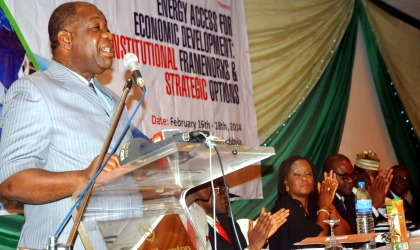
Minister of Power, Prof. Chinedu Nebo (left), declaring open the 7th Annual Nigerian Association for Energy Economics and International Association for Energy Economics’ International Conference in Abuja, last Monday. Photo: NAN
Shedie Okpara



-

 Environment8 hours ago
MOSOP – Tinubu Not Sincere With Ogoni People For Oil Resumption
-

 Nation6 hours ago
RSU, Otonti Nduka Foundation Hold Centenary Conference, Unveil Book on Values in Nigeria
-

 Maritime9 hours ago
Products, Others, To Arrive Lagos Ports Today — MPA
-

 Oil & Energy8 hours ago
SEED: FG To Train 6,000 Energy Professionals
-

 Environment8 hours ago
NEWSAN Urges Investment For Water And Sanitation services
-

 Environment8 hours ago
NGOs Task Media On Investing In Climate Literacy
-

 Education7 hours ago
UNIPort Senate Grants Two-Year Amnesty to U2010–U2018 Students
-
Politics7 hours ago
Primaries: Diri Lauds APC’s Unity, Cohesion In Bayelsa