
News
How I Made Wike Minister, Opara, Deputy Speaker – Amaechi

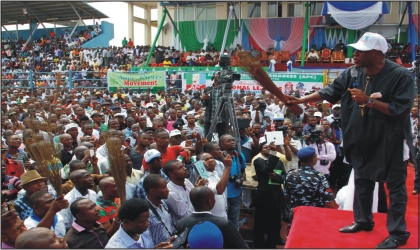
Governor Chibuike Rotimi Amaechi addressing APC faithful
Rivers State Governor and Chairman of the Nigeria Governors’ Forum, Rt Hon. Chibuike Rotimi Amaechi has told the Ogbakor Ikwerre Convention, the socio-cultural body of Ikwerre people in Rivers State, the role he played in the appointment of the Supervising Minister of Education, Chief Nyesom Wike as Minister and Chief Austin Opara as Deputy Speaker, House of Representatives in 2003.
Like Amaechi, both Wike and Opara are from the Ikwerre ethnic group, the largest ethnic group in Rivers State.
However, both Wike and Opara are now leading the fight against Amaechi in Rivers State.
Amaechi spoke last Sunday evening at the 199th Convention of the Ikwerre Cultural Oganization, worldwide held at Ahai Ogbakiri in Emohua Local Government Area of the state.
He lamented that, despite his contributions to give the Ikwerre ethnic nationality a face-lift and give it a pride of place in Rivers State and on the national stage, he had been betrayed by his brothers who are conniving with outsiders to fight him for their personal selfish interests.
“Gradually, we are beginning to wind up in government, and I have started counting either my blessings or losses, one-by-one as a Governor of Rivers State for all Rivers people but from Ikwerre ethnic nationality. I have started asking: What have I done for Ikwerre people? And I am convinced that the Ikwerre history cannot be complete if my name is not mentioned.
“I am not saying this because I am the governor. As speaker of the Rivers State House of Assembly, I ensured that most partS of Ikwerre have roads, the ones that didn’t get then, when I became governor, they got roads. Only a few communities may not have roads in Ikwerre now, and before we go, I will make sure they have roads like most parts of the state. We will ensure that those communities have roads. As Speaker, I asked for the grading of this Ogbakiri Road”.
Amaechi said, “you will ask me apart from these, what have you done? The basic thing we need in Ikwerre is empowerment. You will not recognise it until you take the list of our scholarship programme in the state and know how many of our children are overseas studying. They are quite many and I have met them at different airports. How I know them is because, they greet me in Ikwerre when they see me.”
“I have asked myself, apart from those who are fighting me, how many Ikwerre sons and daughters have one way or the other benefitted from me? When you see Nyesom Wike, tell him I nominated him to be minister. I have one witness sitting here today. Chief Sampson Agbaru is my witness. He led other prominent sons and daughters of Ikwerre to see President Goodluck Jonathan and the President told them that he had not known Nyesom Wike from Adam, that when Amaechi brought Wike’s name, he (Jonathan) opposed it, the President opposed the appointment of my former Chief of Staff as minister.”
“He (President Jonathan) opposed him (Wike) and I begged President Jonathan severally and consistently because I wanted Wike to be Minister. But today, Nyesom Wike has betrayed me for selfish reasons.
“Also, by the grace of God, I made Chief Austin Opara, Deputy Speaker of House of Representatives. God used me. Prominent politicians met me and told me that there cannot be two captains in a boat, if I make Austin Opara, Deputy Speaker, I might not be the political leader in Ikwerre. But I said, I want my people to benefit, and I picked Austin’s name, and we battled to make him Deputy Speaker of House of Representatives in 2003.”
The state chief executive further lamented how Opara allegedly master minded his arrest and detention in 2006.
“In 2006, I was arrested through the machinery of Austin Opara and was detained for one day, meanwhile, he was supposedly one of my supporters to be governor.
“Among those I have also helped, who are now fighting me, is Prof. Simeon Achinewhu, as Vice-Chancellor of Rivers State University of Science and Technology. Achinewhu was sick and at the point of death, and I flew him out of the country for medical treatment, but he is now one of those accusing me and writing against me in the papers.
“For those I gave contracts, they are so many for me to mention, but, if they deny, call the Ogbakor Ikwerre Convention and summon them, I will come here and mention them one-by-one. For instance, Paul Nwonodi is one of them. He is now fighting me and writing and signing all sorts of petition against me. They are people without character, they have no character. They would easily betray anyone.”
“Also, when Ikwerre people met at Aba-Ndele, and told me they wanted roads, I went to the governor (then Dr Peter Odili) and pushed, and roads were constructed. The ones the governor did not do, when I became governor, I did them in the same way as I was doing the roads in other parts of the state. I have told Chief Andrew Uchendu that before the expiration of my tenure, I will make sure I complete all internal roads in Isiokpo and I am also considering the internal roads in Ogbakiri.”
He equally urged the Ogbakor Ikwerre to join forces with other well-meaning Rivers people to resist the plan by the Federal Government to intimidate and influence the votes through the use of police to harass innocent citizens during the elections.
“We will survive the federal might and the way to survive it is to mobilise our people. We must prepare now to chase away those against our people. The President says, he is an Ijaw man, he should not take the oil wells from the Kalabari people”, Amaechi said.
Amaechi also promised that he would remain a detribalised leader until his tenure expires in 2015.
Speaking, President General of Ogbakor Ikwerre Convention, Professor Augustine Ahiazu described the current wave of politicking in the state as alarming, saying that it can cause permanent injury to individuals and the various communities.
“Bitterness in politics can result in undue hatred among friends and relations. It can breed division and polarisation. It can also bring conflict and destruction. Ikwerre sons and daughters should come together to fight any plans for violence in Port Harcourt, because any violence in Port Harcourt is violence in Ikwerre land”, Professor Ahiazu said.



A Professor of Human Anatomy, with specialty in Physical and Forensic Anthropology at the University of Port Harcourt, Prof Gabriel Sunday Oladipo, has expressed delight over the successful delivery of the 207th Inaugural Lecture of the university, describing it as a significant milestone in his academic career.
This is even as he commended the Vice Chancellor of the university, Prof Owunari Georgewill for his tremendous support in achieving the feat.
Speaking in an interview following the lecture in Port Harcourt, the scholar said presenting an inaugural lecture represents one of the highest achievements in a university career, particularly after attaining the rank of professor.
“I feel good. It is a form of achievement. An inaugural lecture is one of the peaks of an academic career in the university, especially after becoming a professor. By the grace of God, I was able to achieve that and also let the world know my area of specialization and what we have been doing over the years. It makes me feel elated,” he said.
Prof Oladipo, who was elevated to the rank of professor in 2018, noted that the journey to the inaugural lecture was built on years of focused research and dedication to his field.
Tracing the motivation behind his research trajectory, he explained that his interest was sparked and rekindled as far back as 1998 during his undergraduate studies.
According to him, he observed that much of the data used in his area of medical research were sourced from foreign populations.
“I noticed as a medical student that most of the data we used were foreign data. I felt we needed local data that are ethnicity-specific. That was the genesis of the whole journey,” he explained.
He said the realization guided his academic pursuits through his master’s and PhD programmes, as he consistently worked towards generating research findings relevant to local populations.
On the reception of his inaugural lecture, the professor expressed satisfaction with the feedback from colleagues and attendees.
“I was happy because I was able to drive home my points, and people clearly understood my presentation. I also received very encouraging commendations from some colleagues,” he said.
The academic also acknowledged the support of the university’s leadership, describing the Vice Chancellor as “highly supportive” of his aspirations and professional growth, saying, “the way the university system runs, if the Vice Chancellor does not approve your inaugural lecture, you cannot present it.”
Inaugural lectures at the University of Port Harcourt provide a platform for newly appointed professors to formally present their research contributions and academic journey to the university community and the wider public.
Prof Oladipo, however, clarified that the Head of Department(HOD) of the Department of Anatomy at the University of Port Harcourt currently functions in acting capacity, in the person of Dr J S Hart.

The Africa Global Development For Positive Change Initiative (ADIAfrica), in collaboration with Stephen Igwe and Judith Igwe International Educational System, has concluded a free eye screening outreach for residents of Rivers State.
The outreach, which was flagged off in Port Harcourt, targeted more than 300 individuals with various eye conditions. Speaking at the event, the International President of ADIAfrica, Prince Dan Mbachi, said the initiative was designed to provide access to essential eye care services for underserved communities.
According to him, the first phase of the exercise commenced in Obio/Akpor Local Government Area and is expected to extend to Etche and Ikwerre Local Government Areas, while the second phase will cover other parts of the state.
Mbachi described the outreach as part of the organization’s commitment to promoting quality healthcare, equity, human dignity, and sustainable development. He emphasized that vision challenges go beyond medical concerns, noting their impact on education, economic productivity, and family wellbeing.
“At ADIAfrica International, we recognize that vision is not merely a medical issue; it is also economic, educational, and social. A child who cannot see clearly struggles to learn. A trader with impaired vision struggles to work. When sight is compromised, opportunity is limited,” he said.
He explained that the exercise provided eye tests, medications, visual field assessments, eyeglasses, contact lenses, and related accessories, stressing that the intervention was aimed at transforming lives rather than serving as a mere charitable gesture.
Mbachi further noted that the initiative aligns with ADIAfrica’s broader mission of advancing sustainable development through practical and people-centered solutions.
Also speaking at the event, a chief from Rumueme Kingdom in Obio/Akpor Local Government Area, Chief Livingston Akaninwo, commended the organisation and its partners for supporting vulnerable members of society. The traditional ruler expressed concern that many people with eye conditions suffer silently due to poverty and limited access to healthcare.
He called on the government and well-meaning individuals to support ADIAfrica’s efforts to enable the outreach to reach more communities across the state.Some beneficiaries, including Mrs. Veronica Peters Olera Pere, expressed gratitude to the organizers for the initiative and appealed for the programme to be extended to other parts of Rivers State to benefit more residents.
By: John Bibor

A three-day intensive training programme aimed at empowering adolescent girls with knowledge, life skills, and advocacy tools to eliminate Female Genital Mutilation (FGM) and promote their wellbeing has ended at Okogbe Community in Ahoada West Local Government Area of Rivers State.
The programme, which held from February 26 to February 28, 2026, was organised by the United Nations Children’s Fund (UNICEF) in partnership with the United Nations Population Fund (UNFPA) and the Rivers State Ministry of Social Welfare and Rehabilitation. It brought together adolescent girls aged between 10 and 19 years drawn from five communities in the area, including Ubeta, Okogbe, Okaki, Akinima, and Akoh.
The training was designed to reactivate and strengthen girls’ clubs across Ahoada West, Abua/Odual, and Emohua Local Government Areas, with a strong focus on ending harmful traditional practices and equipping participants with knowledge to improve their health, safety, and social wellbeing.
Throughout the three days, facilitators engaged the girls in interactive sessions covering a wide range of topics such as menstrual hygiene, puberty education, communication skills, gender-based violence, child rights, personal hygiene, emotional intelligence, and the importance of empathy and peer support. Particular attention was given to the dangers and long-term consequences of FGM, which experts described as a serious violation of the rights of women and girls.
One of the facilitators, child protection advocate, Inyingi Irimagha, specifically of the Child Protection Network(CPN), emphasised the need to challenge harmful cultural practices that negatively affect girls, noting that culture should evolve when it threatens human dignity and health.
UNICEF Desk Officer at the Rivers State Ministry of Social Welfare and Rehabilitation, Victor Iseberetonma, also stressed that empowering young girls with knowledge and confidence remains one of the most effective strategies for eliminating FGM.
He attributed the successful organisation of the programme to the doggedness and commitment demonstrated by UNICEF, the Permanent Secretary of the Ministry, Mrs Lauretta Davies-Dimkpa, and others in making sure that no stone was left unturned for the smooth take-off of the programme, and particularly thanked UNICEF for the great work it is doing in the State.
Other facilitators, including Mr Unah Uchenna and Miss Lucy Uzodinma shared similar sentiments, and called for total elimination of FGM in the society.
Many of the participants described the training as enlightening and transformative, saying, it exposed them to important life lessons they had never received before. One of the girls said the programme helped her understand not only the dangers of FGM but also how to support others emotionally.
“It has educated us about what is wrong, especially about FGM and other issues affecting girls.
“We learned how to talk to people, how to empathise, how to console someone, and how to make others feel relaxed and understood,” Morrow Onisokien Burebure said.
Another participant explained that the programme went beyond discussions on harmful practices to include personal development and daily living skills.
“We learned about our values and how we should live our lives,” she said. “They taught us about menstrual hygiene, how to use sanitary materials properly, how to keep our bodies clean, wash our hands, and how to be friendly even with people we don’t know,” said Dowel Victory Bakewari of Community Secondary School, Akinima.
The participants also pledged to become advocates for change in their communities. One of them stated that she would share the knowledge gained during the training with others back home.
“I will tell people about the effects of FGM and how to stop it.We need to create awareness so that people will understand why it should not continue,” Ake Beauty enthused.
Another participant noted that the training gave her a better understanding of her body and the responsibilities that come with adolescence.
“It is good because we were taught what we need to know about our bodies as girls,” she said. We learned things we should do and things we should not do, and the dangers of FGM. I will tell people in my community that they should stop practising it,” Ebere Testimony Kenneth of Akala-Olu Community Secondary School, Ula-Upata said.
Some participants also expressed appreciation to the organisers for bringing the programme to their in communities, describing it as a life-changing opportunity. One of them simply said, “We thank the organisers for what they have done so far. They have helped us learn things that will protect our future.”
Facilitators at the programme explained that FGM remains deeply rooted in cultural traditions in some communities, which makes sustained awareness and community engagement essential. They noted that while culture plays an important role in society, harmful practices must be abandoned once they are recognised as dangerous.
According to the organisers, the programme successfully met its objectives by equipping participants with practical knowledge, leadership skills, and the confidence needed to speak out against harmful practices. They emphasised that the girls trained would serve as peer educators and change agents within their communities.
The organisers furthermore reaffirmed their commitment to continuing advocacy in efforts, strengthening girls’ clubs, and expanding grassroots awareness campaigns across Rivers State.
As the programme came to a close, the atmosphere was filled with optimism and determination. For the young participants, the training was not just an educational exercise but a call to action — one that has placed them at the forefront of effort to protect the rights, health, and future of girls in their communities.
By: Donatus Ebi


