
Connect with us

Environment

Saving The Environment Via Peaceful Co-Existence

Published

on

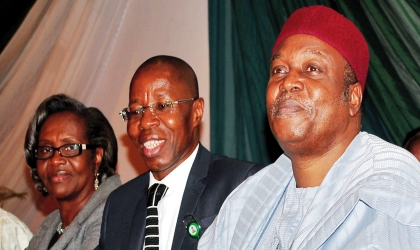
L-R:Director-General, National Environmental Standards and Regulations Enforcement Agency, Dr Ngeri Banabo, Permanent Secretary, Ministry of Environment, Mr Taye Haruna and the suppervising Minister, Mr Darius Ishaku, at the inauguration of the Governing Boards of Agencies and Parastatals under the Ministry of Environment in Abuja, last Monday. Photo: NAN

L-R:Director-General, National Environmental Standards and Regulations Enforcement Agency, Dr Ngeri Banabo, Permanent Secretary, Ministry of Environment, Mr Taye Haruna and the suppervising Minister, Mr Darius Ishaku, at the inauguration of the Governing Boards of Agencies and Parastatals under the Ministry of Environment in Abuja, last Monday.
Photo: NAN
FRED0611130EnviroOn November 5,
2001 the UN General Assembly declared Nov. 6 as the International Day for Preventing the Exploitation of the Environment in Wars and Armed Conflicts.
The declaration was to draw global attention to the negative impacts of war and armed conflicts on the environment.
Through the ages, wars have had their casualties, but the environment has always remained the unpublicised ‘victim’ of such conflicts.
Water wells and soils have been polluted, crops crushed, forests cut down, animals and micro-organisms uprooted from their natural habitat, just to gain military advantage.
Report by the UN Environment Programme (UNEP) showed that over the past 60 years, no less than 40 per cent of all internal conflicts were linked to the exploitation of natural resources.
Against this background, the UN attaches great importance to ensuring that action on the environment was part of conflict prevention, peace keeping and peace building strategies.
This is because there will be no durable peace if the natural resources that sustain livelihoods and ecosystems are destroyed.
UN Secretary-General Ban Ki-moon once called on all nations to prevent the exploitation of the environment in times of conflict.
“The natural environment enjoys protection under Protocol 1 of the Geneva Convention; but this protection is often violated during wars and armed conflicts.
“Water wells are polluted, crops destroyed, forests cut down, soils poisoned, and animals killed, all in order to gain military advantage.
“We must recognise peace and security as a critical ‘fourth dimension’ of sustainable development and also acknowledge that durable peace and post-conflict development depend on environmental protection and good governance of natural resources,’’ he said.
Citing the situation in the Democratic Republic of Congo, Mr Manasseh Ukpabi, a historian, said the crisis had displaced over 250,000 Congolese in the far eastern part of the country.
The UN Secretary-General noted during a recent peace mission to Congo that among other factors, the conflicts in Congo, Sudan and other parts of the world were rooted in the struggle for control of natural resources.
“The United Nations attaches great importance to ensuring that action on the environment is part of our approach to peace.
“Protecting the environment can help countries create employment opportunities, promote development and avoid a relapse into armed conflict,’’ he stressed.
The Secretary-General added that the UN was studying the environmental impacts of conflicts around the world, from the Balkans to Afghanistan, from Lebanon to Sudan.
He, however, said there could be no durable peace anywhere in the world if the natural resources that sustain livelihoods and ecosystems were destroyed.
“We have seen how environmental damage and the collapse of institutions are threatening human health, livelihoods and security.
“These risks can also jeopardise fragile peace and development in post-conflict societies.
“Let us renew our commitment to preventing the exploitation of the environment in times of conflict and to protecting the environment as a pillar of our work for peace,’’ he said.
Mrs Olufunmilayo Oyeyipo, Deputy Director, Environmental Health Services, Federal Ministry of   Environment, noted that children suffered during the 1967-1970 Nigerian civil war, coupled with economic regression.
“The Nigeria economy still has the scares of the 1967 to 1970 civil war. At the end of the war, the South-East of Nigeria suffered a great blow in every area of life.
“Lands and properties were destroyed, starvation and all kinds of diseases came upon the land and the people’s condition was critical.
“Things were so bad that the people fed on anything to survive. It was a great blow to Nigeria even economically,’’ she said.
Oyeyipo, however, said that the Nigeria economy had picked up, adding that the country is blessed with resources, including oil, cocoa, timber, palm kernel, and many raw materials.
She observed that foreign investors now see Nigeria as a destination for investment and are willing to contribute to the growth of the economy.
“A war in this era of growth in the Nigerian economy will be a disaster because the economy is not strong enough to withstand it.
Oyeyipo noted that no matter the kind of war, whether civil or national war, the Nigerian economy would cripple if made to face such crisis, adding that it would take more years to rebuild.
“Whatever the justification, war brings unspeakable terribleness to combatants and civilians alike.
“Wars and conflicts can destroy in minutes what took generations to achieve; beyond the human suffering it causes, war is also devastating to the environment,’’ she said.
The hardship inflicted on the people and damage done to the environment due to wars and conflicts are obvious.
It is, therefore, a situation that must be avoided to ensure human and environmental growth and sustenance for viable national economic development.
Oluleye writes for NAN


Abiodun Oluleye

Continue Reading

Environment

MOSOP – Tinubu Not Sincere With Ogoni People For Oil Resumption

Published

on

The Movement for the Survival of the Ogoni People, MOSOP, has accused President Bola Ahmed Tinubu of lacking sincerity in ongoing efforts to restart  oil exploration in Ogoniland, insisting that key confidence-building promises remain unfulfilled.Gas price forecast
Spokesperson of the Anda Wai-Ogosu faction of MOSOP, Mr. Oscar Imeabe, made the allegation while speaking at the May  stakeholders’ meeting organised by Pipeline Infrastructure Nigeria Limited, PINL, in Port Harcourt.
Imeabe said the Federal Government had failed to implement critical measures it earlier described as confidence-building steps toward the resumption of oil production in Ogoni land.
He specifically cited the Federal University of Environmental Technology in Ogoni, noting that although the institution commenced operations in September 2025, it had not received any operational funding from the Federal Government as of May 2026.
“Part of the confidence building measures by President Tinubu was the establishment of the Federal University of Environmental Technology in Ogoni. The school took off since September 2025, but as we speak, this is May 2026, the Federal Government has not released any funds for the running of that university,” Imeabe said.
“So where is the confidence building measures the president talked about?”
The MOSOP spokesman also referenced the legacy of environmental activism in the region, recalling the execution of Ogoni leader Ken Saro-Wiwa and others, and the longstanding grievances over environmental degradation and economic exclusion linked to oil production.Gas price forecast
“I want to also remind us that people like Ken Saro-Wiwa fought and died for this same oil operations in Ogoni.  Oil was being pumped in thousands of barrels in Ogoni, while Ogoni communities remained impoverished and the environment degraded and devastated,” he added.
Imeabe stressed that MOSOP was not opposed to the resumption of oil production in Ogoni, but insisted that due process, inclusion, and community participation must be guaranteed.
“We are not against oil resumption in Ogoni, but we are saying that the right thing should be done. The people of Ogoni must be involved in the oil resumption process. The people of Ogoni must be part of oil production. The people of Ogoni must benefit from Ogoni oil,” he said.
He urged stakeholders and advisers within the Federal Government to prevail on President Tinubu to fulfil earlier commitments and rebuild trust with the Ogoni people before any restart of oil operations in the area.
By: Kiadum Edookor
Continue Reading

Environment

FG Pledge Support For IOM To Address Climate Incuced In West And Central Africa 

Published

on

The Federal Government has pledged support for the International Organisation for Migration (IOM) initiative aimed at mobilising investment to address climate-induced migration in West and Central Africa.
The Minister of Environment, Mr Balarabe Lawal, made the commitment on Tuesday in Lagos at a regional conference organised by the IOM.
The Tide source reports that the conference was targeted at bridging the gap between climate change policy to the actual climate financing.
Lawal, who was represented by the Director of Climate Change in the ministry, Dr Iniobong Abiola-Awe, said Nigeria would continue to support efforts to bridge the gap between climate policy and financing.
The conference with the theme: “Migration and Climate Action in West and Central Africa: From Policy Commitment to Climate Mobility Investment,” brought together policymakers, development partners and financial institutions.
Lawal said the region was facing increasing environmental pressures, including desertification in the Sahel, coastal erosion in the Gulf of Guinea and flooding across major river basins.
“As widely recognised, climate change acts as a threat multiplier, intensifying vulnerabilities and influencing migration decisions.
“However, we must shift our perspective. Mobility is not only a crisis to be managed, but also a form of adaptation and a pathway to resilience when properly harnessed,” he said.
The minister said Nigeria had taken proactive steps through its National Adaptation Plan, which provides a long-term framework for building resilience and reducing vulnerability to climate risks.
He said the plan prioritised climate-resilient agriculture, water resource management, disaster risk reduction, urban resilience, infrastructure and ecosystem-based adaptation.
Lawal added that Nigeria was integrating human mobility into its climate policy frameworks, recognising migration as a legitimate adaptation strategy rather than solely a consequence of failed adaptation.
He said the country’s approach aligned with the Kampala Ministerial Declaration on Migration, Environment and Climate Change.
Lawal stressed the need for greater investment in climate finance, resilient infrastructure, livelihoods and stronger regional cooperation.
“Without adequate investment, policy commitments risk remaining aspirational,” he said.
He reaffirmed Nigeria’s readiness to collaborate with regional partners, development institutions and the private sector to strengthen climate mobility governance and institutional capacity.
In her opening remarks, the IOM Regional Director for West and Central Africa, Ms Sylvia Ekra, said climate change was already reshaping livelihoods, economies and migration patterns across the region.
She said more than two million people in West and Central Africa had already been displaced by disasters.
According to her, up to 32 million people in the region could be forced to move internally by 2050 if inclusive and effective climate action is not taken.
“Mobility is not only a crisis. It is also part of the solution, enabling people to adapt, manage risks and preserve livelihoods,” she said.
Ekra noted that while policy frameworks existed, responses remained fragmented and insufficient in scale.
She said the conference was significant because it brought together climate and migration stakeholders to jointly develop practical financing solutions.
Also speaking, the Head of Cooperation at the Delegation of the European Union to Nigeria and ECOWAS, Massimo De Luca, reaffirmed the European Union’s commitment to supporting IOM activities in Nigeria and across West and Central Africa.
De Luca described the EU as one of the world’s largest funding partners in the area of migration and said it would continue to work closely with the IOM on climate and migration issues.
Continue Reading

Environment

NGOs Task Media On Investing In Climate Literacy

Published

on

Non Governmental Organisations in Abuja have urged media organisations to invest in climate literacy, aiming to move beyond basic weather reporting toward in-depth, solution-oriented journalism.
The NGOs made the call at a two-day Media Training Conference on “Climate Governance and Gender Mainstreaming in the United Nations Framework Convention on Climate Change (UNFCCC) and Minamata Conventions”.
The Tide source reports that the training was organised by EnviroNews Advocacy & Campaigns for Sustainability (Endvocas) in collaboration with the Women Environmental Programme (WEP).
Rep. Sam Onuigbo, a former two-time member of the House of Representatives, said the media is a critical bridge between scientific knowledge and public action, necessitating specialised reporting to counter misinformation and drive accountability.
Onuigbo, who is also the sponsor of Nigeria’s Climate Change Act 2021, urged the media to also do investigative reports and have specialised environmental desks capable of sustaining informed public engagement.
“Journalism is the bridge between scientific knowledge and public consciousness.
“Scientists can publish reports, legislators can enact laws, and governments can formulate policies, but without journalists who translate technical realities into human understanding, public mobilisation becomes difficult.
“Climate journalism extends far beyond reporting temperature increases or covering international climate summits,” Onuigbo said.
According to him, Climate journalism involves holding governments accountable for climate commitments, investigating climate financing and environmental corruption and also to amplify the experiences of vulnerable communities.
“The Minamata Convention and Environmental Sustainability is beyond greenhouse gas emissions and rising temperatures.
“Environmental governance must also address toxic pollution and hazardous substances capable of threatening both human health and ecological sustainability.
“One of the most important international frameworks in this regard is the Minamata Convention on Mercury, adopted in 2013 and named after Minamata Bay in Japan where industrial mercury poisoning caused devastating health and environmental consequences.”
He stated that mercury pollution remains a major concern, particularly within artisanal and small-scale mining activities where unsafe mercury usage continues to contaminate water bodies, destroy ecosystems, and endanger human lives.
“The consequences include neurological disorders, developmental impairments, respiratory illnesses, and long-term ecological degradation.
“It is now a lived reality affecting communities across Nigeria and beyond. From devastating floods and desertification to food insecurity, displacement, shrinking water bodies, and rising temperatures.
“The consequences of climate disruption are already altering livelihoods and threatening national stability.
“Climate change is too large for one institution to solve alone. It demands a multistakeholder response involving legislatures, executives, the media, civil society, academia, the private sector, traditional institutions, women, and youths,” Onuigbo said.
Mr Michael Simire, Publisher of EnviroNews Nigeria, said that as climate impacts intensify across Nigeria, from devastating floods to heatwaves, biodiversity loss, and pollution, the need for informed, responsible, and gender responsive climate governance has never been more urgent.
“This is where the media stands tall.Journalists are not just storytellers; they are agenda setters, watchdogs, educators, and catalysts for change.
“The narratives you shape influence public perception, policy direction, and community action. When the media is empowered with knowledge, context, and clarity, society benefits from better governance, stronger advocacy, and more inclusive decision-making.
“Women and girls are disproportionately affected by climate change and mercury pollution, yet their voices remain underrepresented in policy spaces.
“Integrating gender perspectives into climate and environmental reporting is not optional, it is essential for justice, equity, and effective solutions,” Simire said.
Mr Steve Abu, the National Network Coordinator, Climate and Sustainable Development Network (CSDevNet) said that in Nigeria and across Africa, climate change is no longer a headline about tomorrow, it is the reality people are surviving today.
“This is why the role of journalists, storytellers, editors, broadcasters, and digital creators has been more critical.
“It is the media that translates complexity into public understanding. It is the media that gives human faces to scientific statistics.
“It is the media that can transform climate conversations from conference halls into kitchen-table discussions across Africa.
Dr Priscilla Achakpa, Founder and Global Lead, Women Environmental Programme said that environmental communication must go beyond headlines.
“Across the world, climate change is no longer a distant threat. It is here with us. We see it in rising temperatures, devastating floods, prolonged droughts, food insecurity, displacement of communities, and growing threats to livelihoods and public health.
“These environmental crises are not just scientific or policy issues. They are human stories. They are economic stories. They are justice stories.
Achakpa added that the role of the media had never been more critical; the media is not merely a channel for information but a force for transformation.
“Without informed and consistent environmental reporting, many citizens may never fully understand the dangers of climate change or the hidden impacts of chemical pollution.
“We need reporting that helps citizens understand why flooding is becoming more frequent, Why heatwaves are intensifying, why unsafe mining practices and mercury exposure matter and why environmental policies should concern every Nigerian.
She emphasised that the fight against climate change and pollution cannot be won by governments alone.
“The stories you tell can influence national priorities.
The questions you ask can drive accountability.
The facts you publish can save lives. And the awareness you create can shape a more sustainable future.
“Because the future of our environment is ultimately the future of our people.
Together, let us amplify the voices for climate justice, environmental protection, and sustainable development,” Achakpa said.
Dr Iniobong Abiola-Awe Director, Department of Climate Change in the Ministry of Environment, advocated gender responsive reporting as regards climate change.
Continue Reading

Trending