
News
Buhari Succumbs To Pressure, Appoints New Service Chiefs …Wike, PDP, Afenifere, Others Hail President’s Action

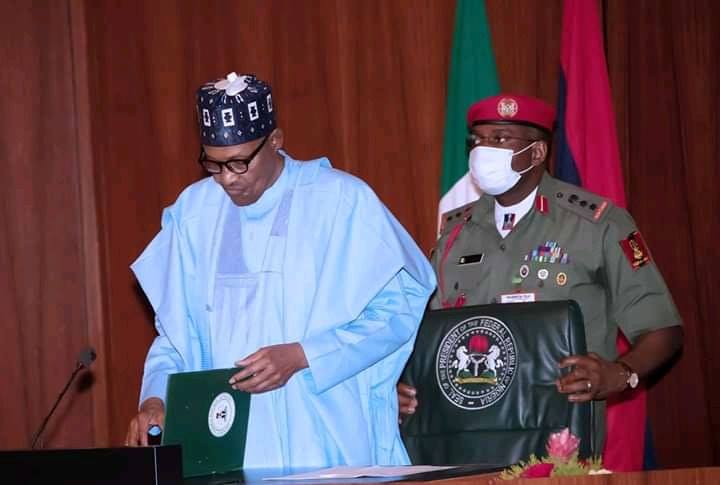
President Muhammadu Buhari has finally succumbed to public pressure to dispense with his service chiefs, who have overstayed their tenure for several years.
In an announcement, yesterday, Special Adviser on Media, Chief Femi Adesina, said Buhari has accepted the immediate resignation of the service chiefs, and their retirement from service.
Those involved are the Chief of Defence Staff, General Abayomi Olonisakin; Chief of Army Staff, Lt-Gen. Tukur Buratai; Chief of Naval Staff, Vice Admiral Ibok Ekwe Ibas; and Chief of Air Staff, Air Marshal Sadique Abubakar.
Buhari thanked the old service chiefs for what he called their “overwhelming achievements in our efforts at bringing enduring peace to our dear country.”
He also wished them well in their future endeavours.
The new service chiefs are: Major-General Leo Irabor, Chief of Defence Staff; Major-General Ibrahim Attahiru, Chief of Army Staff; Rear Admiral Awwal Zubairu Gambo, Chief of Naval Staff; and Air Vice Marshal Isiaka Amao, Chief of Air Staff.
Buhari also congratulated the new service chiefs, and urged them to be loyal and dedicated in the discharge of their responsibilities.
Reacting to the new development, the Rivers State Governor, Chief Nyesom Wike, commended President Muhammadu Buhari for appointing new service chiefs for the country.
Wike noted that even though the appointments came late; the President should be commended for listening to the voice of the people.
He challenged the new appointees to see their appointments as an opportunity to re-engineer the nation’s security architecture which has suffered tremendous setback in the last five years.
“The new service chiefs should not politicise security by aligning with politicians.
“What the country needs now is competence and professionalism that will reduce insecurity to the barest minimum,” he stated.
Wike noted that Nigerians who lost confidence in the former service chiefs are looking up to the new appointees to make the desired change.
He called on all levels of government to give the service chiefs the needed support they would require to execute their assignments.
“This is an opportunity to serve the nation and I believe that the service chiefs will be focused and dedicated,” he added.
Also reacting, the Peoples Democratic Party (PDP) stressed that the senior security officers listened to the party’s voice.
The PDP’s National Publicity Secretary, Kola Ologbondiyan, said the service chiefs outlived their usefulness, hence their resignation, and said the incoming service chiefs should put an end to the spate of insecurity in the country.
The spokesman of the opposition party insisted that the administration of President Muhammadu Buhari was ineffective.
Further reacting, the Coalition of United Political Parties (CUPP) challenged the newly appointed service chiefs to see their appointments as a call to revitalize the weakened security architecture to ensure the country is secured for all.
The CUPP, which said this via a statement issued by its National Secretary, High Chief Peter Ameh, while reacting to the appointment of the new military helmsmen in Abuja, said although, the sack of service chiefs was long overdue but still a welcome development..
Ameh charged that, “The new service chiefs must now go to work to make sure that Nigeria is secured for our people to travel across state lines to do business and prosper the nation without the fear of being kidnapped.”
According to him, “The sack of the service chiefs is a great relief to the officers and men of the Nigerian Armed Forces and the Nigerian people as a whole.
“I have no doubt in my mind that those appointed to lead the new and successful onslaught against those who have boldly taken over our ungoverned spaces have been tested and trusted to do the job.”
Similarly, the pan-Yoruba socio-cultural organization, Afenifere described the sack of service chiefs by President Muhammadu Buhari as a belated exercise.
Reacting to the development, National Publicity Secretary, Afenifere, Mr Yinka Odumakin, said the sack was belated as the service chiefs should have been sacked before now.
He said Afenifere was not impressed with the sack as it was long overdue.
Odumakin stated that Afenifere did not believe that the agenda that made Buhari to keep the service chiefs had been dropped.
He said the Buhari’s government had not changed its agenda of nepotism and managing the country in a sectional manner.
Odumakin also faulted appointment of the new service chiefs, as there was nobody appointed from the South-East part of the country.
Still reacting, the Coalition of Northern Groups (CNG) called on the newly appointed service chiefs to immediately disband all armed groups and militias in the country.
It also urged the security heads to work in harmony with the civil society to ensure that no group has the capacity to challenge the state.
The group in a statement by its spokesman, Abulazeez Sulaiman, also asked President Muhammadu Buhari to “reassert himself by taking direct control of the fight to secure the nation and to finally reclaim the nation’s forests, highways and sea that have been lost to insurgents, other armed criminals.”
The statement reads, “The Coalition of Northern Groups has noted the decision of President Muhammadu Buhari has finally acceded to the huge demands made by Nigerians for the replacement of the nation’s service chiefs as a step towards addressing the serious shortfalls in our policing and security institutions.
“The CNG sincerely welcomes the development in the hope that the hundreds of thousands of people in Northern communities that have been at the mercy of insurgents, bandits, kidnappers, rustlers and rapists without any form of security protection would now get respite.
“CNG advices President Buhari as a military General to reassert himself by taking direct control of the fight to secure the nation and to finally reclaim the nation’s forests, highways and sea that have been lost to insurgents, other armed criminals and assortment of militants in various guises.
“We also advise the new service chiefs on the imperative of involving responsible opinion from community leaders and the civil society for civic contributions in initiatives that will address the manner the nation is designed to be policed and secured.
“We expect them to work in direct harmony with all components of the Nigerian society for action to immediately disband all militias and armed groups in Nigeria to ensure that no group in future has the capacity to challenge the state in its prerogative to maintain law and order, and protect citizens’ lives and properties.
“The acceptable position remains that only legally constituted outfits and lawfully sanctioned organizations under the direct control of the Federal Government, as recognized by the Constitution of the Federal Republic of Nigeria, can be so organized, armed and fitted.
“We expect a renewed commitment by our gallant troops and a stronger will from President Buhari in the fight against Boko Haram, bandits and other forms of criminality without the need for floating victory in the media.
“We urge them to fight this insecurity with resolve and awareness of their obligations under the law, as well as the knowledge that victory will only be pronounced when the nation achieves full cessation of hostilities, disarmament, demobilization and reintegration in the entire region.
“We appeal to fellow Nigerians to show the highest levels of cooperation, restraint and maturity in the manner we relate with the new security chiefs to ensure our defence. Under no circumstances should we as citizens encourage or harbour acts that will increase our exposure to crime, lawlessness and insecurity.”
It would be recalled that Major General Leo Irabor is from Agbor in Delta State, and was a member of the Regular Course 39 of the NDA.
He served as a Commander Training and Doctrine Command (TRADOC) of the Nigerian Army, Minna; Chief of Training and Operations (CTOP) Defence Headquarters; the Theatre Commander, Operation Lafiya Dole, and headed the Multi-National Joint Task Force (MNJTF) as the Field Commander.
The trained engineer also served as Chief of Staff to the Chief of Army Staff.
Major General Attahiru Ibrahim, until his appointment as the Chief of Army Staff, was the General Officer Commanding 82 Division, Nigerian Army.
He was appointed to lead the offensive against Boko Haram in the North-East in May, 2017.
He was, however, redeployed by the then Chief of Army Staff, Lt-Gen Tukur Buratai after a string of attacks by the insurgents, including after giving him a deadline in July to deliver Boko Haram leader, Abubakar Shekau dead or alive within 40 days.
Air Vice Marshal Isiaka Amao was born on September 14, 1965 at Enugu but hails from Oshogbo LGA of Osun State.
He enlisted into the Nigerian Air Force on January 19, 1984 as a member of the 35 Regular Course of the Nigerian Defence Academy.
He had previously served as Trainee/Squadron Pilot, NAF Unit 99 ACTG Kainji (1993-2004), Instructor Pilot/Squadron Pilot, 301 FTS Kaduna (2004-2007), Air Assistance to Chief of Air Staff, Deputy Defence Adviser, Nigerian High Commission London, Assistant Director of Operation Defence Headquarters, Director of Policy and Plans, Nigerian Air Force.
Until his appointment as the Chief of Air Staff by the President, Amao was the Commandant, Armed Forces Resettlement Centre, Lagos.
Rear Admiral Awwal Zubairu Gambo was born on April 22, 1966, and hails from Nasarawa LGA in Kano State.
He enlisted into the Nigerian Navy on September 24, 1984 as a member of Regular Course 36 and was commissioned Sub-Lieutenant on September 24, 1988.
He is an Underwater Warfare specialist with a subspecialisation in Intelligence.
The senior officer has attended several military courses which include, Sub-Technical course and Officers Long course both at NNS QUORRA.
He also attended Junior Division 48/89 and Senior Course 26 both at AFCSC Jaji.
Other courses attended include the National Defence Course at the South African National Defence College.
Until his recent appointment as the CNS, he was the Director of Procurement at the Defence Space Administration.


The Rivers State chapter of the All Progressives Congress Christian Leaders Forum has expressed strong confidence in the capacity of All Progressives Congress (All Progressives Congress) candidates in the state to deliver effective governance if elected into office in the coming elections.
The State Coordinator of the forum, Archbishop Lucky Aroh, made this known during a breakfast and thanksgiving meeting held in Port Harcourt, where leaders gathered to pray for the stability of the party and the safety of its candidates ahead of the 2027 general elections.According to him, the meeting was convened to seek divine intervention for peace, unity, and security among APC candidates across Rivers State.
“Today we are praying for APC stability in Rivers State and the security of our candidates that have been elected to contest the 2027 elections. It is a breakfast meeting,” Aroh said.
He further expressed optimism that the party’s candidates would not disappoint the people if entrusted with leadership responsibilities.
“They will not fail when elected into office. We are here as fathers of the land to let them know, and I must tell you the truth that these are the authentic people that will do well in Rivers State,” he added.
Speaking earlier, the National Chairman of the forum, Professor Olanrewaju Abraham, commended the Rivers State chapter for organizing the programme, noting that the national body of the forum believes strongly in the power of prayer.
He stated that political leadership provides an opportunity to influence society positively, including advancing moral and spiritual values, while expressing confidence that APC candidates at all levels would emerge victorious in the upcoming elections.
Also speaking, the Rivers State Women Leader of the APC, Hon. Darling Amadi, praised the forum for its commitment to prayers for peace, stability, and the protection of party candidates.
Represented by the Deputy Women Leader of the party in the state, she described the initiative as commendable and urged other political and support groups within the party to emulate the gesture in promoting unity and stability.
By: John Bibor, Menebe Emmanuel & Fortune Paibi
Prominent businessman and philanthropist, Elder Anthony Osagwe-Ogo, was celebrated in grand style as he marked his 70th birthday anniversary, with distinguished Nigerians, business leaders, and golf enthusiasts gathering to honour his remarkable contributions to society.
The colourful celebration took place at the Port Harcourt Golf Club, where friends, associates, and well-wishers converged to pay tribute to the revered elder statesman.
Chairman of the occasion, High Chief (Dr.) Ikenna Okafor, described the celebrant as a detribalised Nigerian whose generosity, humility, and commitment to humanity have earned him admiration across different communities and backgrounds.
According to Dr. Okafor, Pa Osagwe-Ogo’s impact on society and the development of his community remains unparalleled. He noted that members of the golfing community are proud to be associated with a father figure who consistently promotes the welfare and well-being of those around him.
He further stated that the history and growth of the Port Harcourt Golf Club cannot be told without acknowledging the significant role played by the celebrant, whose wisdom, encouragement, and leadership have helped sustain the club over the years.
“We are here to celebrate a man who has impacted humanity positively, a peace-loving individual and an epitome of hope for the younger generation. We pray to emulate his virtues. Today, we celebrate a bridge-builder, a trailblazer, and an iconic leader whose life continues to inspire many,” Dr. Okafor said.
He expressed delight at the large turnout of guests from various walks of life, describing it as a testament to the respect and affection Pa Osagwe-Ogo commands within and beyond Rivers State.
In his response, the celebrant, Pa Anthony Osagwe-Ogo, expressed profound gratitude to God for preserving his life and granting him the privilege of attaining the milestone age of 70.
He also thanked members of the Port Harcourt Golf Club, family members, friends, and associates for identifying with him during the celebration and for their unwavering support over the years.
The event featured the cutting of the birthday cake, presentation of awards to deserving members of the club, goodwill messages, and moments of celebration among guests.
The ceremony was attended by notable personalities from the business community, the golfing fraternity, and other sectors, all of whom joined in celebrating the life and legacy of the respected elder statesman.
Rivers State Governor, Sir Siminalayi Fubara, and the Permanent Secretary of the Rivers State Ministry of Information and Communications, Dr. Honour Kuru Sirawoo, have been honoured with awards of recognition in connection with the 2026 Democracy Day celebrations held in Port Harcourt.
The awards, which formed part of activities marking Nigeria’s Democracy Day on June 12, were formally presented on Tuesday at the Ministry of Information and Communications in Port Harcourt.
Presenting the awards was Hon. Abdul Hameed Oladipupo Alli, popularly known as “Mr. Nigeria,” Publisher of Asiwaju Trumpet Magazine and Achievers World International Magazine.
Governor Fubara was recognised for his efforts in sustaining peace, stability, and a conducive political atmospherJohn Bibor / Menebe Emmanuel / Fortune Paibie in Rivers State. The organisers noted that his administration has fostered harmony and strengthened civic participation across the state.
Dr. Sirawoo, on the other hand, was honoured for his exemplary administrative leadership and significant contributions to effective information management within the Ministry of Information and Communications.
Representing Dr. Sirawoo at the presentation ceremony, Dr. Christian Davies received the award on his behalf and expressed gratitude for the recognition. He described the honour as a reflection of Dr. Sirawoo’s unwavering commitment to professionalism, excellence, and dedicated public service.
Dr. Davies assured the organisers that the award would be formally conveyed to the Permanent Secretary.
The event also featured the presentation of commemorative publications highlighting major governance and civic milestones in Rivers State, including Easter celebrations, Workers’ Day activities, the Governor’s third anniversary in office, and Democracy Day programmes.
Organisers of the awards commended the Rivers State administration for what they described as sustained peace, political stability, and improved civic engagement, noting that these achievements have contributed significantly to the state’s continued development.
By: Jessica Sambol
-

 Niger Delta3 days ago
Warri Airport Manager Disputes Air Peace Bird Strike Claim
-

 News3 days ago
Nigeria Won’t Surrender Any Territory To Criminals -Tinubu
-

 News3 days ago
FG Begins Trial Of Over 600 Terrorism Suspects
-

 Politics3 days ago
Parties’ Deregistration: How Justice Lifu Overruled Appeal Court Justices
-

 Rivers3 days ago
79th IAUE Inaugural Lecture: Prof Anero Advoctes Tuition-Free Education For Children
-

 Politics3 days ago
ADC: Okonkwo Rejects Amaechi As Presidential Running Mate, Withdraws Support
-

 Politics3 days ago
2027: Tinubu’s Projects Give APC Edge In South East – Yilwatda
-
News3 days ago
Forum Expresses Confidence In APC Candidates’ Performance In Rivers