Connect with us

Politics

Politics Of A Presidential Team And S’South Dev

Published

on

The meeting was originally scheduled and publicised to hold on Tuesday, November 17, 2020 at the Government House in Port Harcourt, the Rivers State capital and apparent regional headquarters of the South-South geo-political zone. It was, however, botched and some illogical explanations advanced by the Presidency following a barrage of protestations and a demand for an unreserved apology from the Federal Government by governors, governments and peoples of the region.
Exactly one week later, on Tuesday, November 24, 2020, the meeting between the presidential delegation headed by the Chief of Staff to the President, Prof. Ibrahim Gambari, and a cross section of leaders of the region was reconvened at the Rivers State Government’s seat of power, this time around, without much pre-event promotional publicity that attended the ill-fated one.
Alongside the Chief of Staff on the presidential team were the Minister of Niger Delta Affairs, Godswill Akpabio, Minister of State for  Petroleum, Timipre Sylva, Minister of State for Power, Goddy Agba, Minister of State for Labour, Festus Keyamo,  Minister of Health, Osagie Ehanire, Minister of Information, Lai Mohammed, Inspector General of Police, Mohammed Adamu, the Director General of the Department of State Services, Yusuf Magaji Bichi and the Deputy Senate President, Ovie Omo-Agege, amongst others.
Conspicuously absent was the Minister of Transportation, Rotimi Amaechi, in spite of President Muhammadu Buhari’s express directive for all cabinet ministers from the region to be part of the delegation.
In attendance on the side of the South-South region were Governors Nyesom Wike of Rivers State, Ben Ayade of Cross River State, Udom Emmanuel of Akwa Ibom State, Douye Diri of Bayelsa State, Godwin Obaseki of Edo State, Ifeanyi Okowa of Delta State (who is also the chairman of the South-South Governors Forum)  and other stakeholders like the National chairman of the Pan Niger Delta Forum (PANDEF), Idongesit Nkanga.
While there is no indication yet whether the presidency offered the apology earlier demanded by the South-South stakeholders or that the leaders of the region insisted on it, the meeting obviously sailed smoothly.
Intended to identify and deal with latent fundamental issues with the potential of re-enacting the ill-fated #ENDSARS nationwide protests, the meeting, which had also held in other regions of the country, lived up to its billing as it afforded the South-South region’s leaders the opportunity to present nagging socio-political and economic concerns of the people.
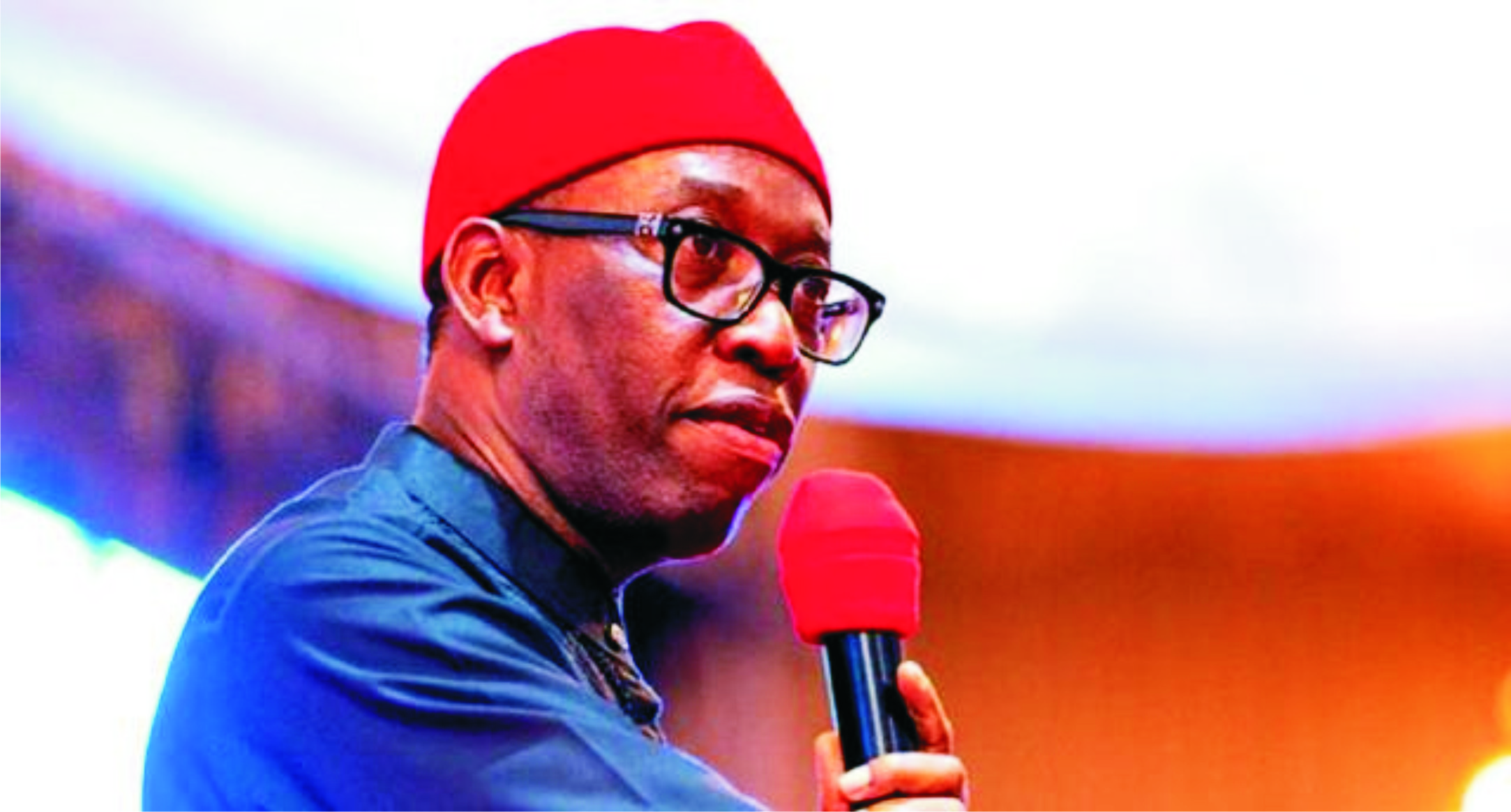
Making the presentation on behalf of the governors and peoples of the region, the chairman of the South-South Governors Forum and Governor of Delta State, Senator Ifeanyi Okowa demanded the restructuring of the Nigerian Federation to align with the principles of true federalism as a guarantee for peace, security and political stability of the nation.
According to Governor Okowa, only the practice of “True federalism guided by the principle of derivation, revenue sharing and control of resources by each state of the federation as it was the case in the First Republic” would meet the aspiration of the people.
“We are all aware of the huge endowment of this country. As such, it is imperative to stress that with a little bit of effort, imagination, hard work, sacrifice and leadership, every state of the federation, as of today, has the ability and capability to contribute to the national purse. This should be encouraged rather than the whole country depending substantially on a region of the country.
“What is worse and even more painful in this ugly situation is the deliberate lack of understanding, empathy and the uncompromising attitude of some Nigerians, who have refused to understand the challenges of the South-South region of the country, especially, the degradation of the environment and our waters. As a result, most of the demands of the region have remained unattended to while the resources of the region have been used continually to develop other parts of the country”, he said.
While reiterating the agitation for the relocation of the headquarters of all oil multi-nationals operating in the country and the Nigeria National Petroleum Corporation’s (NNPC) subsidiaries from Lagos and Abuja to the South-South region, Okowa urged the immediate implementation of the consent judgement delivered in the Supreme Court suit No: SC/964/2016 to enable the South-South region get its share of $55 billion shortfall of collection of deep offshore and inland basin production sharing contracts.
The Governor of Delta State underlined the commitment of the South-South region to the restructuring of Nigeria in a way that guarantees fiscal federalism and devolution of powers to the states to create and manage their own police and security architecture under a federal structure.
He further demanded the rehabilitation and reconstruction of the Port Harcourt, Calabar and Warri Seaports in order to enhance the economic development of the region while asking for the immediate privatisation of the Federal Government owned refineries in Port Harcourt and Warri with the states in the region considered for considerable equity in fairness and justice.
In fact, the presentation is captured succinctly in a seven-point demand viz:
1. Immediate relocation of headquarters of oil multinationals to their operational bases in the South-South region.
2. Immediate relocation of government-owned oil subsidiaries from Lagos and Abuja to the South-South region.
3. Immediate completion of the East-West Road under construction.
4. Immediate privatization of the two refineries in Port Harcourt and the one in Warri for efficiency.
5. Release of all funds due the Niger Delta Development Commission (NDDC) and that henceforth, all NDDC projects be executed in consultation with State governors.
6. The reactivation of seaports in Calabar, Port Harcourt and Warri, including the realisation of the Lagos – Calabar rail line.
7. The implementation of true federalism, resource control, fair revenue sharing and state police as the way to achieving a better Nigeria.
While promising to present the demands of the region to President Muhammadu Buhari, Prof. Gambari said that beyond the #ENDSARS issues, President Buhari acknowledges that the citizens in the region have also been dealing with other peculiarities such as the degradation of the environment due to decades of neglect, mishandling and non-adherence to environmental sustainability standards.
Many  people in the region have since expressed mixed feelings with regard to the meeting as some hold that there was nothing new about the demands and all that was needed to make a difference in the socio-economic fortunes of the people of the region and engender peace, stability and development was the political will to implement the age – old demands.
The question is: What hope is there that this meeting will bring any succour to the suffering people of the oil rich region?
The Deputy Senate President, Ovie Omo-Agege has already pointed out that much of what is being demanded can only be achieved through a constitutional amendment. However, there are a whole lot of others that can be achieved through the exercise of political will by the President and commander- in-chief of the Armed forces of the Federal Republic of Nigeria.
For example, while it is true that such issues as resource control, devolution of power and the like may not be achievable by a Presidential Fiat, the completion of the East-West Road, the revamping of the seaports and related others can be done by executive intervention  and policy reorientation.
Indeed, the governors and those who represented the people of the region did not make any fresh demands from the Federal Government. They merely repeated what had been the main thrust of the heart cry of the people  through the activities and presentations articulated and enunciated over the years by such groups as the Ijaw National Congress (INC), the Ijaw Youth Council (IYC), the Pan Niger Delta Forum (PANDEF), the Traditional Rulers of Oil Mineral Producing Communities (TROMPCOM) and sundry ethnic nationalities, associations and personalities at various official and non-formal fora.
All said and done, the people of the South-South are not asking for special favours from the Nigerian Federation. All they ask of the Nigerian State is fairness, equity, justice and inclusion. And these are the ingredients for a stable and sustainable polity.
By: Opaka Dokubo
Continue Reading

Politics

Jigawa PDP Rejects Lamido’s Suspension, Wants Immediate Reversal

Published

on

The Jigawa State chapter of the Peoples Democratic Party (PDP) has strongly condemned the suspension of a former governor of the state and one of the party’s founding fathers, Alhaji Sule Lamido, by the party’s Board of Trustees (BoT), describing the action as unjust, vindictive and inimical to party unity.

The state chairman of the party, Dr Babandi Gumel, disclosed this in a statement signed and made available to journalists on Saturday.

According to the statement, the Jigawa PDP received news of Alhaji Lamido’s suspension with “profound shock and disappointment”.

The statement added that the suspension, which was reportedly based on allegations that Alhaji Lamido attended meetings capable of undermining party unity, amounts to an affront to justice, internal democracy and the reconciliation efforts recently championed by the PDP leadership.

The party stressed that the exercise of legal and constitutional rights within the party should not be interpreted as an act of disunity. It recalled that Alhaji Lamido approached the court after he was allegedly denied the opportunity to purchase a nomination form to contest the position of National Chairman of the PDP.

The statement further noted that the Federal High Court in Abuja, presided over by Justice Peter Lifu, ruled in Alhaji Lamido’s favour by restraining the PDP from proceeding with its national convention until his right to contest was determined.

The Jigawa PDP argued that the suspension appeared to be a punitive action against Alhaji Lamido for seeking judicial redress over an issue on which the court had already found merit.

The party also faulted the decision of the BoT for contradicting recent public statements by its chairman, Senator Adolphus Wabara, who had emphasised reconciliation within the party, admitted past mistakes and appealed to aggrieved members to return fully to the PDP fold.

However, it maintained that suspending a founding member who sought justice through legal means runs contrary to the spirit of reconciliation and healing publicly advocated by the party leadership.

The chairman said the suspension was premature and prejudicial, as the matter remains before the courts. He also described Alhaji Lamido as one of the few founding fathers of the PDP who has remained loyal to the party without defecting, warning that punishing such loyalty sends a negative signal to other committed members.

The party further argued that the action undermines party unity at a time when the PDP requires cohesion to effectively challenge the ruling All Progressives Congress (APC). It also insisted that there is no provision in the PDP constitution that allows for the suspension of a “life member”.

The party called on the BoT to immediately and unconditionally withdraw the suspension of Alhaji Lamido.

It also demanded that the BoT publicly affirm the right of all party members to aspire to leadership positions in line with the party’s constitution and the laws of the country, without fear of victimisation.

It further urged the BoT to retrace its steps, align its actions with its reconciliation agenda, and tender an apology to Alhaji Lamido.

The Jigawa PDP reaffirmed its commitment to a united, democratic and law-abiding Party.

Continue Reading

Politics

Alleged Tax Law Changes Risk Eroding Public Trust — CISLAC 

Published

on

The Civil Society Legislative Advocacy Centre (CISLAC), Nigeria’s chapter of Transparency International, has raised concerns over allegations that the Presidency assented to a tax law materially different from the version passed by the National Assembly.

In a statement signed by its Executive Director, Comrade Auwal Musa Rafsanjani, CISLAC warned that if proven, such actions would amount to a serious breach of constitutional order, legislative integrity, and public trust.

The organisation noted that Nigeria’s law-making process is clearly defined by the Constitution, stressing that any alteration of a bill after parliamentary passage undermines democratic governance and the principle of separation of powers.

CISLAC further emphasised that taxation has direct implications for citizens, businesses, sub-national governments, and the overall economy. It stated that uncertainty or a lack of transparency in tax legislation could erode investor confidence and raise concerns about accountability and the possible abuse of executive power.

The organisation described the situation as particularly troubling given the rare inclusive, and thorough public consultation that shaped the law’s final provisions prior to its passage.

“This process brought together taxpayers, civil society groups, professional organisations, the private sector, labour unions, local governments, and technical experts, ensuring that diverse viewpoints were considered and carefully balanced.

“Any unilateral changes to these agreed-upon provisions, made outside the established legislative process and without renewed public engagement, not only breach public trust but also violate the fundamental tax principle of representation, which holds that citizens must have a meaningful voice in shaping the laws that govern how they are taxed. Such actions undermine democratic accountability, weaken the legitimacy of the tax system, and risk eroding public confidence”, it noted.

CISLAC expressed particular concern that uncertainty surrounding the authenticity of the tax law, coming at a time when a new tax regime is expected to take effect, could exacerbate the economic hardship already faced by many Nigerians.

It observed that citizens are contending with rising living costs, inflationary pressures, declining purchasing power, and reduced access to basic services, warning that implementing a disputed tax framework under such conditions, risks deepening inequality, discouraging compliance, and fuelling public resentment.

The organisation stressed that tax reforms must be anchored in clarity, legality, fairness, and social sensitivity, cautioning that any tax system introduced without full transparency, adequate public communication, and legislative certainty undermines voluntary compliance and weakens the social contract between the state and its citizens.

As part of its recommendations, CISLAC called on the Presidency to urgently publish the exact version of the tax law assented to, alongside the authenticated copy passed by the National Assembly, to allow for public and institutional verification.

It also urged the leadership of the National Assembly to promptly exercise its oversight powers to determine whether the assented law reflects the will of the legislature, including a review of the enrolled bill process.

The organisation maintained that any discrepancy discovered should be treated as unconstitutional and addressed through lawful means, such as the re-transmission of the correct bill or judicial interpretation where necessary. It further called for an independent review of the process by relevant institutions, including the Office of the Attorney-General of the Federation and, where required, the judiciary, to establish the facts and assign responsibility.

CISLAC noted that the controversy highlights the urgent need to strengthen safeguards at the legislative and executive interface. It recommended measures such as digital tracking of bills, public access to enrolled legislation, and more transparent assent procedures.

CISLAC emphasised that the issue is not about partisan politics but about safeguarding the integrity of Nigeria’s democratic institutions. It warned that allowing any arm of government to unilaterally alter laws passed by another sets a dangerous precedent and weakens constitutional democracy.

The organisation urged all parties involved to act with restraint, openness, and fidelity to the Constitution, noting that Nigerians deserve laws that reflect due process, the public interest, and the collective decisions of their elected representatives.

CISLAC added that it will continue to monitor developments and engage relevant stakeholders to promote accountability, transparency, and the rule of law in Nigeria’s governance processes.

Continue Reading

Politics

DEFECTION: FUBARA HAS ENDED SPECULATIONS ABOUT POLITICAL FUTURE — NWOGU

Published

on

Chairman of the Omuma Simplified Elders’ Council, Chief Cyril Nwogu, says the defection of Governor Siminalayi Fubara to the All Progressives Congress (APC) has brought to an end speculations regarding the governor’s continuation in office beyond 2027.
Chief Nwogu, who stated this while speaking with newsmen in Port Harcourt, also hailed the governor for the bold move, stressing that Rivers State is now fully reintegrated into the national politics.
“I commend the governor for his courage, boldness  and simplicity in defecting to the All Progressive Congress.
 “His defection has brought to an end the threats and speculations against  Governor Fubara’s continuity in office, beyond 2027”, he said.
 The Omuma Simplified Elders Council Chairman, who is also a principal member of Omuma Concerned Elders, also declared the readiness of his group to mobilize support for the governor.
According to him, Omuma people were solidly behind the mandate and leadership of Governor Fubara and prayed that God would grant the governor divine protection.
He also thanked the governor for ensuring that contractors working on the Umuelechi-Umuagwuozhia road in Omuma Local Government Area returned to site, adding that Omuma people will remain grateful to Governor Fubara.
Speaking on the Niger Delta Development Commission (NDDC) solar powered street lights project in Omuma LGA, Chief Nwogu thanked the project coordinators, Mr. Chidi Nwankwo and Hon. Kelechi Nwogu, for bringing such projects to Omuma people.
He, however, noted that most of the solar panels have gone bad, and appealed to the council  Chairman, Hon. Uchechukwu Obasi, to appoint electricity/solar project advisers to monitor and report faulty solar panels for maintenance and immediate replacement.
Chief Nwogu urged Omuma people to support Hon. Obasi and appealed to the council chairman to ensure the continuity of projects that were initiated by the Hon. Promise Reginald led administration.
By: John Bibor
Continue Reading

Trending

Decoration sticker
Decoration sticker
Decoration sticker
Decoration sticker