
News
Boko Haram Kills 11 Soldiers In Borno …NAF Neutralises 10 Bandits In Kaduna

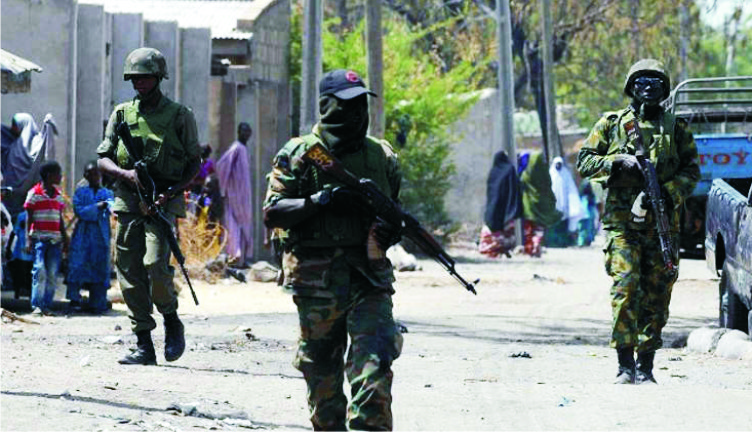
At least, 16 people, including 11 soldiers, have been killed in jihadists’ attacks in Borno State, military and militia sources have said.
Rival factions of Boko Haram launched the attacks on military and civilian targets between Thursday and Saturday, they said.
On Thursday, fighters from the IS-aligned Islamic State West Africa Province ambushed a military convoy near Mauro village in Benisheikh district, a military source said.
“Our men on patrol fell into a terrorist ambush… which claimed 11 soldiers and wounded 16 others. Two other soldiers are still missing,” said the officer, who asked not to be identified.
He said the troops were travelling in three vehicles.
“The terrorists made away with 11 AK-47 rifles and anti-aircraft gun mounted on the gun truck,” he said.
In another attack the same day, Boko Haram gunmen opened fire on a vehicle at Frigi village, killing one person and injuring another, militia sources said.
Jihadist fighters also killed two militiamen in Gubio, 80 kilometres (50 miles) from the state capital, Maiduguri.
On Saturday, Boko Haram militants stormed a camp for those displaced by the conflict in the town of Banki near the border with Cameroon, killing two residents and injuring three vigilantes guarding the area, two militia sources said.
The decade-long Boko Haram campaign has killed 35,000 people and displaced around two million from their homes in northeast Nigeria.
The violence has spread to neighbouring Niger, Chad and Cameroon, prompting a regional military coalition to fight the insurgents.
Similarly, rampaging Boko Haram insurgents, last Saturday afternoon burnt a section of the Emir of Jajare’s Palace in Babangida headquarters of Tarmuwa Local Government of Yobe State.
Eyewitness said the insurgents entered the town in a commando style and headed straight to the emirs palace but the Emir had left the palace two hours before the arrival of the insurgents.
Apparently, in a show of anger, the insurgents decided to burn a section of the palace and carted away with an escort Hilux van (vehicle) of the Emir.
Another resident of Babangida said that the insurgents were on a mission to eliminate the district head in a revenge mission.
The source disclosed that the district head had earlier gave an intelligent report that led to the elimination of some Boko Haram in his domain who were kidnapping locales for ransom.
Information available also indicated that the attack on the town created pandemonium in the entire town as many villagers who came to the market scampered for their lives.
It was gathered that troops in Tarmuwa have been withdrawn more than two months ago following the military recent strategy of Super Camps in Operation Lafiya Dole.
A resident, Iris Adamu, explained that the soldiers came from Dapchi an hour after the attack.
Tarmuwa is located 53km northwest away from Damaturu, the state capital.
But banditry seems not to be abating in Zamfara State despite government’s recent offer of negotiation and amnesty to gunmen troubling the state.
In the latest of their attacks, bandits numbering 300 invaded three local government areas looting foodstuffs, 300 cows, cash and other valuables.
The bandits also killed nine soldiers and then moved to the Birnin Gwari Forest in Kaduna State.
The attack is causing anxiety in the state.
A highly-placed source in the state said that the AK-47-wielding bandits rode on 150 motorcycles (at two each) and easily invaded Mayanchi and Maru from their base in Bayan Ruwa in Maradun Local Government Area.
They wreaked havoc in Sunke in Anka Local Government Area, killing nine soldiers.
The source said: “These bandits raided some parts of Zamfara on Thursday night to Friday morning. They came from Bayan Riwa and passed through Sunke, Mayanci and Maru.
“At Mayanci junction, they ransacked all the shops, collected foodstuffs, many loaves of bread and cigarettes.
“They went to a fuel station in Mayanci and filled up their 150 motorcycles apart from taking away the N300,000 sale proceeds from the staff on duty.
“The people of Mayanci were helpless because each motorcycle was ferrying two bandits with AK-47 rifles.
“They also pounced on herdsmen and loaded cattle into some trucks to their base in Birnin Gwari.
“These bandits killed nine soldiers in Sunke in Anka Local Government Area in what appeared like an ambush.
“It is unfortunate that this is happening in spite of the amnesty deal with the bandits. Most of us were left distraught because policemen were nowhere to assist us.”
Findings revealed that security agencies are already probing the incident especially alleged “no response attitude of the Nigeria Police officers and men in the affected areas.”
A reliable security officer said: “Military authorities and security agencies have started probing the invasion of some of these towns.
“The military command in Sokoto actually alerted the police in Zamfara but there was no response at all. A senior police officer merely said he was aware that the bandits were in transit to the forest in Birnin Gwari.”
Similarly, repentant bandits from Jibia Local Government Area of Katsina State in the early hours of yesterday released another batch of 15 kidnapped victims after having spent 45 days in their custody.
The state Governor, Hon Aminu Bello Masari received the victims at the Government House, Katsina at about 1am.
This brings to about 75 the number of kidnapped victims that have been released by the bandits in the aftermath of the recent dialogue with the state government
The 15 victims, including a day-old baby girl that was delivered in the forest few hours before the release of her mother, arrived Government House, famished and malnourished
They told newsmen that they were kidnapped from Mallamawa village 45 days ago.
According to them since that fateful day nobody knew their whereabouts.
They applauded the governor’s dialogue programme which paved the way for their release.
Fielding questions from newsmen, Masari, who could not hide his joy over the release of the innocent women and children, said the next level of the dialogue programme would be disarmament of the repentant bandits, which he and governors of Zamfara and Maradi in Niger Republic were working on.
In his remarks, Chairman Transition Committee of Jibia Local Government, Alhaji Haruna Musa Mota announced that normalcy has returned to the area since the dialogue initiative undertaken by the government
Some dignitaries at hand to receive the rescued persons include the Secretary to the Government of Katsina State, Mustapha Muhammad Inuwa; Chairman, Afdin Ventures, Alhali Dahiru Barau Mangal; and the state Chairman of the APC, Mallam Shitu S.Shitu.
Meanwhile, the Nigerian Air Force (NAF) says its Air Component of Operation Hadarin Daji (OPHD), has neutralised no fewer than 10 bandits at forests near Birnin Gwari and Janko Hill in Kaduna.
The NAF Director of Public Relations and Information, Air Commodore Ibikunle Daramola, who disclosed this in a statement, yesterday, in Abuja, said the operation was conducted on Saturday.
“The operation was conducted, yesterday, October 5, following the directives by the OPHD Headquarters to resume kinetic operations against camps identified as harbouring unrepentant armed bandits.
“The decision was taken in the wake of the attack on troops’ location at Sunke in Anka Local Government Area of Zamfara State as well as the increased migration of bandits towards the Birnin Gwari area of Kaduna State,” he said.
Daramola explained that the attack on the bandits was undertaken when a NAF helicopter on armed reconnaissance mission over the Birnin Gwari general area spotted several bandits at the location and engaged them with its guns killing some of them.
He said some bandits were similarly tracked to Janko Hill and equally neutralised.
Daramola said the objective of the renewed kinetic operations is to ramp up the pressure on the bandits with a view to ensuring the ongoing peace process is not scuttled.
“Accordingly, the Air Component OPHD will continue to dominate the general area through armed reconnaissance missions to facilitate a return to normalcy in the North-West of the country.
“All persons involved in banditry in the area are therefore strongly advised to renounce violence, surrender to security agencies and hand over their weapons,” he said.
However, the Borno State Governor, Babagana Zulum has engaged the services of 30 clerics to pray for the end of Boko Haram insurgency in his state.
Zulum’s spokesman, Isa Gusau, in a statement in Maiduguri, said that the governor engaged the 30 residents of Makkah, Saudia Arabia to intercede for the state affected by years of Boko Haram violence.
Gusau disclosed that the governor sealed the agreement with the selected persons who are residents of Makkah, to permanently offer daily ‘Dawaf’ (circumambulation of the holy Ka’aba) for the return of sustainable peace in Borno and the country.
He said that the 30 clerics, who hailed from Borno, Katsina, Zamfara, Kano states and other parts of the North-West, have for decades devoted themselves to spending hours at the Ka’aba daily for the purpose of worship.
Gusau explained that an old man among them was said to have been a Ka’aba devotee for the last 40 years.
Ka’aba is Islam’s holiest place located inside the grand Al-Haram ýMosque in Makkah.
“The critical move is aimed at combining different approaches that include sustained support for the Nigerian Armed Force; aggressive mass recruitment and equipping of more counter-insurgency volunteers into the Civilian Joint Task Force, hunters and vigilantes as well as socio-economic approach to enhance access to education, job opportunities and providing other means of livelihood through social protection initiatives,” Gusau said in the statement.
According to him, Zulum interacted with the devotees, last Friday, at the Ka’aba, expressed gratitude and sought for their continued prayers.
Zulum was quoted as saying, “Rather than sending anyone, I’m here, on behalf of the good people of Borno. I thank you so much for your empathy and the compassion in devoting yourselves to prayer for us every day at the Ka’aba which for us as Muslims, is the most sacred place.
“We need prayers more than ever before, we are handling our problem from different approaches. Prayer is key to everything that we seek.
“We will continue to seek prayers from many fronts. We will keep supporting our clerics of different faiths in Nigeria for prayers and we will seek the same from all of you that are always here around the Holy Ka’aba.
“I beg you to continue to pray for us towards achieving three things: first, for us to regain peace in Borno State, the North and Nigeria in general. We will have to continue to pray on a permanent basis because we need peace to be sustained.
“Secondly; we need prayers for us to achieve our ambitious plan for Borno State and lastly for Allah to make us remain focused and not to get carried away by power.”


The Rivers State Government has commended the Church of Nigeria (Anglican Communion) for its outstanding contributions to the development of Rivers State, particularly in the areas of peacebuilding, education, healthcare, and moral development.
Governor of Rivers State, Siminalayi Fubara, stated that the Church has remained a dependable partner in promoting peace, unity, justice, moral discipline, and social harmony across society.
The Governor, who was represented by the Secretary to the State Government, Dr. Dagogo Wokoma, made the remarks during the thanksgiving service marking the 30th Anniversary and First Session of the 11th Synod of the Diocese of Niger Delta North, held at St. Peter’s Anglican Church on Sunday.
Governor Fubara described the Synod’s theme, “Kingdom Advancement: The Priority of Every Believer,” as timely and relevant, considering the prevailing realities in society.
According to him, the Church continues to play a vital role in shaping societal values and inspiring hope among citizens.
“The Church remains a vital partner in promoting peace, unity, justice, and moral discipline. Its role in shaping values and inspiring hope cannot be overemphasized,” he stated.
The Governor further acknowledged the Anglican Communion’s contributions in education, healthcare delivery, youth empowerment, humanitarian services, and spiritual guidance across communities in Rivers State.
“The Rivers State Government appreciates the invaluable contributions of the Anglican Communion in education, healthcare, youth development, humanitarian support, and spiritual guidance. Your impact across communities in Rivers State continues to strengthen families and promote peaceful coexistence among our people,” he added.
Governor Fubara reaffirmed his administration’s commitment to building a peaceful, united, and prosperous Rivers State where all citizens can thrive irrespective of religion, ethnicity, or social background.
He also urged the Synod to continue praying for sustainable development and progress in Rivers State and Nigeria at large.
Earlier in his sermon, the Guest Minister, Joseph Olushola, spoke on the topic, “Kingdom Investment and Internal Rewards,” urging Christians to remain faithful stewards of God’s blessings and committed to advancing God’s kingdom through service and generosity.
The cleric emphasized that believers are custodians of the virtues and resources entrusted to them by God, stressing that divine rewards are based on faithfulness and impact rather than material possessions.
The Shell Nigeria Gas Limited, in partnership with the Manufacturers Association of Nigeria (MAN), has reaffirmed support for efforts to expand gas distribution infrastructure in Rivers State as part of initiatives aimed at improving access to affordable, cleaner and more reliable energy for industries across the South-South region.
The commitment was highlighted during the SNG–MAN Business Forum held in Port Harcourt, where stakeholders from the industrial and public sectors examined the role of natural gas in driving industrialisation, boosting local production and strengthening energy security.
Speaking at the forum on behalf of the Managing Director of Shell Nigeria Gas Limited, the company’s Head of Gas Distribution, Mr. Chukwuka Amos Ejesi, described natural gas as a critical component of Nigeria’s energy mix and a key driver of sustainable industrial growth.
According to him, Nigeria’s gas development agenda has reached a stage where policy direction must be matched with practical implementation capable of addressing the energy challenges confronting manufacturers.
He noted that pipeline gas offers industries a cleaner, more dependable and cost-effective energy alternative capable of supporting uninterrupted operations, reducing emissions and improving production efficiency.
“Gas is the backbone of manufacturing, and we are encouraged by the growing recognition among stakeholders of the need for cleaner and more reliable energy solutions,” he said.
Ejesi stressed the need for sustained collaboration among energy providers, government institutions and industrial stakeholders to maximise the country’s gas resources for economic development.
He added that improved gas infrastructure would strengthen manufacturing value chains, enhance productivity and promote more competitive industrial operations across Rivers State and the wider South-South region.
Participants at the forum also emphasised the importance of expanding energy infrastructure as a pathway to unlocking industrial capacity, reducing operating costs and promoting sustainable industrial development.
Representing Governor Siminalayi Fubara, the Director-General of the Rivers State Investment Promotion Agency, Dr. Chamberlain Peterside, reaffirmed the state government’s commitment to partnering with private sector investors to revitalise industrial activities in the state.
He identified key projects targeted under the initiative to include the revival of the Ahoada Industrial Park, the New Port City project and the proposed Bonny Industrial Park, all aimed at stimulating economic growth and expanding industrial opportunities along the Bonny corridor.
According to the governor, the long-term vision is to position Rivers State as a leading manufacturing hub in Southern Nigeria through strategic public-private partnerships.
Governor Fubara also commended Shell Nigeria Gas and MAN for sustaining engagements geared towards improving industrial energy access, noting that gas infrastructure development remains central to the state’s economic recovery plans.
He further observed that the gas sector presents enormous opportunities for economic growth, especially as global energy systems continue to shift towards cleaner energy sources.
The governor called on stakeholders to work collectively towards developing a practical and sustainable gas framework capable of supporting the state’s industrial and energy development objectives.
By; Kevin Nengia
Rivers State Deputy Governor, Prof. Ngozi Nma Odu, has charged newlywed couples to build their marriages on the virtues of love and submission as taught in the Word of God.
Prof. Odu gave the charge at the wedding ceremony of Amblessed Favour Sunny-Cookey and Samson Jesuganji at Lifegate Power Ministries, Dominion Cathedral, in Port Harcourt on Saturday, 16th May 2026.
The Deputy Governor congratulated the couple on beginning a new phase of life together and prayed for God’s blessings upon their union, noting that the couple had been raised by godly parents and encouraged them to uphold the Christian values instilled in them.
Referring to the sermon delivered during the ceremony, Prof. Odu emphasized that the principles of love and submission remain fundamental to a successful marriage.
According to her, genuine love reflects the nature of God, stressing that love should remain the foundation of the couple’s relationship as they journey through life together.
Prof. Odu further prayed for enduring peace, happiness, and progress in the home, expressing confidence that the marriage would continue to flourish under God’s guidance.
The Deputy Governor also commended the families of the couple for their support and upbringing, while urging the newlyweds to always remember the significance of the day and the commitment they had made before God and witnesses.
In his sermon at the wedding, the Founder and Presiding Pastor of Salvation Ministries, Pastor David Ibiyeomie, stated that marriage did not originate from Western culture, traditions, or human ideas, but from God, whom he described as the “manufacturer” of marriage.
According to the cleric, couples seeking lasting and peaceful homes must rely on biblical principles rather than societal trends or assumptions.
He explained that many marital crises and rising divorce rates stem from ignorance and failure to apply scriptural teachings in family life.
Drawing from the biblical parable of building a house on a rock, Pastor Ibiyeomie said the Word of God remains the only solid foundation capable of sustaining marriages through challenges and difficult times.
He noted that marriage naturally comes with unexpected realities and pressures, stressing that religious ceremonies or cultural practices alone are not enough to sustain a home without proper understanding of God’s instructions.
The pastor further warned that ignorance of scripture remains one of the greatest weapons against believers, urging Christians to study and practice the Word of God rather than merely attending church services.
It would be recalled that the bride is the daughter of Pastor Sunny Cookey the Founder and Presiding Pastor of Lifegate Ministries. The Ceremony had lots of Ministers in attendance which includes Apostle Zilly Aggrey, Pastor George Izunwa, and Bishop Winston Iwo
-

 Editorial3 days ago
Enough Of Xenophobic Attacks On Nigerians
-

 Nation3 days ago
RSU, Otonti Nduka Foundation Holds Centenary Conference, Unveil Book on Values in Nigeria
-

 Oil & Energy3 days ago
Rivers PETROAN Elects 12-Member Executive
-

 Sports3 days ago
Oparaodu Urges Rivers United To Win Katsina United
-
Politics3 days ago
APC Group Protests Ex–Presidential Aspirant’s Disqualification From Rivers Senatorial Race
-

 Sports3 days ago
” Nigeria’s best domestic players are not in NPFL”
-
Politics3 days ago
Reps Speaker Secures APC Return Ticket For Fifth Term
-
Politics3 days ago
Primaries: Diri Lauds APC’s Unity, Cohesion In Bayelsa