
Politics
Let Us Conclude The Inconclusiveness

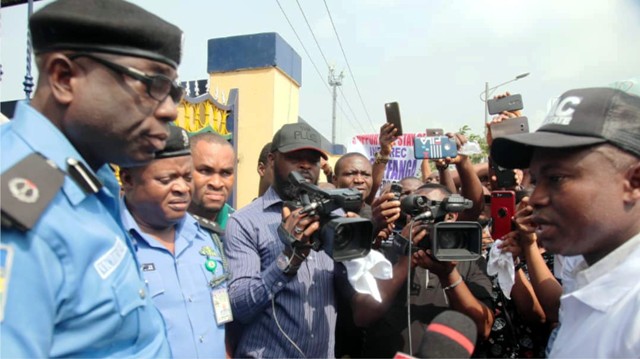
At last, the tension in Nigeria over who becomes President and governor has reduced drastically, as almost all the elections have been concluded and results announced except that of Rivers State.
An overview of what really happened nationwide on the general conduct of the elections really leaves much to be desired. It is true that there were intimidations, this is irrefutable. It is also true that in Nigeria, elections are rigged, there has always been violence but that notwithstanding after much hues and cries some would go to court to get redress, whether they win or lose at the courts or election tribunals that would be decided by the tribunal members after much deliberation.
But the major headache in the electoral system has always been working out modalities on how to checkmate desperate politicians who will go all out to subvert the system. It seems that the politicians in Nigeria are more creative in election rigging than in other clique. Here it has become a profession that sometimes is not done with finess.
The worst of such elections was the supplementary vote in Kano State where election observers were prevented from doing their job, security agents were helpless or indifferent to their primary assignment allowing thugs to hijack the process in full glare of the public.
Reacting to the charade in Kano, The Coalition of United Political parties (CUPP) called for the cancellation of the election following violent activities by thugs who took over the accreditation process. On its part the Nigeria Civil Society situation room, condemned the abuse of the Nations electoral process by politicians inspite of the deployment of top-level police officers to Kano in particular.
Spokesman for the group, Clement Nwankwo said “it was ironic and curious that the level of violence and political thuggery would occur with the quantum of Senior Police Officers deployed to Kano.
Invariably, what this mean is that thuggery can only be stopped if the nations security agents are really serious with their statutory duties. The situation whereby people mandated to protect lives and property shy away from their responsibilities raises more questions than answers and paints such institutions as unrealiable and untrustworthy.
Notable Nigerians apart from social activits including clerics have condemned the inherent disruptive tendencies of some Nigerian politicians, especially the Notion of cutting corners by riggers themselves into power stressing that elections should always be seen as a vehicle for sustainable development. This view is apt as hooligans use the opportunity created by their masters to bring shame to the country.
Politicians continue to blame the past military government and past civilian administrators for the nation’s short-comings, but what have they really done to eliminate the evils of the present day such as electoral malpractices. Are they also offshoots of the military governments?
What Nigerians should be thinking now is how to go out of the whirlpool of primordial politicking and fast forward ourselves to think like 21st century social scientists who have all the modern gadgets to get things right. But this not really hard, the problem has always been the mindset of the average Nigerian politician or those in authority to cheat. Maybe if we continue to wobble and fumble it will get to a situation where we will have to invite our neighbouring counties to assist us especially in conducting our elections as a critical look at the governorship elections has shown that the new slogan “Inconclusive” has become the hallmark of our electoral system.
Collation and announcement of results are now uphill tasks that will take weeks and huge manpower to conduct. No loser is ready to accept defeat even if the collacted results shows that his opponent is leading him with a huge margin. No wonder people describe Nigerian as a country of contradiction. “a society where the best are never given the opportunity to serve but only excel outside the country.
This year marks 20 years of uninterrupted democratic governance but we seem to have learnt nothing, seen nothing and have given out nothing to the younger generation except cheating, riggings, stealing and deceit. For how long can we as a people be honest to ourselves and collectively do what is right?
To be fair to INEC the fallout of the electoral process is not its fault but the problems created by the political class. And for the first time an the country’s political history elections in seven states were declared inconclusive which nobody envisaged.
However in Rivers State INEC is being looked at with suspicion in some quarters that it might not do what is right by announcing the clear winner of the election but rather call for a re-run. From available records it was only in Abua/Odual local government area that collation was not allowed to take place as the army hijacked the process.
INEC should not keep the people in suspense any longer and do the needful by announcing Chief Ezenwo Nyesom Wike as governor re-elected to govern the state. Because to do otherwise would be seen as a conspiracy between the APC led federal government at the centre and INEC to truncate the will of Rivers people.
Why should the case of Rivers State be different that it should be treated last? Are there hidden truths that INEC does not want the people of Rivers State to know? Or is INEC and the federal government perfecting plans so that a scenario would be created whereby the governor’s tenure will expire creating room for the appointment of a Sole administrator?
We hope that INEC will not allow itself to be used to formed injustice and instability in Rivers State.
Tonye Ikiroma-Owiye




The Court of Appeal in a unanimous decision of a panel of three Justices had on May 22, 2026 directed the Federal High Court Judge not to proceed with the suit until an appeal pending before them and filed by Accord Party is resolved.
In a Certified True Copy Enrol Order of the Superior Court, Justices Mohammed Danjuma, Adebukola Banjoko and Oyejoju Oyewumi asked the lower Court Judge to stay proceedings until all issues on the appeal filed by the Accord Party were resolved
Governor Ademola Adeleke of Osun State had, through the Accord Party, applied to justice Lifu to join him as a defendant in the deregistration legal battle instituted by a group of former legislators.
The contention of the Osun State governor was that he had a stake in the Accord Party, being the platform he was seeking re-election in the August 15 gubernatorial poll in the state.
In his ruling, Justice Lifu on April 27 ruled against the Osun State governor, rejecting his request to be joined in the suit to defend his own position and interest.
Not satisfied with the Federal High Court decision, the Osun State governor, through his lawyer, Musibau Adetunbi (SAN), moved to the Court of Appeal in Abuja where he challenged the Justice Lifu decision to refuse to allow him join the suit.
After listening to the argument canvassed, especially that he has interest to protect as Accord Party gubernatorial candidate for Osun State governorship election, the three Justices of the Court of Appeal, unanimously directed Justice Lifu to allow them look into the grievances of the governor.
In specific terms, the Court of Appeal Justices directed Justice Lifu not to proceed further with the matter and fixed October 27 to determine the interlocutory appeal of the appellant.
However, when the certified enroll order and notice of appeal were served on Justice Peter Lifu by Mr Adetunbi (SAN), the judge rejected it on the ground that it was a ploy to arrest his judgment in the matter.
Although the judge had adjourned his judgment delivery in the matter indefinitely, he finally made a dramatic turn around on Monday and proceeded to deliver the judgment that has now proscribed the five political parties.

In a statement on Monday, Mallam Bolaji Abdulllahi, the National Publicity Secretary of the ADC, announced the party’s choice of Mr Amaechi.
However in a statement, Mr Okonkwo said that the choice of Mr Amaechi from the South South strengthens the continued marginalization of people from the South East.
According to the former spokesperson of the Labour Party, any arrangement that would not factor a person from the South East either as president or vice president in the party is anti-Igbo.
He contended that Chief Raph Nwosu, who founded the ADC in 2005 and willingly surrendered it’s leadership to Senator David Mark did not do so to entrench Igbo marginalization in the party.
The former actor said: “I heard from the social media that ADC has picked its vice presidential candidate from the South-South. If this is true, it is unfortunate, as this will continue the crude marginalisation of the South-East.
“This geo-political zone has neither produced a president or vice president since 1999. To deny the South-East the opportunity to produce the president or vice president in the ADC in 2027, will amount to perpetuating the marginalisation.
“The ADC was founded by Ralphs Nwosu from the South-East in 2005. He made the sacrifice to give up the party in 2025 for the coalition to usher in a better Nigeria. He couldn’t have made that sacrifice to marginalise his own people.
“I did not join the coalition to assist in marginalisation of my own people further. I am of the opinion that if we made a sacrifice to give up the national chairman and the president, it will amount to unpardonable injustice to deny us the vice president in 2027.
“I joined politics to fight for a better Nigeria where no region, geo-political zone, or person will be marginalised.
“The only favour I asked Atiku Abubakar, who openly declared that he is the pathway to the presidency of the South-East, is to show it by choosing someone from the South-East to be his vice.
“If it is confirmed that he has chosen a candidate from the South-South, I wish him well. I am not favourably disposed to campaigning for any presidential ticket that does not have a person of South-East origin as president or vice in 2027”

Prof. Yilwatda stated this at the Abakaliki Township Stadium during a mega rally organized by the Ebonyi State government and Minister of Works, Senator David Umahi, during which President Tinubu and other APC candidates for the 2027 general elections were adopted.
According to the APC National Chairman, no President had done for the southeast region what President Tinubu has done for them and expressed the confidence that the president would not only win in Ebonyi State but in the entire South East.
Prof. Yilwatda also used the occasion to address growing insinuations in some quarters that Ebonyi State had been conceded to the Peoples Democratic Party (PDP) ahead of the 2027 general elections.
Dismissing the claim, Prof. Yilwatda said the state would not allow the PDP to win any position in the forthcoming general election.
“We will return President Bola Ahmed Tinubu and Francis Nwifuru as Governor of Ebonyi State in 2027.
“We want to return all APC senators, members of the House of Representatives and House of Assembly candidates in 2027.
“Nobody has conceded Ebonyi to the PDP. Therefore, there is no vacancy in Ebonyi State. Ebonyi PDP has no place, and there is no vacancy at all in the Government House come 2027,” the APC National Chairman declared.
He commended the people of the state for their support for President Tinubu and urged them to re-elect him in the next presidential election in appreciation of what he has done for the state and the entire South-East through infrastructural transformation and human capital development.
Governor Francis Nwifuru, who also spoke at the event, said the state had no other presidential candidate for the 2027 general elections apart from President Tinubu.
He declared that Ebonyi remained a stronghold of the APC and vowed that the party would deliver the President in the state.
Gov. Nwifuru said President Tinubu had shown exceptional commitment to the state and deserved total support for appointing Senator Umahi as Minister of Works, a role he said Senator Umahi had performed creditably.
“Ebonyi has no other presidential candidate apart from President Bola Ahmed Tinubu, and we will return him in the presidential election.
“We are standing here today to tell the whole world, especially those using the President’s name to orchestrate division and confusion in this great state, that we have only one party, and that is the APC.
“This statement became necessary because some people are going around claiming they have discussed with Mr President and that he has handed Ebonyi over to the PDP. They are also saying that Chief Nyesom Wike is their leader and that Wike said the President has given Ebonyi to him.
“Ebonyi is not for sale. We are restraining ourselves because the people are with us. Nobody should push us because we have what it takes to confront anyone trying to destabilise us.
“We want to tell Mr President that he has earned our votes. He gave us what we had never had in Eastern Nigeria — the office of the Minister of Works. And this Minister of Works is not sitting idle; he is working,” he stated.
Senator Umahi, in his remarks, said President Tinubu had done what no other President had done for Ebonyi State and the entire South-East by executing numerous projects across the state and the region.
“Ebonyi State is a one-party state under Governor Francis Ogbonna Nwifuru. We are not going to repeat the mistakes of the past.
“President Bola Ahmed Tinubu has done a lot, not just for Ebonyi State but for the entire South-East and other geopolitical zones,” he said.