
Politics
Citizens’ Participation In A Democratic Government (II)

This article was first published on Monday, August 15, 2016.
As was hinted at above,
the citizens’ struggle to bend the state to their will was often violent. The elements of the bourgeoisie who wrestled the state from the monarch, may have been liberals who reclaimed their freedoms from the ruling houses. But they were not democrats by definition who desired to create the conditions under which the generality of the people would determine their representatives in the state apparatuses and therefore, how the state would serve them. For, just as the monarchs were reluctant to part with power, so were the bourgeoisie unprepared to accommodate the unwashed masses. Power, it is said, is never voluntarily given to the people; they have to fight for, and to grab it. To understand what happened in this instance, we need to look beyond the political space to understand the nature of the movement that turned democratic.
The logic of capital whose bearers the bourgeoisie had become, obliged them to gradually dismantle the barriers against all freedoms: movement, belief and confession. Movement is not just one of the laws of nature which would impel the citizens to seek wider political participation. But what is natural was given a purely intellectual interpretation and it became embodied in that most obvious crystallization of matter – capital. Here, it seems, science and the economy found mutual support; both helped propel the political push for democratisation sometimes against the short-term interests of the new ruling class. Without the freedom of movement, the factors of production could not be shifted to the most critical points of need at anyone time. Thought, speech and information had to be unfettered otherwise science and its associated inventions which are absolutely necessary for production would not flourish. This, it will be recalled, was the era of the industrial revolution.
The imperative of these freedoms was also what propelled the people, over time, to demand political participation. By the same token, it provided also the push factor that made the bourgeoisie bow to the persistent demands from below. In the long run, these tendencies yielded the state’s gradual recognition of the rights of the people and the welfare state. The people had triumphed, had they? Historical experience would show that real power was in the economy and that what the people won was the power of the relatively inferior power of the ballot. It is not to be overlooked on this account, but neither should be exaggerated.
What had appeared to be the steady march of the power of the people began to suddenly unravel in the last decades of the 20th century. Hitherto the economy, not minding some hiccups, had been growing reasonably well until the 1970s. Signs of decline first manifested in the periphery where declining state revenue forced the push for balanced budgets. Quickly withdrawn were the critical social support for health and education which the wretched of the earth needed. The negative impact on growth and development was obvious, hence the 1980s were rightly described as a lost decade for Africa. The forces of freedom and independence weakened as capital, shielded by the state, easserted itself with imposition of austerity regimes by International Monetary Fund and the World Bank. Under these conditions the rights to health and education which the people thought they could take for granted simply fizzled into the thin air. That was only in the first phase of what was to become a global phenomenon. A decade later in the second phase, profits declined further in the advanced regions of capitalism where democracy had won the people cover under the social security network, the demand of capital won over those of the people. The state was rolled back and as in the periphery, if with less devastating result, as it opted to balance budgets by either removing, reducing or freezing welfare programmes, depending on the strength of social and forces it encountered. Since then the state has always responded against the people and in the interest of capital any moment a choice has had to be made. The last stark example was the struggle the Greek government waged with the European Union in the bid to help Greece and Spain manage their economic crisis. On each count the people lost and capital won.
This harsh state of affairs actually helps us to better understand the nature of contemporary democracy. It can be logically argued that what we witness now is the true nature of democracy. It has always seemed to be about all the people but it has usually always been about some of the people. And because it claims to be about the people, the people have ever been struggling to force it live up to that beautiful claim. The ideology of democracy presents the state as the agent and instrument of the people but the stark reality of democratic life shows that the state always attempts to hoist itself above the people. Thus, at best the political space is filled with tension as the state seeks to maintain its position and the people insist on bending it to their will. It is in the context of this nature of the democratic political space that one can meaningfully discuss our topic today.
Citizen participation in a Democracy:
If our interpretation of history and theory of democracy presented here is meaningful, it can then be concluded that democracy is not just about the existence of political parties, periodic, free and fair elections with an independent umpire, rule of law, existence of virile media, observation of human and civil rights, etc, all of which may have been encoded in constitutions that appear to accord sovereignty to the people. These are merely the structures of the system. In and of themselves they can easily constitute clutters in the political space and can even be impediments to democracy. Because they are not unimportant, however, we may term them the “hardware”, to be digitally correct. More important than those are elements of the “software” without which the hardware is of little use: this software is the culture of sustained political consciousness and behavior with which the people, as citizens, interact in and with these structures to give them life and expression, so to speak. In the United States of America, Germany, the United Kingdom or Nigeria, Ghana, and Rwanda, all have political structures are in place alright. But regardless of this, democracy works differently in each of these countries because the levels of consciousness and culture or how these find expression, differ. It is the process of participation that gives expression to that software of democracy.
Participation is a many-sided concept. It includes voting and or being voted for, attending political meetings, expressing political views and opinions, membership of political parties and pressure groups (including civil society associations); being regularly updated about political developments; monitoring how the state performs and demanding responsiveness, transparency and accountability from its officials. There is an ethical component to the concept of participation and it demands that exchanges must be based on mutual respect, tolerance and civility. All these are obvious enough and have been much discussed. It is difficult to know what to add to these. The challenge as I see it has to do with how we work them in the context of the tension of the democratic space. How do we participate so that we hold democracy to be about the majority of the people and not just for minority of the people; how do we ensure that the state more or less reflects the citizens’ will?
Perhaps only one qualification should be made to all this, namely, that citizen participation must be active, sustained and critical. But this implies an important assumption, namely, that the people have already become citizens. Democracy is possible only with citizens, otherwise the leaders deceive themselves and the people. I mentioned earlier that the transformation from being subjects to being citizens had taken place in the older democracies; it was in fact critical for taking the first tentative steps away from feudal rule and its ideology of the divine right of kings. A subject in a state is politically inactive or gets involved only sporadically; she believes she is incapable of making any political difference. Thus he lacks self-confidence. A citizen on the hand is politically active and wants to make an impact through some input at any point in the political process. Unless people in a democracy are in a sustained “citizen mode”, dictatorship will thrive under its cloak.
Eme Ekekwe



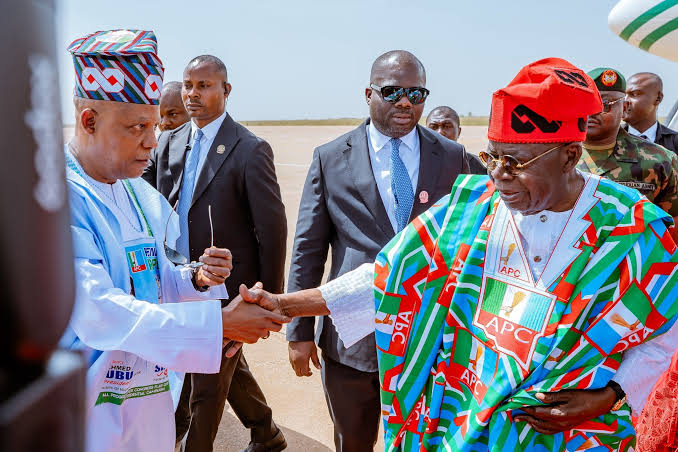
The campaign rally, held at the Kaduna Township Stadium, attracted Vice-President Kashim Shettima, APC governors, party leaders, federal and state lawmakers, political stakeholders and supporters from across the country.
The flag-off marks the beginning of the APC’s drive to secure a second presidential term for President Tinubu, with the party expected to promote its achievements, defend its economic reforms and outline its policy priorities under the proposed Renewed Hope 2.0 agenda.
Kaduna’s selection for the campaign launch underscores the strategic importance of the North-West, a region with a substantial voting population and considerable influence on presidential election outcomes.
The APC faces a significant challenge in Kaduna, where the Peoples Democratic Party’s presidential candidate, Alhaji Atiku Abubakar, defeated President Tinubu in the 2023 election. The rally therefore provides the ruling party an opportunity to strengthen its grassroots structures and regain electoral support in the state.
Addressing supporters, Vice-President Shettima appealed to Northern voters, highlighting President Tinubu’s political relationships with prominent Northern leaders, including Alhaji Abubakar, Mallam Nuhu Ribadu and the late President Muhammadu Buhari.
The Vice-President’s appeal reflects the APC’s determination to consolidate its support in the North as the party intensifies preparations for the presidential contest.
The Renewed Hope 2.0 agenda is expected to feature prominently in the campaign, providing a platform for President Tinubu to explain his administration’s economic policies and outline plans for another term.
However, the President’s record on economic reforms, rising living costs, petrol prices, employment, infrastructure and insecurity is expected to attract considerable scrutiny during the electioneering period.
-

 Education2 days ago
FCE Yola Graduates 3,555 Teachers , Seeks Upgrade to University
-

 Sports2 days ago
Nigerian Trio Target Titles At PFL Africa Finals
-

 Niger Delta2 days ago
Diri Restates Stance On Lagos-Calabar Coastal Highway
-

 Niger Delta2 days ago
C’River, NUJ Pay Tribute To Late Guardian Editor
-

 News2 days ago
NDLEA Recovers Tons Of Illicit Drug Consignments In Nine States
-

 Opinion2 days ago
Checking Voter Apathy In Nigeria’s Electoral Process
-

 Politics2 days ago
2027: DICKSON’S EX-ALLY VOWS TO WORK AGAINST NDC INTEREST IN BAYELSA
-

 Politics2 days ago
2027: GROUP PLEDGES 40,000 SUPPORTERS FOR COALITION CANDIDATES IN RIVERS