
News
Presidency Revises 2016 Budget …Senate Begins Debate, Today …Reps Bicker Over Corrections

There are indications that the 2016 budget was actually withdrawn for a major amendment as two different versions of the budget are showing different figures and adjustments in expenditure heads.
A version indicating to be an amendment version shows a major cut of about N8.8billion in the Presidency’s original figure with purchase of vehicles receiving the deepest cuts.
Also, the new version has provision of N17billion for capital expenditure allocated to Niger Bridge in Asaba-Onitsha, Delta and Anambra states, though there was no such provision in the first version submitted to the National Assembly.
The expense heads that received big cuts include Fixed Asset Purchase reduced by N3.374 billion to N1.196 billion from N4.57 billion while purchase of motor vehicles was reduced by N3.29 billion to N599 million from N3.889 billion.
Others include State House headquarters, recurrent costs, overhead, miscellaneous, honorarium/sitting allowance each of which were reduced by N100 million.
Expenditures for construction and provision of general fixed asset, which appeared to have had double entry at N764.67 million each, were scrapped in the second budget.
The President of the Senate, Bukola Saraki, had last Thursday accused the Presidency of substituting the original copy of the budget presented by President Muhammadu Buhari to the National Assembly on December 22, 2015 with a new version.
Saraki’s claim was the climax of days of suspense following claims and counter-claims that the document was missing.
The president also reduced allocation for exotic cars by N17billion
A review of the fresh copy of the budget uploaded to the website of the Budget Office of the Federation on Friday showed a massive cut by about 83.5 per cent in the total allocation for the vehicles.
A total of N7.52 billion was provided previously for the purchase of various exotic vehicles, including BMW saloon cars, in addition to another N566 million for the procurement of vehicles, including 16-seater Toyota Hiace coaster buses for the State House.
Despite the adjustments to the allocations to the various departments and units, the total appropriation of N39.13billion for the Presidency remained unchanged in both the previous and current budget versions.
Details of the different adjustments showed that State House headquarters, which got total allocation of N11.91billion in the original budget has now been cut by N100million, same as allocations for its recurrent costs, overheads, honorarium & sitting allowances as well as miscellaneous expenses.
Equally, the purchase of fixed assets, which received N4.57billion previously, has drastically been reduced to about N1.2billion, while preservation of the environment and wildlife conservation, which got a total of N978.3million, has now been reduced to N347.4 million.
The Office of the Chief of Staff to the President had its initial allocation of N2.3million raised to N22.3million, while allocation to the office of the Chief Security Adviser to the President has also been raised from N3.18million to N28.18million.
Details of the provision for the two offices include allocation of N25 million each for overhead costs, recurrent and miscellaneous expenditures. Another N25 million has been budgeted for honorarium and sitting allowance for the office of the Chief of Staff.
The State House Medical Centre has been allocated N100 million for total overheads and recurrent costs.
The State House, Lagos Liaison Office, which had its allocation increased from N126.7million to N151.7 million, would get in addition N25 million each for recurrent, overhead and miscellaneous costs.
About N2.3 billion provided earlier for the construction and general provision of fixed assets as well as recreational facilities for the State House has now been removed, while rehabilitation and repairs of fixed assets previously allocated N4.48 billion was increased to N13.2 billion.
Rehabilitation/repairs of residential buildings and electricity facilities previously allocated N388million and N1.7billion respectively have now been raised to N642.6million and N1.8billion respectively.
Another provision of N3.9 billion has been made for the rehabilitation of office building, while renovation of eight blocks of 16 two-bedroom flats at State House Security Quarters, Asokoro, would take about N254.6 million.
About N3.9 billion has been set aside for the annual routine maintenance of Villa facilities by Julius Berger, in addition to N764.7million provided for the construction/provision of recreational facilities.
However, after receiving the corrected version of the 2016 budget, yesterday, the Senate President, Bukola Saraki, told members of the upper chamber that the Senate will now begin consideration of the 2016 budget, today.
Saraki said that the debate on the document follows the acceptance of President Muhammadu Buhari’s request for the budget’s amended areas to be considered.
Meanwhile, members of the House of Representatives, yesterday, argued over a letter sent by President Muhammadu Buhari indicating corrections in the 2016 budget.
The Speaker, Yakubu Dogara, while reading the letter said the president said corrections have been made to the details of the budget as presented on December 22.
Bickering, however, started at about 11.25am immediately the speaker read the president’s letter when the Minority Leader of the House Rep, Leo Ogor (PDP, Isoko Federal Constituency), cited Sections 81 and 84 of the Constitution, which he said do not give the president powers to amend budget, adding that such powers lie with the legislature.
Ogor immediately called on the House to disregard Buhari’s letter.
Dogara apparently defending the president said there was nowhere in the letter that Buhari said the budget was amended, adding that it is only the president that has powers to make corrections to the budget if he observes any error.
The PDP lawmakers started chanting “no, no!” preventing Dogara from making his point for some minutes.
But the speaker drove home his point as he hinged his argument on the fact that there was nowhere the president mentioned the word amendment rather he used the word correction “which the president alone can correct,” the speaker added.
Also, Rep Linus Okorie (PDP, Ebonyi), raised a point of order that the speaker did not follow the order of House procedure as he chose to read petitions before the House when in actual practice, the president’s letter ought to have been read first.
Again, Dogara simply told Okorie that he followed the House rule in his introduction of issues for the day, unless the House otherwise directs, and an applause from members followed immediately.
The speaker in self-defence, told the House that immediately he arrived the House chambers, the first thing he did was to explain to the entire House that he was going to take petitions first before the letters he had with him.
The president’s letter read in part: It will be recalled that on Tuesday, 22 December, 2015, I presented my 2016 budget proposals to the joint sitting of the National Assembly.
“I submitted a draft bill accompanied by a schedule of details. At the time of submission, we indicated that because the details had just been produced, we would have had to check to ensure that there were no errors in the detailed breakdown contained in the schedule. That has since been completed and I understand that the corrections have been submitted.
“The National Assembly would therefore have the details as submitted on the 22nd December, and a copy containing the corrections submitted last week. It appears that this has led to some confusion.
“In this regard, please find attached the corrected version. This is the version the National Assembly should work with as my 2016 budget estimates. The draft bill remains the same and there are no changes in any of the figures”.
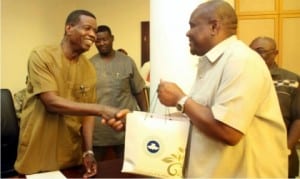
Governor Nyesom Wike of Rivers State (right), with the General Overseer, Redeemed Christian Church of God, Pastor Enoch Adeboye (left) at Government House, Port Harcourt on Monday


The Rivers State chapter of the All Progressives Congress Christian Leaders Forum has expressed strong confidence in the capacity of All Progressives Congress (All Progressives Congress) candidates in the state to deliver effective governance if elected into office in the coming elections.
The State Coordinator of the forum, Archbishop Lucky Aroh, made this known during a breakfast and thanksgiving meeting held in Port Harcourt, where leaders gathered to pray for the stability of the party and the safety of its candidates ahead of the 2027 general elections.According to him, the meeting was convened to seek divine intervention for peace, unity, and security among APC candidates across Rivers State.
“Today we are praying for APC stability in Rivers State and the security of our candidates that have been elected to contest the 2027 elections. It is a breakfast meeting,” Aroh said.
He further expressed optimism that the party’s candidates would not disappoint the people if entrusted with leadership responsibilities.
“They will not fail when elected into office. We are here as fathers of the land to let them know, and I must tell you the truth that these are the authentic people that will do well in Rivers State,” he added.
Speaking earlier, the National Chairman of the forum, Professor Olanrewaju Abraham, commended the Rivers State chapter for organizing the programme, noting that the national body of the forum believes strongly in the power of prayer.
He stated that political leadership provides an opportunity to influence society positively, including advancing moral and spiritual values, while expressing confidence that APC candidates at all levels would emerge victorious in the upcoming elections.
Also speaking, the Rivers State Women Leader of the APC, Hon. Darling Amadi, praised the forum for its commitment to prayers for peace, stability, and the protection of party candidates.
Represented by the Deputy Women Leader of the party in the state, she described the initiative as commendable and urged other political and support groups within the party to emulate the gesture in promoting unity and stability.
By: John Bibor, Menebe Emmanuel & Fortune Paibi
Prominent businessman and philanthropist, Elder Anthony Osagwe-Ogo, was celebrated in grand style as he marked his 70th birthday anniversary, with distinguished Nigerians, business leaders, and golf enthusiasts gathering to honour his remarkable contributions to society.
The colourful celebration took place at the Port Harcourt Golf Club, where friends, associates, and well-wishers converged to pay tribute to the revered elder statesman.
Chairman of the occasion, High Chief (Dr.) Ikenna Okafor, described the celebrant as a detribalised Nigerian whose generosity, humility, and commitment to humanity have earned him admiration across different communities and backgrounds.
According to Dr. Okafor, Pa Osagwe-Ogo’s impact on society and the development of his community remains unparalleled. He noted that members of the golfing community are proud to be associated with a father figure who consistently promotes the welfare and well-being of those around him.
He further stated that the history and growth of the Port Harcourt Golf Club cannot be told without acknowledging the significant role played by the celebrant, whose wisdom, encouragement, and leadership have helped sustain the club over the years.
“We are here to celebrate a man who has impacted humanity positively, a peace-loving individual and an epitome of hope for the younger generation. We pray to emulate his virtues. Today, we celebrate a bridge-builder, a trailblazer, and an iconic leader whose life continues to inspire many,” Dr. Okafor said.
He expressed delight at the large turnout of guests from various walks of life, describing it as a testament to the respect and affection Pa Osagwe-Ogo commands within and beyond Rivers State.
In his response, the celebrant, Pa Anthony Osagwe-Ogo, expressed profound gratitude to God for preserving his life and granting him the privilege of attaining the milestone age of 70.
He also thanked members of the Port Harcourt Golf Club, family members, friends, and associates for identifying with him during the celebration and for their unwavering support over the years.
The event featured the cutting of the birthday cake, presentation of awards to deserving members of the club, goodwill messages, and moments of celebration among guests.
The ceremony was attended by notable personalities from the business community, the golfing fraternity, and other sectors, all of whom joined in celebrating the life and legacy of the respected elder statesman.
Rivers State Governor, Sir Siminalayi Fubara, and the Permanent Secretary of the Rivers State Ministry of Information and Communications, Dr. Honour Kuru Sirawoo, have been honoured with awards of recognition in connection with the 2026 Democracy Day celebrations held in Port Harcourt.
The awards, which formed part of activities marking Nigeria’s Democracy Day on June 12, were formally presented on Tuesday at the Ministry of Information and Communications in Port Harcourt.
Presenting the awards was Hon. Abdul Hameed Oladipupo Alli, popularly known as “Mr. Nigeria,” Publisher of Asiwaju Trumpet Magazine and Achievers World International Magazine.
Governor Fubara was recognised for his efforts in sustaining peace, stability, and a conducive political atmospherJohn Bibor / Menebe Emmanuel / Fortune Paibie in Rivers State. The organisers noted that his administration has fostered harmony and strengthened civic participation across the state.
Dr. Sirawoo, on the other hand, was honoured for his exemplary administrative leadership and significant contributions to effective information management within the Ministry of Information and Communications.
Representing Dr. Sirawoo at the presentation ceremony, Dr. Christian Davies received the award on his behalf and expressed gratitude for the recognition. He described the honour as a reflection of Dr. Sirawoo’s unwavering commitment to professionalism, excellence, and dedicated public service.
Dr. Davies assured the organisers that the award would be formally conveyed to the Permanent Secretary.
The event also featured the presentation of commemorative publications highlighting major governance and civic milestones in Rivers State, including Easter celebrations, Workers’ Day activities, the Governor’s third anniversary in office, and Democracy Day programmes.
Organisers of the awards commended the Rivers State administration for what they described as sustained peace, political stability, and improved civic engagement, noting that these achievements have contributed significantly to the state’s continued development.
By: Jessica Sambol
-

 Niger Delta1 day ago
Warri Airport Manager Disputes Air Peace Bird Strike Claim
-

 News1 day ago
Nigeria Won’t Surrender Any Territory To Criminals -Tinubu
-

 News1 day ago
FG Begins Trial Of Over 600 Terrorism Suspects
-

 Rivers1 day ago
79th IAUE Inaugural Lecture: Prof Anero Advoctes Tuition-Free Education For Children
-

 Politics1 day ago
Parties’ Deregistration: How Justice Lifu Overruled Appeal Court Justices
-

 Politics1 day ago
ADC: Okonkwo Rejects Amaechi As Presidential Running Mate, Withdraws Support
-
Politics1 day ago
2027: Rivers PFN To Mobilise 600,000 Votes
-

 Politics1 day ago
2027: Tinubu’s Projects Give APC Edge In South East – Yilwatda