Connect with us

Oil & Energy

SPDC Begins Crude Recovery From Adibawa Spill

Published

on

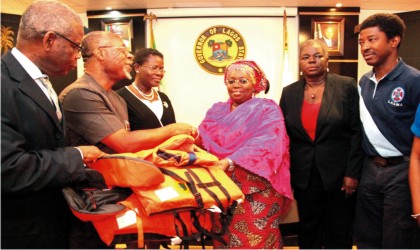
l-R: Business Development Manager, Emo Exploration and Production Ltd, Mr Dennis Otsemobior, Deputy Managing Director, Total Nigeria, Mr. Charles Ngoka, Supervisor, Community Development, National Petroleum  Investment Management Services, Mrs Helen Nkwo, Lagos Deputy Governor, Dr Oluranti  Adebule, Acting Permanent Secretary, Ministry of Transportation, Mrs Adebisi Ariyo and Managing Director, Lagos State Waterways Authority (LASWA), Mr Olayinka Marinho, at the handing over of  2,400 Life Jackets Donated by Total Nigeria Plc. to the Lagos State Government on Wednesday

l-R: Business Development Manager, Emo Exploration and Production Ltd, Mr Dennis Otsemobior, Deputy Managing Director, Total Nigeria, Mr. Charles Ngoka, Supervisor, Community Development, National Petroleum Investment Management Services, Mrs Helen Nkwo, Lagos Deputy Governor, Dr Oluranti Adebule, Acting Permanent Secretary, Ministry of Transportation, Mrs Adebisi Ariyo and Managing Director, Lagos State Waterways Authority (LASWA), Mr Olayinka Marinho, at the handing over of 2,400 Life Jackets Donated by Total Nigeria Plc. to the Lagos State Government on Wednesday

The Shell Petroleum De
velopment Company of Nigeria(SPDC) has started the recovery of spilled crude from its Adibawa oil fields.
The Paramount Ruler of Edagberi community, Chief Sunny Jacob Ubele, disclosed this to newsmen at the weekend.
He said the recovery began after the resolution of a face-off between officials of SPDC and the chairman of Ahoada West Local Government Area of Rivers State.
Ubele said that the community co-operated with officials of the oil firm but expressed reservations when Shell officials attempted to manipulate the Joint Investigation Visit (JIV) procedure.
“It is very untrue that we denied them access. If we did, how did they manage to stop the spill,” he said, adding that SPDC fixed a JIV on the community meeting day and the people urged them to fix it the next day.
“When we went there with them, we found out they went to the site unilaterally and tampered with the evidences that would assist in arriving at conclusion, so we told them that we were excluded from that exercise”, he stated.
The traditional ruler explained that the community declined to sign the JIV reports because they were not part of it, not that the people denied the team of officials access as alleged by SPDC.
“There is no truth in the allegations”, he said revealing that the council of chiefs has met and restated that the company should commence recovery of crude from the site.
Meanwhile, SPDC said that the oil leakage from its oil fields located in Edagberi community was caused by thieves who targeted the Well Head.
A statement from SPDC spokesman, Mr. Joseph Obari, regretted the delay to an investigation of a leak at Adibawa-well-8 in the Eastern Niger Delta, where a suspected attempt to steal the well head led to spill.
Obari equally alleged that the community people were thwarting the efforts of the oil company to contain the leakage and remediate the polluted environment.
However, The Tide gathered that the caretaker committee chairman of Ahoada West Local Government, Ikechukwu Obuzor, is leading mediation after the leadership of the Edagberi Betterland community allegedly prevented the representatives of industry regulatory agencies, the Rivers State Ministry of Environment and SPDC from accessing the spill site.


Chris Oluoh

Continue Reading

Oil & Energy

TotalEnergies, Conoil Sign Deal To Boost Oil Production

Published

on

TotalEnergies has signed agreements with Conoil Producing Limited under which to acquire from Conoil a 50 per cent interest in Oil Processing Licence (OPL) 257, a deep-water offshore oil block in Nigeria.
The deal entails Conoil also acquiring a 40 per cent participating interest held by TotalEnergies in Oil Minining Lease (OML) 136, both located offshore Nigeria.
Upon completion of this transaction, TotalEnergies’ interest in OPL257 would be increased from 40 per cent to 90 per cent, while Conoil will retain a 10% interest in this block.
Covering an area of around 370 square kilometres, OPL 257 is located 150 kilometers offshore from the coast of Nigeria. “This block is adjacent to PPL 261, where TotalEnergies (24%) and its partners discovered in 2005 the Egina South field, which extends into OPL257.
Senior Vice-President Africa, Exploration & Production at TotalEnergies, Mike Sangster, said “An appraisal well of Egina South is planned to be drilled in 2026 on OPL257 side, and the field is expected to be developed as a tie-back to the Egina FPSO, located approximately 30 km away.
“This transaction, built on our longstanding partnership with Conoil, will enable TotalEnergies to proceed with the appraisal of the Egina South discovery, an attractive tie-back opportunity for Egina FPSO.
“This fits perfectly with our strategy to leverage existing production facilities to profitably develop additional resources and to focus on our operated gas and offshore oil assets in Nigeria”.
Continue Reading

Oil & Energy

“COP30: FG, Brazil Partner On Carbon Emissions Reduction

Published

on

The Federal Government and Brazil have deepened collaboration on climate action, focusing on sustainable agriculture, renewable energy, and the reduction of black carbon emissions.
The partnership is anchored in South-South cooperation through the Brazil-Nigeria Strategic Dialogue Mechanism, which facilitates the exchange of ideas, technology, and policy alignment within the global climate framework, particularly the Paris Agreement.
The Executive Secretary, Amazon Interstates Consortium, Marcello Brito, made the disclosure during an interview with newsmen, in Abuja, on the sidelines of the 2025 COP30 United Nations Climate Change Conference, held in Belem, Brazil.
Brito emphasized that both nations are committed to global efforts aimed at curbing black carbon emissions, a critical component of climate mitigation strategies.
“Nigeria and Brazil are collaborating on climate change remedies primarily through the Green Imperative Project (GIP) for sustainable agriculture, and by working together on renewable energy transition and climate finance mobilisation,” Brito said.
“These efforts are part of a broader strategic partnership aimed at fostering sustainable development and inclusive growth between the two Global South nations,” Brito added.
TheTide gathered that President Bola Ahmed Tinubu announced an ambitious plan to mobilize up to $3 billion annually in climate finance, through its National Carbon Market Framework and Climate Change Fund, positioning itself as a leader in nature-positive investment across the Global South.
Represented by the Vice President, Senator Kashim Shettima, Tinubu made the announcement during a high-level thematic session of the conference titled ‘Climate and Nature: Forests and Oceans’
Tinubu stressed that Nigeria’s climate strategy is rooted in restoring balance between nature, development, and economic resilience.
Hosted in the heart of the Amazon, on November 10—21, the 30th COP30 conference brought together the international community to discuss key climate issues, focusing on implementing the Paris Agreement, reviewing nationally determined contributions (NDCs), and advancing goals for energy transition, climate finance, forest conservation, and adaptation.
Continue Reading

Oil & Energy

DisCo Debts, Major Barrier To New Grid Projects In Nigeria ……. Stakeholders 

Published

on

Energy industry leaders and lenders have raised concerns that the high-risk legacy debts of Distribution Companies (DisCos) and unclear regulatory frameworks are significant barriers to the financing and development of new grid-connected power projects in Nigeria.
The consensus among financiers and power sector executives is that addressing legacy DisCo debt, improving contractual transparency, and streamlining regulatory frameworks are critical to unlocking private investment in Nigeria’s power infrastructure.
Speaking in the context of new grid-connected power plants, during panel sessions at the just concluded Lagos Chamber of Commerce and Industry (LCCI) Power Conference, Senior Vice President at Stanbic IBTC Infrastructure Fund, Jumoke Ayo-Famisa, explained the cautious approach lenders take when evaluating embedded or grid-scale power projects.
Ayo-Famisa who emphasized the critical importance of clarity around off-takers and contract structures said “If someone approaches us today with an embedded power project, the first question is always: Who is the off-taker? Who are you signing the contract with?” . “In Lagos State, for example, there is Eko Electricity and Excel Distribution Company Limited. Knowing this is important,” she said.
She highlighted the nuances in contract types, whether the developer is responsible just for generation or for the full chain, including distribution and collection.
“Collection is very important because you would be wondering, ‘is the cash going to be commingled with whatever is happening at the major DISCO level, is it ring-fenced, what is the cash flow waterfall,” she stated.
Ayo-Famisa pointed out that the major stumbling block remains the “high leverage in the books of the legacy DisCos.” Incoming project financiers want to be confident that their cash flows won’t be exposed to the financial risks of these indebted entities. This makes clarity on contractual relationships and cash flow mechanisms a top priority.
Noting that tariff clarity also remains a challenge, Ayo-Famisa said “Some states have come out to clearly say that there is no subsidy; some are saying they are exploring solutions for the lower income segments. So, the clarity would be on who is responsible for the tariff, is this sponsored?, Can they change tariffs?, In terms of if their cost rises, they can pass it on, or they have to wait for the regulator.
“Unlike, what you find in the willing seller-willing buyer, where they negotiate and agree on their prices. Now they are going into grid, there is Band A, Band B, if my power goes into, say, Ikeja Electric, or I have a contract with them, “am I commingled with whatever is happening across their multiple bands?”
Also speaking, Group Managing Director and CEO of West Power & Gas Limited, Wola Joseph Condotti, stressed the dual-edged nature of decentralization in the power sector.
“Of course, decentralization brings us closer to the people as the jurisdiction is now clear. You also know that your tariff would be reflective of the type of people living in that environment. You cannot take the Lagos tariff to Zamfara, and this is what has been happening before now in the power sector. So, decentralization brings about a more customized solution to issues you find on the ground.
“Some of the issues I see are those that bother on capacity. It was a centrally run system that had 11 DISCOs. Of the 11 DISCOs, I think there are 3 or 4 of us today that are surviving or alive, if I may put it that way. If you go to electricity generation companies, they are doing much better,” she said.
Condotti highlighted regulatory overlaps as another complication, especially when power generation or distribution crosses state lines.
She said, “Investors would definitely have a problem. Say if you have a plant in Ogun State supplying power to another state, say Lagos State; you are automatically regulated by NERC. But the truth is that the state regulator of Ogun State and Lagos State wants you to comply with certain regulatory standards.”
With the growing demand for reliable electricity and an urgent need for infrastructure expansion, the ability to navigate these complex financial and regulatory landscapes would determine the pace at which new grid-connected power projects can be developed.
Continue Reading

Trending