
Business
…Spends N10bn On 2nd Niger Bridge
President Goodluck Jonathan said the Federal Government has spent N10 billion on construction of the 2nd Niger Bridge out of the N130 billion total cost of the project.
The President disclosed this when he stopped over at the project’s site in Asaba on Saturday on his way to PDP campaign in Onitsha, Anambra.
Jonathan said it was a big project being executed under a Public Private Partnership (PPP) arrangement.
He said that now that it had taken off, its execution would go on smoothly and uninterrupted through the 48 months completion period.
“So far, out of the N130 billion total cost of the project, we have spent about N10 billion.
“It is a big project and now that it has taking off, it will go on smoothly through the 48 months completion time.
“The project is a PPP arrangement, I am quite impressed with what I have seen”, he said.
He added that most components required for the construction had been procured and piling work had commenced.
Minister of Works, Mr. Mike Onolomemen said a lot had been done since the flag off of the project in March 2014.
Onolememen said the contracting firm, Julius Berger Nigeria, was engaged because of its antecedents, adding that almost all the procurements for the construction of the bridge were imported.
According to him, works are in progress with the piles being driven into the ground and dredging going on along the River Niger.
“For us, it is a thing of joy and certainly before the next raining season, a lot of piles would have been driven in. No doubt, development of infrastructure takes a long time.”
Managing Director, Julius Berger, Mr. Detler Lubasch said work on the project would be sustained.
Lubasch said the project would be of enormous social and economic benefits and significance to the country.
The Tide source reports that the President was accompanied to the project site by former Gov. Peter Obi of Anambra State among other dignitaries.
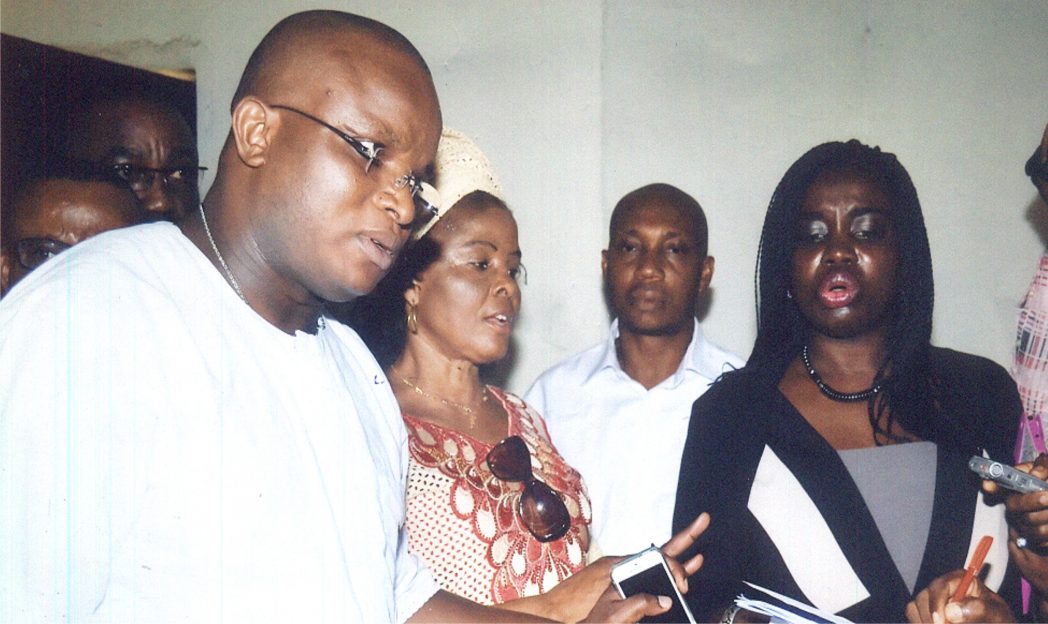
Chairman Rivers State Internal Revenue Service, Mrs Onene Osila Oshiko-Obele (right) explaining things to the Chairman House Committee on Finance, Hon. Josiah Olu (left), member of the committee Hon. Dr Innocent Barikor (2nd left), during the committee’s oversight function to Internal Revenue Service. Photo: Chris Moyanaga

Business
FIRS Clarifies New Tax Laws, Debunks Levy Misconceptions
Business
CBN Revises Cash Withdrawal Rules January 2026, Ends Special Authorisation
The Central Bank of Nigeria (CBN) has revised its cash withdrawal rules, discontinuing the special authorisation previously permitting individuals to withdraw N5 million and corporates N10 million once monthly, with effect from January 2026.
In a circular released Tuesday, December 2, 2025, and signed by the Director, Financial Policy & Regulation Department, FIRS, Dr. Rita I. Sike, the apex bank explained that previous cash policies had been introduced over the years in response to evolving circumstances.
However, with time, the need has arisen to streamline these provisions to reflect present-day realities.
“These policies, issued over the years in response to evolving circumstances in cash management, sought to reduce cash usage and encourage accelerated adoption of other payment options, particularly electronic payment channels.
“Effective January 1, 2026, individuals will be allowed to withdraw up to N500,000 weekly across all channels, while corporate entities will be limited to N5 million”, it said.
According to the statement, withdrawals above these thresholds would attract excess withdrawal fees of three percent for individuals and five percent for corporates, with the charges shared between the CBN and the financial institutions.
Deposit Money Banks are required to submit monthly reports on cash withdrawals above the specified limits, as well as on cash deposits, to the relevant supervisory departments.
They must also create separate accounts to warehouse processing charges collected on excess withdrawals.
Exemptions and superseding provisions
Revenue-generating accounts of federal, state, and local governments, along with accounts of microfinance banks and primary mortgage banks with commercial and non-interest banks, are exempted from the new withdrawal limits and excess withdrawal fees.
However, exemptions previously granted to embassies, diplomatic missions, and aid-donor agencies have been withdrawn.
The CBN clarified that the circular is without prejudice to the provisions of certain earlier directives but supersedes others, as detailed in its appendices.
Business
Shippers Council Vows Commitment To Security At Nigerian Ports
-
Business3 days agoCBN Revises Cash Withdrawal Rules January 2026, Ends Special Authorisation
-
Business3 days ago
Shippers Council Vows Commitment To Security At Nigerian Ports
-
Business3 days agoNigeria Risks Talents Exodus In Oil And Gas Sector – PENGASSAN
-
Business3 days agoFIRS Clarifies New Tax Laws, Debunks Levy Misconceptions
-
Business3 days ago
NCDMB, Others Task Youths On Skills Acquisition, Peace
-
Politics3 days agoTinubu Increases Ambassador-nominees to 65, Seeks Senate’s Confirmation
-
Sports3 days ago
Obagi Emerges OML 58 Football Cup Champions
-
News3 days agoTinubu Swears In Christopher Musa As Defence Minister
