
Nation
THE STATES

Ekiti
An Ado-Ekiti Customary Court has dissolved a 9-
year-old marriage between Mrs Enema Friday and his wife, Mary.
Our correspondent reports that the case first came up for mention on May 6.
The marriage was dissolved on grounds of frequent beating, threat to life, as well as lack of care.
Mary, 32, told the court that her husband maltreated her which made her to pack out of his house.
She said the husband had not been taking care of her because of her childlessness, and that he once threatened her with a pistol for allegedly having extra marital affairs.
Mary explained that she contributed to the building of their house, but had to pack out because of the threat.
FCT
Some workers in the Federal Capital Territory (FCT)
have reacted to plans by the territory’s administration in conjunction with the Nigerian Labour Congress (NLC) to provide affordable, quality accommodation for workers.
While some of the respondents commended the initiative as a way of ameliorating the high cost of accommodation in Abuja, others advised parties to the agreement to extend such opportunity to workers in the public sector.
According to Mr Samson Isah, an Abuja-based civil servant, the housing initiative was commendable and should be encouraged by well-meaning Nigerians.
He advised government and the labour unions to monitor the project thoroughly to ensure that the contractors delivered on schedule.
Gombe
Members of the Sickle Cell Association club in
Gombe, have appealed for increase in their drugs following a rise in the number of their registered members.
The Chairman of the association, Malam Isa Barkama, made the appeal in an interview with newsmen in Gombe.
He said that the number of the registered members rose from 10,000 to 17,000 following awareness campaigns embarked upon by the association.
“Initially, we had only 10,000 members who were registered but our number increased to 17,000 because of the awareness campaigns we embarked upon,” he said.
He said that the wife of the Gov. Hajiya Adama Dankwambo, had been giving them the drugs free of charge.
He said that people were now voluntarily bringing their children for the test, adding, “it is important for everyone to know his or her genotype’’.
Jigawa
The Nigeria Security and Civil Defence (NSCDC)
in Jigawa State said it arrested a 33-year-old-man with 16 bags of adulterated animal feed.
The NSCDC Commandant in the state, Mr Muhammad Gidado, told newsmen in Dutse that the suspect was arrested at Maigatari International Market recently.
Gidado complained that many people engaged in selling adulterated food items, particularly Sesame oil and other cooking oil.
He said “our men have succeeded in arresting a 33-year-old-man with 16 bags of adulterated animal feed at the popular Maigatari International Market.
“Intelligence report shows that many people have developed the habit of selling adulterated food items such as Sesame oil, cooking oil and many more.’’
Katsina
The Tertiary Education Trust Fund (TETFund),
yesterday, said it placed top priority on entrepreneurship training of lecturers and students in public tertiary institutions.
The TETFund Board Chairman, Alhaji Musa Babayo, stated this in Katsina at the opening of a two-day capacity building workshop on Entrepreneurship Development in Public Tertiary Institutions in Nigeria.
According to him, the capacity building workshop for lecturers in public tertiary institutions is aimed at promoting entrepreneurship skills.
He said “entrepreneurship has the capacity to create wealth for students and empower them to become self innovative and creative thinkers in business.”
Kwara
Kwara State Government said it was working
toward improving its internally generated revenue (IGR) to better the lots of its citizens.
The state Commissioner for Information and Communication, Mr Tunji Moronfoye, stated this in llorin in an interview with newsmen.
He said that the improved internal revenue would augment the shortfalls in the state’s allocations from the Federation Account.
According to him, this is part of viable initiatives being put together to deliver the dividends of democracy to the people, adding that the government was committed to providing quality and affordable healthcare services.
He said that no fewer than 8,500 people had benefited from the state’s primary healthcare programme.
Lagos
An Ikeja High Court has rejected the bail application
filed by a 52-year-old man, Moses Olayemi, accused of defrauding a Senior Advocate of Nigeria, Dr Aliyu Salman, of N2.5 million.
The trial judge, Justice Lateef Lawal-Akapo, in a ruling on Olayemi’s bail application, agreed with the objections raised by the Economic and Financial Crimes Commission (EFCC).
The judge noted that the defendant was previously convicted for the same offences by a Kano State High Court.
He said that Olayemi’s prior criminal record and the severity of the charge could make him abscond if the application was granted.
Lawal-Akapo consequently dismissed the application and ordered Olayemi to be remanded in Kirikiri Maximum Security Prison, pending the conclusion of the case.
Ogun
The convener, Save Nigeria Group, Pastor Tunde
Bakare, says students unionism has fallen from its pinnacle of intellectual doggedness to become mere appendage of political parties.
Bakare, who made this assertion in Abeokuta at the 2014 anniversary of the International Day of Students, said “it is also now a tool for corrupt politicians”.
In a paper titled: “Good Governance: Sustainability of Democracy, the Role of Students in the Forthcoming General Election”, Bakare said students unionism in the country had lost its activists steam and was in a sorry state.
He called on the students’ body to embark on a journey of rebirth to return to the good old days of students’ activism.
“To achieve this, you must rid yourselves of cultism and other self-destructive tendencies and take back student unionism from hoodlums and charlatans.
Osun
The Osun State sector command of the Federal Road
Safety Commission (FRSC) said last Tuesday that it issued 268 new number plates to motorists in the state in the month of October.
The Sector Commander, Mr Muhammad Husaini, made the disclosure in an interview with newsmen in Osogbo.
Husaini said the figure was submitted to the commission by the state revenue board, the department responsible for number plates production.
He added that the figure covered number plates for cars, buses, articulated vehicles and motorcycles.
The sector commander said “the FRSC works in partnership with the state revenue board in registration and production of new number plates or upgrading of old ones by motorists.’’
Sokoto
Governor Aliyu Wamakko of Sokoto State said that
about 1,000 indigent students of the state were currently pursuing various academic programmes in various universities abroad.
They are being sponsored by the government.
Wamakko announced this at the inauguration of Hamma Ali Road in Kware Local Government Area of the state.
He said that the students were studying Medicine, Pharmacy and Engineering, among others.
He said that the state government was committed to producing the needed manpower to develop the state.
Wamakko said that already 240 ward primary health centres had been equipped and provided with ambulances to ensure smooth and effective health care delivery in the state.
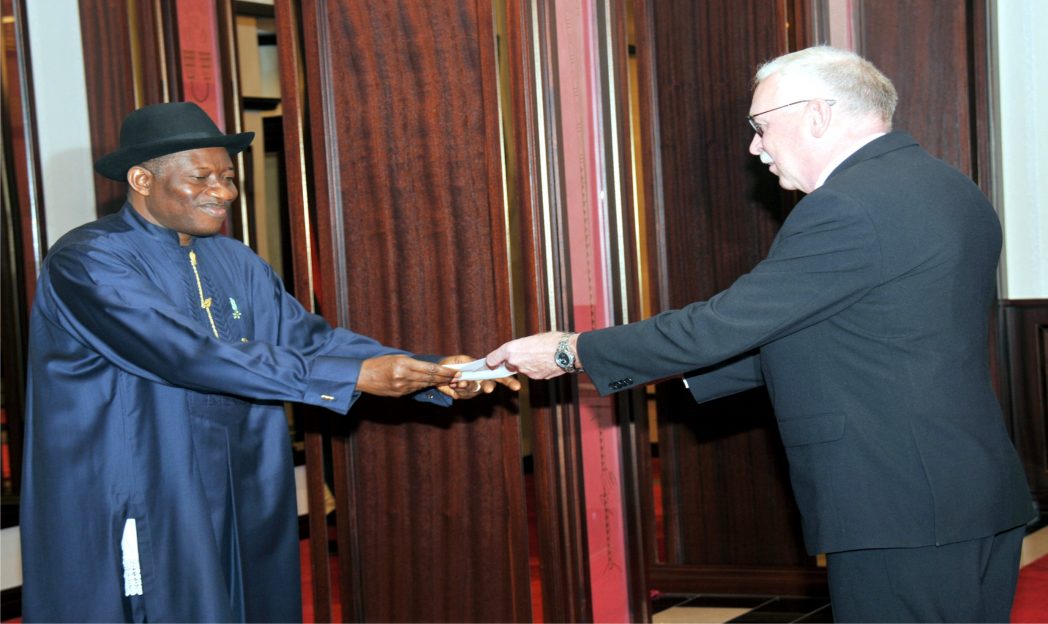
President Goodluck Jonathan (left), receiving letter of credence from the new Ambassador of Denmark to Nigeria, Mr Torben Gettermann in Abuja recently



The Hydrocarbon Pollution Remediation Project (HYPREP) has commemorated the 15th anniversary of the release of the United Nations Environment Programme (UNEP) Environmental Assessment Report on Ogoniland, reaffirming its commitment to restoring the environment and improving the livelihoods of affected communities.
In a statement signed by the Project Coordinator, Prof Nenibarini Zabbey, to commemorate the anniversary, HYPREP described the anniversary as a significant milestone in Nigeria’s environmental restoration efforts, noting that the project has made remarkable progress in implementing the recommendations of the landmark UNEP report released on August 4, 2011.
The UNEP report had revealed extensive oil pollution across Ogoniland, severe environmental degradation, and serious public health risks resulting from decades of petroleum operations. It also recommended an initial $1 billion fund to commence the cleanup of the affected communities.
According to HYPREP, the Federal Government formally launched the Ogoni clean-up in 2016, while the Project Coordination Office was established in 2017 to drive the implementation of UNEP’s recommendations.
Zabbey said the current administration has continued to prioritise the project under the Renewed Hope Agenda.
Providing an update on the cleanup, the Project Coordinator disclosed that 30 of the 65 contaminated sites identified by UNEP have been fully remediated, while work is ongoing at several medium- and high-risk locations. It also stated that more than 1.5 million mangrove seedlings have been planted as part of what it described as the world’s largest restoration of oil-degraded mangroves, with over 1,000 hectares of shoreline already rehabilitated.
Zabbey further revealed that 49 Ogoni communities have been connected to potable water schemes through multiple water projects and booster stations aimed at providing safe drinking water across the region.
In the health sector, he said the 100-bed Ogoni Specialist Hospital in Kpite and the 43-bed Cottage Hospital in Buan are nearing completion, adding that several existing health facilities have been upgraded with modern medical equipment, while five ambulances have been donated to improve emergency healthcare services. The Project Coordinator also disclosed that a three-year human health biomonitoring study is being conducted in collaboration with the World Health Organization’s International Agency for Research on Cancer (IARC).
On economic empowerment, Zabbey stated that the Project has created more than 8,000 direct jobs and trained thousands of Ogoni youths and women in various vocational and technical skills, including software development, cybersecurity, aviation, commercial diving, seafaring, mechatronics, and creative arts. The project also reported awarding scholarships to more than 1,000 students, providing grants to small businesses, and supporting persons living with special needs through skills acquisition programmes.
The statement further highlighted ongoing legacy projects, including the Ogoni Power Project and the Centre of Excellence for Environmental Restoration, which it said is about 96 per cent complete. HYPREP also welcomed the recent designation of the Ogoni Wetland as a Ramsar Site of International Importance and pledged to continue promoting biodiversity conservation and sustainable management of the ecosystem.
Marking the anniversary, Zabbey said the progress achieved over the past 15 years demonstrates the collective commitment of government, development partners, stakeholders, and local communities to restoring Ogoniland. He called for renewed collaboration to sustain the cleanup effort, promote environmental sustainability, and support the long-term development of the region. 3
-

 News2 days ago
RSG Targets Nine Million Residents in Mosquito Net Distribution Campaign
-

 Oil & Energy2 days ago
Aiyedatiwa Signs New Electricity Bill
-

 Maritime2 days ago
Marine Minister Commends President Tinubu On NPERA Bill Assent
-

 Oil & Energy2 days ago
NLNG Commissions Research And Innovation Centre In RSU
-

 News2 days ago
KenPoly Holds Eight Convocations, August 29
-

 News2 days ago
RSG Begins Another Phase of Projects Commissioning Today
-

 News2 days ago
RMAFC Completes Revenue Sharing Review, Proposes New Pay
-

 Maritime2 days ago
NAGAFF Petitions IGP Over Alleged Maritime Police Harassment