
Editorial
For Super Eagles To Fly Again

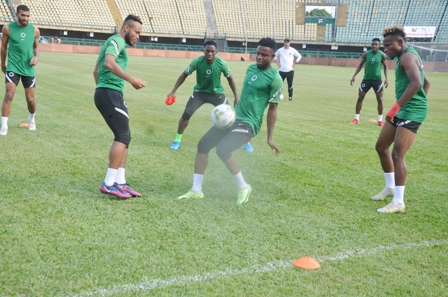
Tuesday, March 29, 2022, will remain a spectre for most Nigerian soccer enthusiasts as that was the
day when their cherished Super Eagles failed to qualify for the 2022 World Cup in Qatar. The Black Stars of Ghana thwarted the Eagles with a superior goal tally. Had the Eagles soared above the Ghanaian Black Stars to Qatar, it would have been their seventh FIFA World Cup appearance and their fourth in a row.
The second round of the match took place at the Moshood Abiola Stadium in Abuja. Nigeria played a scoreless draw with Ghana in the opening round of the playoffs at the Baba Yala Stadium in Kumasi. Unfortunately, the three-time African champions failed to improve their game when it mattered the most, leaving their fans in peril and despair. The Black Stars dictated the pace and depth of the proceedings and put together a dynamic game plan.
Indeed, the loss was so vitriolic that some indignant devotees instantly voiced their outrage and dissatisfaction as they overran the MKO Abiola Stadium pitch and extirpated property when they could not get their hands on the players who inflicted them with searing pain. Although hurtful, we condemn the fans’ infantile and irrational reaction to the disastrous defeat of the Nigerian team.
The awful event of March 29 saw Nigeria fail to qualify for the senior World Cup for the second time since 1994. The first mishap happened in 2006 when the Super Eagles lost a Germany 2006 ticket to Angola in Kano on the away goals rule. The loss by the Super Eagles rudely alarmed many Nigerians as in recent times, the team had not relished the kind of irresistible support it got before the must-win clash with the Black Stars of Ghana.
Considering that the first leg of the CAF third round qualifiers in Kumasi had ended 0-0, and the Ghanaians going into the return leg in a more propitious position, the Federal Government and the Nigeria Football Federation (NFF) mobilised Nigerians to come out en masse to upraise the Super Eagles in the second leg of the fixture. To draw fans to the stadium, the authorities had provided more than 100 buses to provide free rides for supporters in Abuja and neighbouring states.
Intriguingly, the technique exploited by the Sports Ministry and the NFF produced favourable results as for the second time since it was launched in 2003, the mainbowl of the MKO Abiola National Stadium was full. It was the right ambience for the team to glide to Qatar. Sadly, the national team reiterated similar blunders in Kumasi that robbed them of at least an away goal that would have made the second leg less unpredictable for them.
Painfully, Nigeria’s technical adviser, Austine Eguavoen, floundered to organise his team to attack and the Black Stars capitalised on this technical drawback to the utmost benefit. The Super Eagles stayed predictable, unable to surprise their rivals. However, Napoli youngster, Victor Osimhen, did his best to save the team’s World Cup yearning, but all his endeavours came to nought as the Black Stars shone to their fourth World Cup.
For Eguavoen, this is nothing more than a dismal record as he was a member of the technical team that failed to qualify Nigeria for the 2006 World Cup in Germany. Therefore, 2022 offered him a rare opportunity to make amends, but he was outsmarted by his opposite number in Ghana’s dugout, Otto Ado, whose tactical tweak at half-time completely confounded the former Super Eagles captain.
In addition to Ghana, other African representatives at the Qatar event scheduled to take place in November/December 2022 include Senegal, Cameroon, Morocco and Tunisia. The absence of the Super Eagles at the Qatar World Cup offers us an opportunity to rethink the state of Nigerian football and chart the best course for the future. This is the time to really assess the nation’s football fortune and the best way to stimulate it in the years ahead.
With the exit of the senior national team from the mundial football event, the NFF and the handlers of the team should commence preparations for the next competition. Our ordeals in AFCON 2021 in Cameroon and the World Cup qualification ties have amply confirmed that we cannot do much without sufficient planning and groundwork. No team can get far in a regional or global football tournament without preparatory work.
The board of directors of the NFF led by Amaju Pinnick should resign honourably and give Nigerian football a chance to breathe. Board members would be doing a great disservice to the nation if they continue to misdirect the country’s football after the latest misadventure. We welcome the decision to terminate the Super Eagles technical team as it will provide a clean break.
The inability of the Eguavoen coaching team to make the necessary impact in Cameroon and World Cup qualification ties has boldly underlined the imperative of rejigging the technical crew to make it more effective and decisive in reading games and preparing the team for tournaments. For all his faults, however, Eguavoen is only a symptom, a manifestation of a broader cultural malaise in Nigerian football.
It is depressing that the NFF has killed the local league to such an extent that no player from the domestic game is deemed capable of playing for the Super Eagles. Nigeria’s football league is a pathetic state. There is no regularity in the league. It is inconsistent and has become a patronage system. Junior national teams no longer produce quality youth because of corruption that has killed age teams. These trends should be reversed immediately.
The government has to take its hands out of football entirely to avoid indiscretion and interference in the administration of the game. The national teams and professional clubs should find their means to be financially stable. It is not good enough for teams to always run to the government, begging for grants. The NFF, the national football teams and professional clubs must attract investors and sponsors to stay alive.




Nigeria stands at a critical juncture as the world marked World Press Freedom Day (WPFD) on May 3. This annual observance is a reminder that a free press is central to democratic life, good governance, and public accountability. For Nigeria, it is also a moment for sober reflection on how far the country has come and how far it still has to go in safeguarding the independence of its media.
World Press Freedom Day exists to highlight the fundamental importance of freedom of expression and to honour journalists who risk their lives in pursuit of truth. It underscores the idea that without a free press, societies cannot function transparently, nor can citizens make informed decisions. In countries like Nigeria, where democracy continues to evolve, the observance carries particular urgency.
This year’s theme, “Shaping a Future at Peace: Promoting Press Freedom for Human Rights, Development and Security”, places journalism at the heart of global stability. It emphasises that a peaceful society cannot be built on silence, fear, or manipulated information. Rather, it depends on the free flow of accurate, timely, and independent reporting.
At its core, the theme highlights the role of journalism in fostering accountability, dialogue, and trust. These are not abstract ideals. In Nigeria, where public confidence in institutions is often fragile, the media remains one of the few platforms through which citizens can question authority and demand transparency. When press freedom declines, so too does public trust.
Journalism serves as a foundation for peace, security, and economic recovery. Countries with robust media systems tend to attract greater investment, maintain stronger institutions, and resolve conflicts more effectively. Nigeria’s economic challenges, ranging from inflation to unemployment, require open scrutiny and informed debate, both of which depend on a free press.
However, the issue of information integrity has become increasingly complex in the digital age. Artificial Intelligence (AI) and online platforms have amplified the spread of misinformation and disinformation. In Nigeria, where internet penetration has grown rapidly, false narratives can travel faster than verified facts. This makes the role of credible journalism more vital than ever.
The challenge is not only technological but also ethical. AI-driven manipulation of information threatens to distort public discourse, influence elections, and deepen social divisions. In such an environment, professional journalism must act as a stabilising force, ensuring that truth prevails over sensationalism and propaganda.
Equally troubling is the safety of journalists. Across Nigeria, reporters face growing levels of online harassment, judicial intimidation, and physical threats. Self-censorship is becoming more common, as media practitioners weigh the risks of reporting sensitive issues. This trend undermines the very essence of journalism.
A particularly alarming incident involved a serving minister in the present administration, who openly threatened to shoot a journalist during a televised exchange. Such conduct, broadcast to the public, sends a dangerous signal that hostility towards the press is acceptable. It erodes the norms of democratic engagement and places journalists in harm’s way.
This year’s theme aligns closely with the United Nations Sustainable Development Goal (SDG)16, which promotes peace, justice, and strong institutions. Freedom of expression is a cornerstone of this goal. Without it, institutions weaken, corruption thrives, and justice becomes elusive. Nigeria’s commitment to SDG 16 must therefore include genuine protection for the media.
Historically, the Nigerian press has been a formidable force. From resisting colonial rule to challenging military dictatorships, our journalists have played a central role in shaping the nation’s political landscape. Today, however, that legacy appears to be under strain, as the media operates under what can best be described as a veneer of freedom.
Beneath this facade lies a troubling reality. Journalists are routinely harassed, detained, and prosecuted for performing their constitutional duties. Reports from media watchdogs indicate that dozens of Nigerian journalists face legal threats or arrest each year, often for exposing corruption or criticising those in power.
The Cybercrimes (Prohibition, Prevention, etc.) Act of 2015 has become a focal point of concern. Originally intended to combat cyber threats, it has increasingly been used to silence dissent. Sections 24 and 27(1)(b), in particular, have been invoked to target journalists, bloggers, and social commentators.
Although amendments introduced in February 2024 were meant to safeguard journalists, concerns persist. The law continues to be wielded in ways that stifle investigative reporting and restrict freedom of expression. Legal reforms must go beyond cosmetic changes to address the root causes of misuse.
To safeguard the future of journalism in Nigeria, decisive action is required. The Cybercrimes Act must be revisited to ensure it cannot be weaponised against the press. Law enforcement agencies must operate free from political influence, upholding the rule of law and protecting journalists’ rights. Civil society and international partners must also strengthen independent media through funding, training, and platforms for wider reach.
In this rapidly evolving world shaped by artificial intelligence and digital innovation, Nigeria faces a clear choice. It can either allow press freedom to erode under pressure, or it can champion a truly independent media landscape. The path it chooses will determine not only the future of journalism, but also the strength of its democracy and the peace it seeks to build.