
Politics
CJN’s Non-Asset Declaration: The Frills, Thrills And Implications

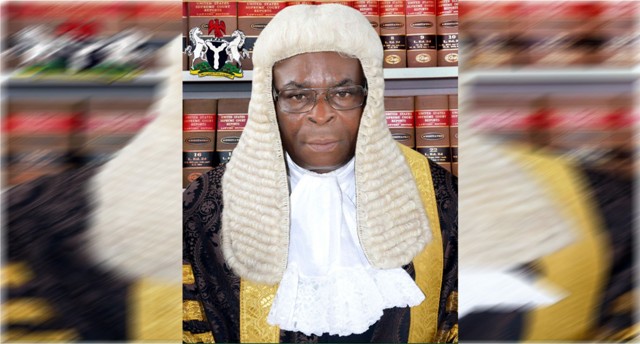
The ongoing matter regarding the trial of the Chief Justice of Nigeria (CJN), Walter Samuel Nkanu Onnoghen, over non-declaration of assets has become one of the most controversial developments to dominate the country’s political space ahead of the 2019 general elections scheduled to hold in February.
The crux of the matter is that a civil society group, Anti-Corruption and Research-Based Data Initiative (ARDI), on the 7th of January 2019, petitioned against the CJN to the Code of Conduct Bureau (CCB) and the Economic and Financial Crimes Commission (EFCC) over his non-compliance to the Nigerian constitution regarding declaration of assets.
The petition reads in parts: “We hereby petition you on suspected violations of the law and the Constitution of Nigeria by the Chief Justice of Nigeria, the Honourable, Justice Walter Samuel Nkanu Onnoghen.
“Specifically, we petition you based on the alarming facts detailed below, all of which indicate that the leader of our country’s judicial branch is embroiled in suspected official corruption, financial crimes and breaches of the Code of Conduct Bureau and Tribunal Act”.
The organisation alleged that Justice Onnoghen made five different cash deposits in dollars into an identified Standard Chartered Bank Account, which was not declared to the CCB as part of his assets, being a requirement for a public office holder, especially of his status.
Following this, on Thursday, January 10, 2019, the Federal Government filed charges against Justice Onnoghen, accusing him of false declaration of assets.
The Federal Government said, against the provisions of the law, the Chief Justice only partially declared his assets in 2016 after the controversial crackdown on judges.
The government further said that the number one judge of the nation still failed to declare a series of bank accounts, denominated in local and foreign currencies, linked to him at a Standard Chartered Bank branch in Abuja.
In his response to the CCB upon receiving the query, the CJN said he forgot to update his asset declaration, after the expiration of his 2005 declaration.
In his words: “My asset declaration form numbers SCN 00014 and SCN 00005 were declared on the same day, 14/12/2016 because I forgot to make a declaration of my assets after the expiration of my 2005 declaration in 2009. Following my appointment as acting CJN in November 2016, the need to declare my assets anew made me realise the mistake.
“I then did the declaration to cover the period in default. I did not include my Standard Charted Bank account in SCN 000014 because I believed they were not opened.
“I did not make a fresh declaration of asset after my substantive appointment as CJN because I was under the impression that my SCN 000015 was to cover that period of four years which includes my term as CJN.”
Meanwhile, the trial which was billed to commence last Monday, had two-key hick-ups: Onnoghen, who was represented by a team of 47 senior lawyers, led by Wole Olanipekun, was absent during the first sitting, and the defence, as presented by Olanipekun, was that the court has no power to hear the charges at all, because due constitutional procedure had not been followed.
The Nigerian Constitution required in Section 292 that a serving judge must first be investigated and indicted by the National Judicial Council (NJC) before dismissal or trial for misconduct in open courts. The NJC regulates the Nigerian judiciary.
Olanipekun also argued that the tribunal summons to Mr Onnoghen was delivered to his personal assistant and not him personally, arguing that this was an anomaly and added to the reasons for his absence.
While the prosecution, led by Umar Aliyu from the Federal Ministry of Justice, views this as a mere distraction, Danladi Umar, the tribunal chairman, adjourned further hearing until January 22. He ordered that Mr Onnoghen must appear to be docked for the charges against him, as well as listen to arguments on whether or not the tribunal could assert jurisdiction.
Expectedly, there have been so many interpretations attached to the first ever trial of the Chief Justice of Nigeria, cutting across interests ranging from political affiliations, through ethnic considerations to professional standpoints, and personal opinions.
Going back memory lane, pundits express the belief that Onnoghen’s present travail may have started from the point of his appointment. Upon the retirement of the former Chief Justice, Mahmud Mohammed, in 2016, at the statutory age of 70, Onnoghen’s appointment suffered unprecedented delay by President Mohammadu Buhari. But he was finally sworn in as Acting Chief Justice of Nigeria (CJN) on the 10th of November 2016.
There was however a prolonged delay in confirming him as the substantive Chief Justice, the position he rightly deserved as the most senior Justice of the Supreme Court.
The delay led to series of speculations from various quarters. Finally, on March 7, 2017, Onnoghen was sworn in as the 17th Chief Justice of Nigeria by Vice President Yemi Osinbajo, in his position as Acting President.
Amidst the cheers from mostly the ruling party, APC, and the holes picked by the opposition led by the PDP in the timing of the allegation and the manner of its execution, certain salient points remain very clear, and hence deserve to be treated cautiously and rightly, if the country must progress without avoidable political ranscour capable of destabilising the current fragile unity of purpose.
Following some body language of the Buhari-led government regarding the execution of the anti-corruption fight, as exemplified by the President’s refusal to assent the amended Electoral Act, close watchers of Nigeria’s political terrain have already indicated that the Federal Government is doing everything possible to gag any suspected decentering voice.
The question is, if the President’s excuse for not assenting to the Electoral Act was to avoid destabilising the electoral process, even when assent would mean less room for rigging, why would he allow the Onnoghen matter to be so pursued unconstitutionally in a hurry and with about a month to elections?
The answer seem, to be in what critics of the administration have adduced from the unfolding scenario: that Mr Buhari was behind the move to remove a Chief Judge of Southern origin in order to replace him with a judge from his northern region who would be more amenable to political influence.
In the words of Charles Omole, in a message to Premium Times, ”The timing of the indictment is suspicious. The speed with which it is being pursued strengthens the suspicion as it is uncharacteristic of the slow approach of this administration to act on even far more crucial matters in the past three years.”
The onus is thus on Mr President to prove otherwise: That his whole heightened drama over Onnoghen is not just for the February 2019 elections, even as non-declaration of asset is against the law. The only way to do this is to allow the law take its full course.
Soibi Max-Alalibo


Rt Hon. Abbas secured the party’s ticket through an affirmation exercise conducted across the 13 electoral wards in the constituency.
The wards involved include Kwarbai A, Kwarbai B, Limancin-Kona, Unguwar Fatika, Unguwar Juma, Dutsen Abba, Gyallesu, Kufena, Dambo, Wuchichiri, Tudun Wada, Tukur-Tukur, and Kaura.
The exercise, which began simultaneously in all wards at about 10 a.m., recorded large turnout of APC members who gathered at various party offices across the constituency.
At Kwarbai B Ward, the Speaker’s ward, the process was conducted peacefully under the supervision of the ward APC Returning Officer, Malam Iliyasu Muhammad Balarabe, in the presence of Rt Hon. Abbas.
According to the ward APC secretary, Nafiu Sabo, the ward has over 10,000 registered members, but 220 members were accredited for the exercise.
Before the affirmation, Mallam Balarabe informed members that Rt Hon Abbas was the only aspirant who purchased nomination forms, underwent screening, and was cleared by the APC national leadership to contest the Zaria Federal Constituency seat.
Following a voice vote by accredited members, the Speaker was affirmed as the party’s candidate in the ward, a process replicated across the remaining 12 wards.
At the constituency collation centre, the APC Returning Officer for the House of Representatives primary in Zaria Federal Constituency, Dr. Hamisu Ibrahim Kubau, announced that 1,376 APC members across the 13 wards endorsed Rt Hon. Abbas as the party’s flag bearer.
He explained that although thousands of party members participated in the exercise, only accredited delegates were allowed to vote.
Dr. Kubau declared: “There are 13 wards in Zaria Federal Constituency, and only one aspirant purchased a form, was screened, and cleared. He is Rt. Hon. Abbas Tajudeen. After due process, we conducted affirmations across all wards.”
He added that the process was peaceful and monitored by officials of the Independent National Electoral Commission (INEC) and party representatives.
Chairman of the APC House of Representatives Primary Elections in Kaduna State, Senator Yakubu Oseni, described the outcome as a reflection of the Speaker’s popularity and acceptance among constituents.
He expressed confidence that Rt Hon Abbas would secure victory in the 2027 general elections.
Speaking after his declaration, Rt Hon. Abbas expressed appreciation to APC members for reaffirming their confidence in him.
The incumbent Reps including Emily Inyang and Godwin Offionio, in separate interviews
protested the handling of the primaries conducted by the leadership of the party in the state, saying it was skewed against them.
The aspirants further described the primaries as a charade and an embarrassment to the state.
According to them, the House of Representatives primaries fell short of the provisions of both the Electoral Act as amended in 2026 and the party’s constitution.
They accused the leadership of the party in the state, backed by Governor Bassey Otu, of violating the party’s constitution in the conduct of the House of Representatives primaries across the state on Saturday.
Hon. Godwin Offiono, representing Ogoja/Yala Federal Constituency, particularly expressed disappointment with the primary that allegedly disenfranchised registered members of the party in his constituency.
Hon. Offiono asserted that having failed to arrive at a consensus, the party leadership opted for a direct primary to decide the candidate for the 2027 election.
“But what I witnessed today was not only alarming, but quite disheartening that our electoral system have not shown any improvement, especially now that we have a man of God in the person of the governor as the leader of the party.
“How do you declare a result by 9:00am even when the electoral materials were yet to arrive at Yala.
“As an aspirant, I couldn’t even vote or see the materials for my own primary at my Okuku ward in Yala Local Government Area, where I come from. But no matter what happens I am still in the race and have not stepped down for anybody.
“The governor had all the time in the world to drive the process of consensus but he never did. As a representative, I cannot even see my governor. I called, no response. I sent text no reply. I am treated as an out cast,” he lamented.
In an emotion laden tone during a telephone interview, Hon. Offiono further said: “I could not believe that first term NASS members like me can be treated in this shoddy manner even when I don’t know my offence.
“I have been a loyal party man. I appeal to the governor to do the right thing, follow the Electoral Act and party constitution in electing representatives.”
Similarly, Hon. Emil Inyang of Akamkpa/Biase Federal Constituency said he still remained in the race and had not stepped down for anybody.
According to him, “If this shenanigan called primary is allowed to stand, it would affect the party’s fortune in the general elections.
“My appeal to the governor is to allow the people to decide. And if they so voted against me, I will rest and not fight over anything.
“There was no stakeholders meeting held to decide on anything before now, and someone can not be unilaterally imposed on us all in the name of compromised primary,” he stated.
A coalition of support groups within the All Progressives Congress (APC) has protested the disqualification of former presidential aspirant, Mr Tein Jack-Rich, from the Rivers West Senatorial race ahead of the party’s primaries for the 2027 general elections.
The groups, in a statement issued on Saturday morning in Abuja, described the action of the party’s screening committee as unjust and capable of worsening internal divisions within the APC in Rivers State.
The statement, signed by the coalition’s National Coordinator, Dr. Bilal Galadima, and General Secretary, Hon. James Ogenyi, accused the party leadership in Rivers State of favouring politicians loyal to the Minister of the Federal Capital Territory, Chief Nyesom Wike, while sidelining long-standing members of the APC.
The coalition alleged that only aspirants aligned with Chief Wike were cleared to contest for elective positions in the state.
“How can our party allow only one man who is not a member of our party to make decisions or dictate the direction of our party?”, the group queried.
The coalition specifically faulted the exclusion of Mr Jack-Rich, describing him as a loyal party member who had supported the APC for more than 13 years and previously contested the party’s presidential ticket.
It also questioned the alleged clearance of Chief Felix Obua, whom it described as a recent entrant into the party and an ally of Chief Wike.
“How can our party disqualify Jack-Rich, a former presidential aspirant who has been loyal and supported our party for the last 13 years, only for our party to choose Felix Obua, a Wike loyalist who only joined the party three months ago?”, the statement read.
The group warned that failure by the APC leadership and National Working Committee (NWC) to address the matter as it could weaken the party’s structure in Rivers State ahead of the 2027 elections.
It called on party leaders to uphold internal democracy, reward loyalty and ensure a level playing field for all aspirants.
INEC TO BEGIN MEMBERSHIP VERIFICATION AS POLITICAL PARTIES SUBMIT REGISTER
All 22 registered political parties have successfully submitted their membership registers to the Independent National Electoral Commission (INEC) in compliance with the Electoral Act 2026, the Commission has said.
In a statement issued on Friday, Chairman, Information and Voter Education Committee, Mr Mohammed Haruna, said the submission followed the extension granted by the Commission after political parties raised concerns during a meeting on Tuesday, March 24, 2026, regarding the timeline provided in the Revised Timetable and Schedule of Activities for the 2027 general elections.
He said, “The Commission is pleased to note that all registered parties submitted their registers as of 8th May 2026, two days before the extended deadline.”
He recalled that following a meeting with political parties, the Commission, in a statement issued on the 27th of March, 2026, adjusted the deadline for the submission of party registers from 21st April 2026 to 10th May 2026 to align with the provisions of Section 77(4) of the Electoral Act 2026 and the actual dates fixed by political parties for their primaries.
Mr Haruna noted that political parties were accordingly allowed to conduct their primaries within the approved period from 23rd April 2026 to 30th May 2026, while the register of party members was required to be submitted to the Commission not later than 21 days before the conduct of their respective primaries.
He added, “INEC wishes to state that all registered political parties complied with the requirement within the extended timeframe and will subject the submitted registers to the necessary verification processes in line with the law.”
The Commission restated its commitment to the conduct of free, fair, credible and inclusive elections.
-

 Environment5 hours ago
MOSOP – Tinubu Not Sincere With Ogoni People For Oil Resumption
-

 Maritime7 hours ago
Products, Others, To Arrive Lagos Ports Today — MPA
-

 Environment5 hours ago
NEWSAN Urges Investment For Water And Sanitation services
-

 Oil & Energy6 hours ago
SEED: FG To Train 6,000 Energy Professionals
-

 Environment5 hours ago
NGOs Task Media On Investing In Climate Literacy
-

 Education4 hours ago
UNIPort Senate Grants Two-Year Amnesty to U2010–U2018 Students
-
Politics5 hours ago
Primaries: Diri Lauds APC’s Unity, Cohesion In Bayelsa
-

 Maritime7 hours ago
Lagos Records Major Gains In Road, Rail, Water Transport —Osiyemi