
Business
Eleme Bridge Collapse: The Untold Story

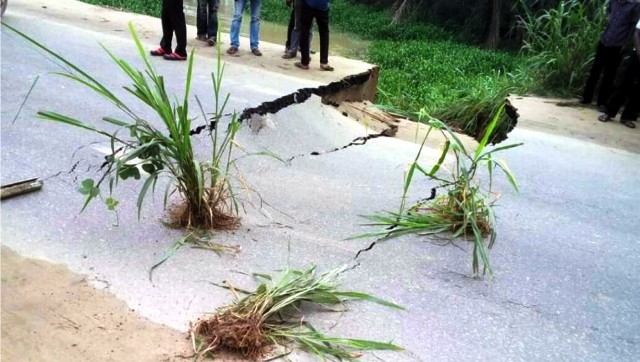
Eleme, like other Niger Delta Communities, stands on a Pinnacle of Wealth, but the natural disposition of the area as the hub of hydrocarbon exploration and development in Nigeria seems to have turned a mirage for the people.
The height of this ironical situation was the recent collapse of the Alode bridge which has resulted in untold suffering for the people and other users of that axis of the East-West Road.
Since the collapse of the bridge, three days ago, tension and anxieties have continued to mount, as life is now unbearable for the teeming road users.
Commercial motorists, tanker drivers and private vehicles owners that ply the route are presently cut off, as the major link road is now shut down.
Angered by the prevailing circumstance, youths from Eleme communities now besiege the road on daily basis in protest, calling for a total shut down of vehicular movement until permanent solution is put to the problem.
The protesting youths in a voiced discontent, said they have consistently raised alarm over the deplorable condition of the road, but such appeals seem to fall on deaf ears.
The aggrieved youths pointed out that before the final collapse of the bridge, users of that axis of the East-West Road, experienced grave difficulties trying to get to their destinations.
Rather than give urgent attention to the deplorable state of the road, the youth, said tankers loaded with petroleum products and other heavy lorries belonging to the various multi-nationals operating in the area continued to stretch the aging bridge until it collapsed.
With the mounting tensions, an orgy of violence is imminent, as the youths have vowed to continue with the protest even in the face of military resistance.
A visit to the road last weekend revealed shootings by soldiers to disperse the protesting youths, leading to a pandemonium, as pedestrians scampered for safety from stray bullets.
Travelling the route is now nightmares as a long file of pedestrians was spotted trekking from Akpajo junction to Refinery Junction where vehicular movement is a little bit freer.
The languid spectacle of line-up of stationary heavy trucks and tankers and the spectacle of pedestrians in long files trying to meet up their appointments painted an odious scene of organised chaos.
Some of the road users who spoke with The Tide, during a visit to the road, bemoaned what they considered the “total neglect of the road, despite the fact that it was the major access route to the two federal terminals, a Mega Petrochemical Plant, Port Harcourt Refinery and myriads of other multi-nationals that prospect for the economic fortune of the Oil and Gas Free Zone Authority”.
A commercial bus driver, Mr Akanimo Udosen, lamented the sufferings to which the road users are subjected as a result of the collapse of the bridge.
Akanimo, who decried the loss of man hour as a result of the collapse of the bridge, thanked God for ensuring that no life was lost in the unfortunate incident.
He called on the Federal Government to construct the road and save the road users from further sufferings.
A private car owner, Engr Festus Tor, said the road has become a death trap for drivers. Tor said the total breakdown of the road had caused severe difficulties to him as he now parks his car and uses Okada, which takes advantage of the situation to swindle the public with exorbitant fares.
Another commercial bus driver, simply known as Mr David, who plies Port Harcourt-Bori route, said the bad road has severely affected his business.
He said commercial drivers now pass through Ban Ogo 1, in Tai Local Government Area through a meandering track route to Afam, Oyigbo before getting to Port Harcourt. This development, he said, has resulted in the increase in Transport fare from Bori to Port Harcourt, while a journey of two hours is now five hours, according to him, the fare which was previously N400, is now N700.
Apart from the increase in the transport fare, he said, the journey has become risky because of the narrow bush track, which is now also used by heavy trailers.
Also in apparent protest to the bad road, tanker drivers in the state have also embarked on an indefinite strike action.
According to the Zonal Chairman of National Union of Petroleum and Natural Gas Workers, NUPENG, Comrade Charles Aleto, the strike is not an industrial action intended to bring hardship to the people but to save the lives of its members.
Aleto said the continuous movement of tanker drivers on the road was dangerous, adding that the strike may be sustained if the Federal Government failed to fix the road. Aleto called on the Federal Government to treat the road as a matter of national emergency, as companies have also, within the past few days, suffered incalculable losses which “vehicles cannot carry products to their target destinations as a result of poor shape of the road”.
A stakeholder in the Oil and Gas Sector, Mr Ali Nyobana, has warned that if the road is not fixed as a matter of urgency, it may result to scarcity of petroleum products in the state.
“It is regrettable that, the road had been abandoned to declay to its present state of disrepair, it is the major route for tankers to carry petroleum products for distribution.
If nothing is done, then there may be fuel scarcity”, he stated.
A social activist, Mr Christain Lekia, described the situation as “the height of political gimmickry and insensitivity to the plight of the people. It is something of a puzzle that the federal government would neglect the major road that leads to its economic nerve wire”.
According to Lekia, the situation amounts to “snuffering of life out of the proverbial goose that lays the golden egg”.
Also in apparent reaction to the bad road, the Ogoni Youth Federation (OYF), has expressed dismay at the state of events in the area.
Coordinator of the Eleme Chapter of the Organisation, Comrade Nwigbalor Gideon Gad, expressed shock over the abandonment of the road, despite its strategic importance to the Nigerian economy. He said the government should urgently swing into action to avert further disaster on the road. He said “the sacrifice of Eleme to the Nigerian economy has turned awry for the people who are now cut off from the rest of the world”.
Apart from serving as a major route to the various companies in the area, the collapsed bridge is also a major route to adjoining L.G.As like Khana, Gokana, Andoni, Okrika, Tai, Opobo/Nkoro and states like Akwa Ibom and Cross River.
The said road had been a major subject of public concern and criticism. Many pundits blame the state of the road on partisan intrigues and lack of political will.
With apparent failure of remediation and palliative measures in fixing the road, it has now become a national emergency to put the road in proper shape to ameliorate the plight of the people. It could be recalled that recently, the Acting President of Nigeria, Prof Yemi Osinbajo, commissioned the world’s largest single-line Urea fertilizer plant, estimated at over $4 billion in Eleme.
The months ahead will, therefore, determine the seriousness or otherwise of government to create a sustainable access route to the mega plant, with 1.5 million tonnes per annum capacity, which places Nigeria on a vantage economic position of being the largest exporter of urea in the world.
Taneh Beemene



-

 Editorial4 days ago
Enough Of Xenophobic Attacks On Nigerians
-

 Education4 days ago
UNIPort Senate Grants Two-Year Amnesty to U2010–U2018 Students
-

 Nation4 days ago
RSU, Otonti Nduka Foundation Holds Centenary Conference, Unveil Book on Values in Nigeria
-

 Sports4 days ago
Oparaodu Urges Rivers United To Win Katsina United
-

 Oil & Energy4 days ago
Rivers PETROAN Elects 12-Member Executive
-
Politics4 days ago
APC Group Protests Ex–Presidential Aspirant’s Disqualification From Rivers Senatorial Race
-

 Sports4 days ago
” Nigeria’s best domestic players are not in NPFL”
-
Politics4 days ago
Reps Speaker Secures APC Return Ticket For Fifth Term