
Politics
National Confab: Nigeria At It Again

In the next three months,
beginning from today, 492 ‘wise men’ who are believed to be the true representatives of over 160 million Nigerians will be putting the soul of Nigeria on the slab, courtesy of the national conference. The national dialogue which kicks off today in the nation’s capital, Abuja with the inauguration of 492 delegates is a platform that affords Nigerians yet another opportunity to agree on the basis of their togetherness.
The state of the nation which has been held captive by the nation’s main fault lines – politics, religion and ethnicity, has made the conference compellingly appealing to many Nigerians, even though some others have questioned the timing of the conference and the motive behind the Federal Government’s sudden romance with a national dialogue it had consistently rejected as unnecessary.
This year’s talkshop will be one in a series of discussions that would take place since the amalgamation of the Southern and Northern protectorates by the British colonialists in 1914 to form a single entity known as Nigeria. The first discussion which took place in 1922 gave birth to Clifford Constitution which introduced the principle of election in Nigerian politics. This was followed by another talkshop which produced the 1946 Richard Constitution that recognised regionalism in Nigeria, and then the 1951 Macpherson Constitution which was a bye-product of a conference that recognised federalism and expanded the frontiers of regional autonomy.
In 1953, there was yet another constitutional conference in London that produced a federal constitution known as the 1954 Lyttleton Constitution. That constitution allocated limited but specific powers to the federal government while allowing the three regions that made up Nigeria at that time – North, West and East, to develop at their own pace.
The 1957 constitutional conference also in London, prepared Nigeria for independence and gave birth to the 1960 Constitution; while the conference that produced the 1963 Republican Constitution formally freed Nigeria from the apron strings of the British colonialists. The year 1978 saw Nigeria organising a constituent Assembly which produced the 1979 Constitution and the presidential system of government, while 20 years later, Nigeria achieved another constitution – 1999 Constitution which is now in place, and currently undergoing amendment.
With the exemption of the 1995 and 2005 national confabs held under General Sani Abacha and former President Olusegun Obasanjo, respectively, and whose outcome were not effected, other national dialogues produced results and made clear impacts in moving Nigeria forward. This year’s talk shop is expected to produce similar results, depending however on how the 492 delegates canvass and aggregate their views at the confab.
Most of the discussions that will feature in the conference are already in the public domain, as have been canvassed by several ethnic groups in the country. But the most central and perhaps most thorny ones are issues of true federalism and resource control. Given the cacophony of voices trailing these two issues over the years, with the South-West and South-South leading the campaign in favour of true federalism and resource control as against the North’s retention of the status quo, it will require a political savvy on the part of the delegates to resolve the impasse these contentious issues might create.
Rising from a Pan-Niger Delta conference organised by the Social Development Integrated Centre in collaboration with other civil society and community groups in Port Harcourt on January 28, the South South demanded a structuring of the country into a truly federal state where the component ethnic nationalities own and control their natural resources with residual powers residing in the constituent units.
Also on February 24, the various ethnic nationalities in Southern Nigeria met in Calabar to articulate their positions in the national conference. The Southern leaders summit which was attended by delegates from the three southern geopolitical zones – South-West, South-East and South-South deliberated extensively on the issue of resource control as the only way to make the federating units look inward by exploring and exploiting their natural resources under the economic principle of comparative advantage. It also recommended an increase in the percentage of revenue allocation from oil and gas production under the derivation principle.
In a separate position, the Committee of Benin Elders, just like their counterparts in the South-West, proposed regional governments. The Benin Elders Committee particularly proposed the structuring of the country into eight regions with four regions each for Northern Nigeria and Southern Nigeria. The committee also proposed that the regions should be allowed to control their resources and pay a royalty tax of 25 per cent to the Federal Government.
For the Northern Nigeria, however, there was the need for a review of the revenue sharing formular. Although the North held no mini or pre-national conference to articulate a common position to be presented at the national conference, its leaders have consistently opposed the idea of resource control, just as they have always argued that the huge allocations to the South South, where the bulk of the nation’s revenue comes from through oil exploration, amount to an injustice. The Arewa Consultative Forum which is regarded as the mouthpiece of the North, at a public hearing in Sokoto, called for the abolition of onshore/offshore dichotomy in the calculation of revenue accruing to the littoral states.
While it may be difficult to predict the outcome of the confab, there are two issues that are germane to the success or otherwise of the talkshop. The first is the issue of whether or not Nigeria should remain as one indivisible entity. And if the answer is yes, what will be the term of reference of living together peacefully?
Although President Goodluck Jonathan had during the inauguration of the Presidential Advisory Committee on National Dialogue, last year, foreclosed any discussion on the unity of the country, the objection of some delegates to the President’s no-go-area, calls for utmost caution, especially against the backdrop of secession threat by a section of the South East, as represented by the Movement for the Actualisation of the Sovereign State of Biafra (MASSOB).
There is also a groundswell of objections to some recommendations of the Senator Femi Okunrounmu-led Presidential Advisory Committee which designed the modality for the national conference. While the committee recommended that the outcome of the conference be ratified by the National Assembly, many Nigerians, including some of the delegates prefer that the outcome of the confab be subjected to a referendum.
Whatever option the confab chooses to ratify its decisions, it is expected that the outcome will promote unity and peace among all ethnic nationalities, and above all assuage the feelings of ordinary people who have over the past 100 years of existence as Nigerians been held down by socio-economic, political and ethno -religious challenges that were recently exarcerbated by the seemingly intractable Boko Haram insurgency.
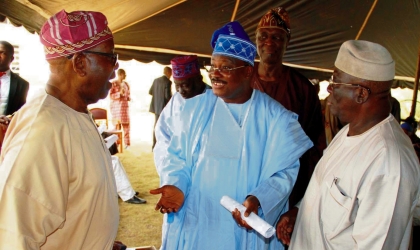
L-R: Afenifere Chieftain, Sir Olaniwun Ajayi, Governor Abiola Ajimobi of Oyo State and Chief Ayo Adebanjo, during the preliminary meeting of the Yoruba Committee on National Conference in Ijebu Ode last Monday
Boye Salau


Rt Hon. Abbas secured the party’s ticket through an affirmation exercise conducted across the 13 electoral wards in the constituency.
The wards involved include Kwarbai A, Kwarbai B, Limancin-Kona, Unguwar Fatika, Unguwar Juma, Dutsen Abba, Gyallesu, Kufena, Dambo, Wuchichiri, Tudun Wada, Tukur-Tukur, and Kaura.
The exercise, which began simultaneously in all wards at about 10 a.m., recorded large turnout of APC members who gathered at various party offices across the constituency.
At Kwarbai B Ward, the Speaker’s ward, the process was conducted peacefully under the supervision of the ward APC Returning Officer, Malam Iliyasu Muhammad Balarabe, in the presence of Rt Hon. Abbas.
According to the ward APC secretary, Nafiu Sabo, the ward has over 10,000 registered members, but 220 members were accredited for the exercise.
Before the affirmation, Mallam Balarabe informed members that Rt Hon Abbas was the only aspirant who purchased nomination forms, underwent screening, and was cleared by the APC national leadership to contest the Zaria Federal Constituency seat.
Following a voice vote by accredited members, the Speaker was affirmed as the party’s candidate in the ward, a process replicated across the remaining 12 wards.
At the constituency collation centre, the APC Returning Officer for the House of Representatives primary in Zaria Federal Constituency, Dr. Hamisu Ibrahim Kubau, announced that 1,376 APC members across the 13 wards endorsed Rt Hon. Abbas as the party’s flag bearer.
He explained that although thousands of party members participated in the exercise, only accredited delegates were allowed to vote.
Dr. Kubau declared: “There are 13 wards in Zaria Federal Constituency, and only one aspirant purchased a form, was screened, and cleared. He is Rt. Hon. Abbas Tajudeen. After due process, we conducted affirmations across all wards.”
He added that the process was peaceful and monitored by officials of the Independent National Electoral Commission (INEC) and party representatives.
Chairman of the APC House of Representatives Primary Elections in Kaduna State, Senator Yakubu Oseni, described the outcome as a reflection of the Speaker’s popularity and acceptance among constituents.
He expressed confidence that Rt Hon Abbas would secure victory in the 2027 general elections.
Speaking after his declaration, Rt Hon. Abbas expressed appreciation to APC members for reaffirming their confidence in him.
The incumbent Reps including Emily Inyang and Godwin Offionio, in separate interviews
protested the handling of the primaries conducted by the leadership of the party in the state, saying it was skewed against them.
The aspirants further described the primaries as a charade and an embarrassment to the state.
According to them, the House of Representatives primaries fell short of the provisions of both the Electoral Act as amended in 2026 and the party’s constitution.
They accused the leadership of the party in the state, backed by Governor Bassey Otu, of violating the party’s constitution in the conduct of the House of Representatives primaries across the state on Saturday.
Hon. Godwin Offiono, representing Ogoja/Yala Federal Constituency, particularly expressed disappointment with the primary that allegedly disenfranchised registered members of the party in his constituency.
Hon. Offiono asserted that having failed to arrive at a consensus, the party leadership opted for a direct primary to decide the candidate for the 2027 election.
“But what I witnessed today was not only alarming, but quite disheartening that our electoral system have not shown any improvement, especially now that we have a man of God in the person of the governor as the leader of the party.
“How do you declare a result by 9:00am even when the electoral materials were yet to arrive at Yala.
“As an aspirant, I couldn’t even vote or see the materials for my own primary at my Okuku ward in Yala Local Government Area, where I come from. But no matter what happens I am still in the race and have not stepped down for anybody.
“The governor had all the time in the world to drive the process of consensus but he never did. As a representative, I cannot even see my governor. I called, no response. I sent text no reply. I am treated as an out cast,” he lamented.
In an emotion laden tone during a telephone interview, Hon. Offiono further said: “I could not believe that first term NASS members like me can be treated in this shoddy manner even when I don’t know my offence.
“I have been a loyal party man. I appeal to the governor to do the right thing, follow the Electoral Act and party constitution in electing representatives.”
Similarly, Hon. Emil Inyang of Akamkpa/Biase Federal Constituency said he still remained in the race and had not stepped down for anybody.
According to him, “If this shenanigan called primary is allowed to stand, it would affect the party’s fortune in the general elections.
“My appeal to the governor is to allow the people to decide. And if they so voted against me, I will rest and not fight over anything.
“There was no stakeholders meeting held to decide on anything before now, and someone can not be unilaterally imposed on us all in the name of compromised primary,” he stated.
A coalition of support groups within the All Progressives Congress (APC) has protested the disqualification of former presidential aspirant, Mr Tein Jack-Rich, from the Rivers West Senatorial race ahead of the party’s primaries for the 2027 general elections.
The groups, in a statement issued on Saturday morning in Abuja, described the action of the party’s screening committee as unjust and capable of worsening internal divisions within the APC in Rivers State.
The statement, signed by the coalition’s National Coordinator, Dr. Bilal Galadima, and General Secretary, Hon. James Ogenyi, accused the party leadership in Rivers State of favouring politicians loyal to the Minister of the Federal Capital Territory, Chief Nyesom Wike, while sidelining long-standing members of the APC.
The coalition alleged that only aspirants aligned with Chief Wike were cleared to contest for elective positions in the state.
“How can our party allow only one man who is not a member of our party to make decisions or dictate the direction of our party?”, the group queried.
The coalition specifically faulted the exclusion of Mr Jack-Rich, describing him as a loyal party member who had supported the APC for more than 13 years and previously contested the party’s presidential ticket.
It also questioned the alleged clearance of Chief Felix Obua, whom it described as a recent entrant into the party and an ally of Chief Wike.
“How can our party disqualify Jack-Rich, a former presidential aspirant who has been loyal and supported our party for the last 13 years, only for our party to choose Felix Obua, a Wike loyalist who only joined the party three months ago?”, the statement read.
The group warned that failure by the APC leadership and National Working Committee (NWC) to address the matter as it could weaken the party’s structure in Rivers State ahead of the 2027 elections.
It called on party leaders to uphold internal democracy, reward loyalty and ensure a level playing field for all aspirants.
INEC TO BEGIN MEMBERSHIP VERIFICATION AS POLITICAL PARTIES SUBMIT REGISTER
All 22 registered political parties have successfully submitted their membership registers to the Independent National Electoral Commission (INEC) in compliance with the Electoral Act 2026, the Commission has said.
In a statement issued on Friday, Chairman, Information and Voter Education Committee, Mr Mohammed Haruna, said the submission followed the extension granted by the Commission after political parties raised concerns during a meeting on Tuesday, March 24, 2026, regarding the timeline provided in the Revised Timetable and Schedule of Activities for the 2027 general elections.
He said, “The Commission is pleased to note that all registered parties submitted their registers as of 8th May 2026, two days before the extended deadline.”
He recalled that following a meeting with political parties, the Commission, in a statement issued on the 27th of March, 2026, adjusted the deadline for the submission of party registers from 21st April 2026 to 10th May 2026 to align with the provisions of Section 77(4) of the Electoral Act 2026 and the actual dates fixed by political parties for their primaries.
Mr Haruna noted that political parties were accordingly allowed to conduct their primaries within the approved period from 23rd April 2026 to 30th May 2026, while the register of party members was required to be submitted to the Commission not later than 21 days before the conduct of their respective primaries.
He added, “INEC wishes to state that all registered political parties complied with the requirement within the extended timeframe and will subject the submitted registers to the necessary verification processes in line with the law.”
The Commission restated its commitment to the conduct of free, fair, credible and inclusive elections.
-

 Maritime4 hours ago
Products, Others, To Arrive Lagos Ports Today — MPA
-

 Environment3 hours ago
MOSOP – Tinubu Not Sincere With Ogoni People For Oil Resumption
-

 Oil & Energy3 hours ago
SEED: FG To Train 6,000 Energy Professionals
-

 Environment3 hours ago
NEWSAN Urges Investment For Water And Sanitation services
-

 Environment3 hours ago
NGOs Task Media On Investing In Climate Literacy
-

 Maritime4 hours ago
Lagos Records Major Gains In Road, Rail, Water Transport —Osiyemi
-

 Oil & Energy3 hours ago
‘Trans Niger Pipeline Records Zero Infraction ‘ ……..As FG Hits 99.2% OPEC Target
-
Politics2 hours ago
Primaries: Diri Lauds APC’s Unity, Cohesion In Bayelsa